



Synth plugins have the power to go far beyond what’s available in a DAW, letting you explore hardware synth sounds without the price tag, experiment with different types of synthesis, and achieve anything from ’70s pop to trance-inspired sounds.
If a producer has access to a variety of plugins made by specialised professionals, they’re well on their way to crafting the exact sound their track needs with the best quality possible.
This article will provide you with everything you need to know about the best synth plugins available right now.
In a hurry?
Here’s the best of the best to get you started:
| u-he Diva | Unrivalled analog sound through mixing and matching filter, oscillator, mixer, and envelope modules from legendary synths. | Check the current price |
| Arturia Pigments 6 | Allows you to blend up to four different synthesis types simultaneously; analog-modelled, wavetable, harmonic, and sample-based. | Check the current price |
| Cherry Audio GX-80 | Immaculate recreation of two of the most coveted synths, the Yamaha GX1 and Yamaha CS-80. | Check the current price |
The best synth plugin
1. U-he Diva – The most authentic analog feel and sound
 Key features
- Mix and match modules from up to five legendary hardware synths
- World-class host-syncable arpeggiator
- Tweakable “under the hood” parameters
Pros
- Immaculate analog accuracy in feel and tone
- Complete solution with two stereo effects slots
- Discover all the sounds on offer with over 1000 presets
Cons
- Not the most elegant preset browser when compared to modern plugins
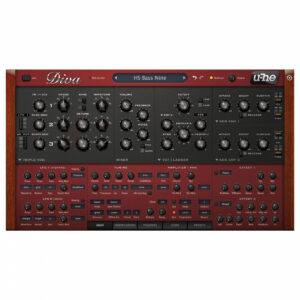
U-he Diva has been meticulously designed to replicate the essence of classic analogue synthesizers in a digital format. Imitating the oscillators, filters, and envelopes of five iconic monophonic and polyphonic synths, you can mix and match each module to create a custom-designed analog-modelled synth.
The sound quality Diva possesses surpasses the norm, providing an authentic analog-modelled experience through the application of real-time circuit simulation techniques. The zero-delay feedback (ZDF) design of Diva ensures that the filters behave just like their physical counterparts, offering rich and authentic resonance.
Going far beyond what’s possible in hardware, Diva’s modulation options are expansive, including three ADS(S)R envelope models based on classic hardware, two host-syncable LFOs with multiple waveforms, and a user-definable modulation source.
Additional Trimmers and the Modifications panel in Diva allow users to control voice detuning, oscillator drift, and other small imperfections, bringing an organic feel to patches and enabling more experimental and modern manipulations.
Diva’s sound character is not just a mere imitation of analog sound, but a modelled representation right down to the last resistor and capacitor. For this reason, it’s a must-have for any musician or producer.
2. Arturia Pigments 6 – Everything you need in one plugin
 Key features
- Blend four synthesis techniques into one complex sound
- Process external sound through the instrument
- Highly CPU-efficient for powerful sound design without latency
Pros
- Nearly unbeatable value for money
- Generative sequencing means you’ll never run out of creative ideas
- Easy to access all parameters with drag-and-drop modulation routing
Cons
- The massive range of possibilities could be overwhelming for beginner users
Pigments 6 has earned its place as one of the most powerful soft synth VST plugins. This multi-functional synth offers unbeatable value for money. Its multi-engine design allows for a blend of synthesis methodologies – virtual analogue, wavetable, additive, sampling, and granular to create intricate and lush sounds.
Leveraging the expertise gained from emulating classic hardware, Arturia have infused Pigments with premium virtual analogue elements. This is manifested in robust VA engines and a variety of vintage filter emulations.
The strength of Pigments lies in its balance between complexity and user-friendliness. It provides an exciting array of modulation tools and effects, inviting you to experiment. If you prefer simplicity, Pigments 6 comes with a wide range of ready-to-use presets and a streamlined Play View for adjusting core sound elements.
The user interface is aesthetically pleasing and intuitive, allowing access to all of Pigments’ features without the need for navigating multiple screens. Colour-coded modulation routes with drag-and-drop routing make what was once difficult, easy.
While no single synth can provide every desired feature or sound, Pigments 6 comes remarkably close. It’s designed for musicians willing to delve into its capabilities, rewarding those who invest time in its features. However, its extensive and growing sound library ensures there’s something for everyone, making it accessible and enjoyable for all users.
3. Reveal Sound Spire – The best synth for trance producers
 Key features
- Unison engine offers nine voices per oscillator
- Huge range of modulation across nearly all parameters
- Built-in effects including EQ and multi-band compression
Pros
- Excellent at producing trance-inspired sounds
- Huge amount of flexibility for customising your sound
- Dual resonant filters with self-resonance modes
Cons
- Very little analog flavour, can be a bit sterile-sounding
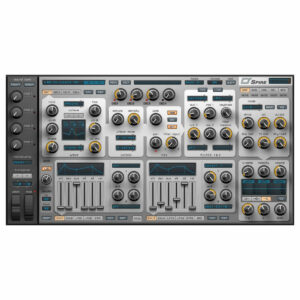
Not just another trance ‘n’ dance synthesizer, the Reveal Sound Spire offers a variety of clever and unusual features that transcend typical virtual analogue synth expectations. A broad selection of waveforms is made available, extending beyond the standard sine, saw, square, and triangle shapes commonly associated with virtual analogue synths.
Crisp and clear, Spire is recognised for its impact on progressive music and excels at creating sounds synonymous with the trance genre. Whether it is big supersaw chords, stabby baselines, or lush pads that are sought after, Spire serves as a reliable option across genres.
A wide range of tones can be produced using Spire, depending on the chosen wave, synthesis mode, and knob settings. Labelled as “polymorphing”, this hybrid wavetable/waveshaping technique contributes to Spire’s power and flexibility. A nice touch, you can copy and paste settings between oscillators.
Inspirational and simple, the intuitive interface and collection of 500 presets bring real value to this synth plug-in. The filters’ clarity and quality alone justify the price, and the distortion and tube effects add depth and energy to the sound.
4. Arturia V-Collection 11 Pro – Creative producers looking to go beyond hardware
 Key features
- 45 virtual instruments
- Refined interfaces and hybrid workflows
- TAE and Phi advanced component-level modelling tech
Pros
- Huge variety of high-quality instruments
- Fast, controller-friendly browsing and control
- Great tools for cinematic and hybrid sound
Cons
-
Large install size needs good storage
Spanning 45 software instruments, Arturia V-Collection 11 Pro brings together iconic analog synths, acoustic sounds, percussive textures, and more. It’s designed to cover virtually any musical genre or workflow. With more than 14,000 curated presets and over 50GB of content, it’s a complete package for any producer looking to expand their toolkit.
This version introduces seven new instruments, including Jup-8000 V, Pure LoFi, Synthx V, and MiniBrute V, each reimagining a classic sound or bringing something new. You’ll also find upgraded versions of Augmented series instruments, offering detailed sampling and new user interfaces for enhanced creativity and intuitive control over cinematic, experimental landscapes.
Navigation and usability have been improved across the board. Analog Lab Pro offers a smoother way to browse, tweak, and perform, with quicker preset loading and better filter views. Integration with DAWs and MIDI controllers is seamless, and support for MPE and microtuning allows for advanced expression. Behind the sound, Arturia’s TAE and Phi modelling ensure impressive authenticity — replicating hardware instruments down to their core.
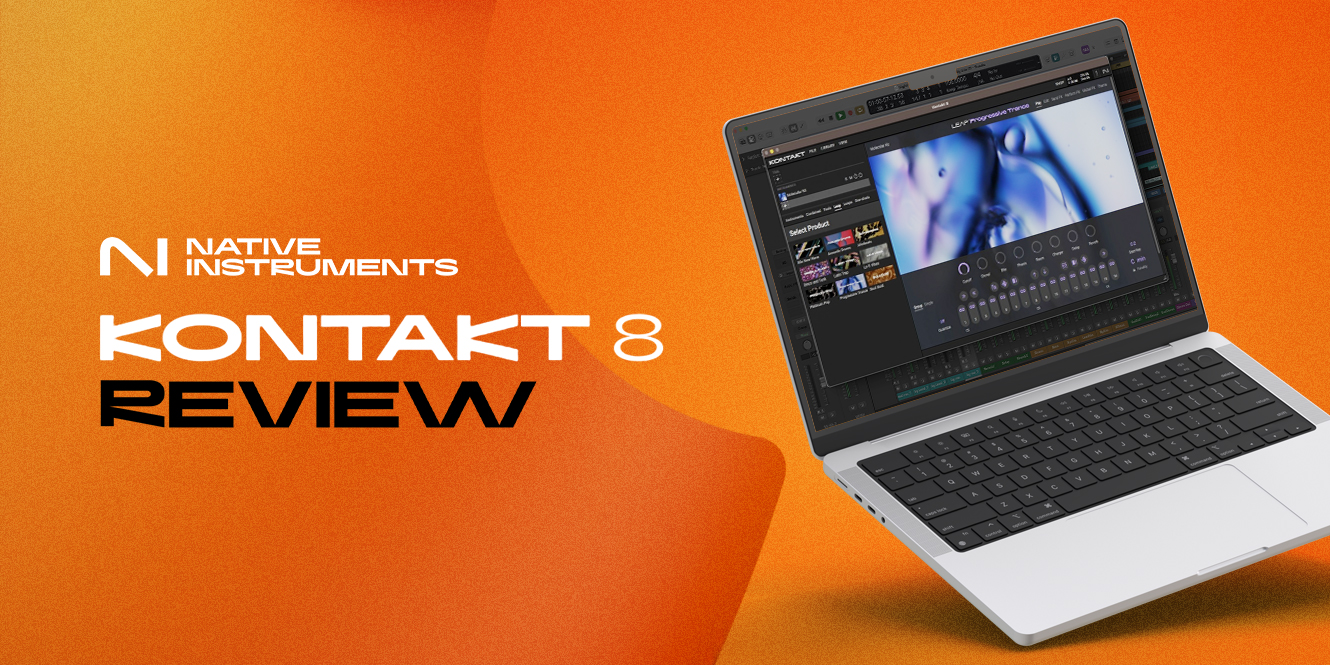
5. Native Instruments Kontakt 8 – The best for realistic instrument sounds
 Key features
- Unites sampling depth with synthesis flexibility
- Discover 900 included sampled instruments or utilise third-party libraries
- Realistic samples deliver authentic instrument sounds
Pros
- Simple interface makes navigating the functions easy
- Native Instruments often offer more instruments in free updates
- Manipulation of audio files produces unique results
Cons
- Very resource-heavy will slow down less powerful machines
Primarily a sampler, Kontakt 8 transcends conventional sampling capabilities by incorporating a variety of synthesizer engines. This integration means audio files can be processed using traditional synth parameters such as Low-Frequency Oscillators (LFOs), Envelopes, and Modulation.
The Factory Library of Kontakt 8 has undergone a revamp, now boasting over 900 meticulously sampled instruments. This vast collection provides you with a wealth of options, allowing you to produce a diverse range of sounds. With the Kontakt platform, you can also take advantage of third-party developers to find sample libraries that align with your needs.
What makes Kontakt unique in this list is also what holds it back. Realistic sound libraries mean there is less room for creative sound design as the sound has already been established in the recording of the samples. So, unless you have a specific instrument in mind for a sound, Kontakt 8 won’t inspire creativity like other synth plugins.
6. Moog Mariana – The exact sound of the vintage Moog in a plugin
 Key features
- Dual layer bass synthesizer, inspired by the Minimoog Model D and the Minitaur
- Blend between both layers simultaneously, or stack individual duophonic tones
- Huge range of onboard effects from distortion and compression
- Enhances your tracks with analog-emulated tube overdrive and saturation for added glue and weight to your bass sounds
- Over 200 onboard presets help you find a sound to suit your needs instantly
- Seamlessly connects with Moogerfooger effects plugins for enhanced functionality
- Modulation interface could be improved
The Moog Mariana is a software synthesizer built with a clear focus: exceptional bass. Its dual-layer design means you can blend two fully-featured synth engines, each equipped with independent oscillators and sub-oscillators. This gives you the flexibility to create anything from tight, punchy stabs to wide, cinematic low-end textures.
You’re able to layer or split sounds for expressive performance or intricate production work. Both layers feature Moog’s signature resonant filters, plus a separate filter for the sub-oscillator, ideal for carving out your bass tone without sacrificing weight.
Its built-in effects and compression are tailored for bass, helping you shape and refine your sound from the outset. The stereo oscillator design and crossover filtering also make it easy to manage your stereo image while keeping the low end grounded and mono-compatible.
Designed with producers and musicians in mind, Mariana balances Moog’s classic analogue character with the convenience of modern digital tools. Whether you’re sound designing or mixing, it’s a dependable choice for shaping impactful, well-defined bass.
7. Arturia Jup-8000 V – A must-have for Eurodance musicians and producers
 Key features
- Incredibly realistic and authentic plugin replica of the famous JP-8000 synth, built with Arturia’s advanced TAE technology
- Gritty and analog-sounding multi-mode filters
- Built on the same seven oscillator modes as the hardware original
- Enhanced functionality over the original with the “Advanced” panel, offering Multi-Arp sequencing, Modulation routing, Macro control and more
- MPE-compatible for expressive real-time performances
- It’s an incredibly versatile synth, capable of everything from leads, expands pads, basses, drones and more
- The onboard Chorus effect could be refined to sound closer to the original
The Arturia Jup-8000 V brings the iconic sound of the JP-8000 into your DAW, offering a detailed recreation of the original’s architecture and tone. At the heart of this plugin is the renowned supersaw oscillator mode – perfect for wide, detuned stacks that excel in dance, trance and cinematic genres alike.
You’ll find seven oscillator types onboard, from the classic sawtooth, square and triangle waves to noise and feedback options. These allow for a range of textures from sharp and aggressive to smooth and mellow. Cross-modulation and envelope shaping offer further control, making it easy to build evolving patches that cut through or blend in.
Its flexible filter section lets you tailor each sound to your mix. Choose between low-, band- or high-pass settings, set your slope to 12 or 24dB, and shape with precision using resonance and cutoff controls.
Whether you’re designing big leads, atmospheric pads or tight sequences, the Jup-8000 V delivers with authenticity and ease. It’s a reliable go-to for producers who want the JP-8000 character without the need for vintage hardware.
8. Cherry Audio GX-80 – Cinematic soundscapes with distinct analog flavour
 Key features
- Blends the GX-1 extended features with the CS-80 functionality
- Dual-layer voicing architecture with 16 polyphonic voices per layer
- Studio-quality integrated effects with global or dual-layer modes
Pros
- Extremely affordable recreation of a virtually unobtainable hardware synth
- Two synths in one, enhancing the performance of the original synth
- Fantastic interface that labels all parameters clearly
Cons
- There’s a steep learning curve if you’re not familiar with the original
The Cherry Audio GX-80 synthesizer plugin is an emulation of the classic CS-80, widely celebrated for its rich cinematic chords that were integral to Vangelis’s Blade Runner soundtrack. Yet, the GX-80 goes beyond mere imitation; it incorporates elements from Yamaha’s rare GX-1 organ, adding to its depth and potential for creativity.
Reintroducing the high-pass filtered square wave, band-pass filtered sawtooth wave, and the distinctive triangle wave one octave higher, the inclusion of the GX-1 filter adds a characterful dimension to the sound palette.
Moreover, the GX-80 allows you to layer two complete CS-80 voices and their effects together or split them across the keyboard. Each rank can be independently panned in stereo, creating truly massive sounds. Herein lies the secret for those immersive soundscapes the hardware is known for.
The GX-80 also offers minute pitch and timing variations throughout the synth, replicating the authentic analog feel of the CS-80. This detail helps to deliver an enormous range of tones, from soft and elegant to engaging and thunderous.
The GX-80 synthesizer plugin represents the core benefit of synth plugins, taking what made hardware special and improving upon it. Its impressive soundstage, extensive extra parameters, and intuitive interface make it a dream come true for synthesizer enthusiasts. It excels in producing big, synthy sounds with a distinct ’70s edge, making it an indispensable tool for any digital musician’s arsenal.
9. Synapse Audio DUNE 3 – The sound of modern cinematic Hollywood
 Key features
- Dual arpeggiator with MIDI support
- Dual Filter
- In-depth wavetable and WAV editors
Pros
- Excellent oscillator and unison capabilities
- High-quality effects, including EQ and Shimmer Hall
- Vast preset library and modulation options
Cons
-
Steep learning curve for beginners
Synapse Audio DUNE 3 is designed to give you serious control over your synthesis. The dual filter is a core part of its flexibility, with serial and parallel routing options plus a balance knob that lets you blend your signal in real time. With new filter types, including zero-delay feedback filters modelled on analogue circuits, it’s built to handle complex shaping and movement.
You get two independent arpeggiators, each capable of classic patterns, step sequences, or MIDI file playback. Then you have features like Arp Hold and Random mode for further depth. Together, they make intricate sequencing a breeze.
The oscillator engine supports VA, FM, and Wavetable synthesis, with up to 8,320 oscillators in use at once thanks to the 8x unison mode. The enhanced Swarm feature subtly modulates each oscillator to deliver a vibrant, ever-changing sound.
There’s also a versatile FX section. Alongside familiar tools like delay and reverb, you’ll find professional-grade effects such as a high-end parametric EQ and Shimmer Hall, great for ambient pads and expressive leads. The modulation system is wide-reaching too, letting you route both synth and FX parameters with ease.
Finally, the Wavetable and WAV editors give you detailed control over audio shaping. You can draw your own waveforms, morph them, or even import your own WAV files into the oscillator. It’s an expansive environment for anyone looking to push their sound design further.
10. Rob Papen SubBoomBass 2 – All things low-end
 Key features
- The quintessential bass synth for dance music
- Manipulate six parameters simultaneously with intuitive X/Y pad
- Create sounds quickly with “Easy Mode”
Pros
- Physical modelling mode offers realistic bass sound possibilities
- Over 2,000 presets to explore
- Excellent filters and sequencing capabilities
Cons
- A third oscillator would offer better flexibility
It does exactly what it says on the tin. The Rob Papen SubBoomBass 2 is the go-to synth plugin for EDM and dance music bass. It’s unashamed in what it’s meant for, and that’s what makes it a must-have synth plugin, it doesn’t try to give you something that does everything but, instead, focuses on giving you what you need to make sub-rattling low-end.
SubBoomBass 2 includes an impressive range of waveforms and diverse modulation possibilities. The new waveforms contribute to its sonic colour, making it a more flexible and vibrant synth. A combination of pulse width modulation, symmetry, and sine or square sub-oscillators form the core of this powerful synth, allowing for an extensive variety of sounds.
The addition of Karplus-Strong, filters, and physical modelling modes enhances the flexibility beyond traditional bass synth tones and lets you create string-based sounds from plucked bass, bass arps, and metallic hits.
Classy, powerful and full of sounds, SubBoomBass 2 should be on every producer’s plugin list and with the extremely attractive price point, it’s hard to say no!
11. Rhodes V8 Pro – The only authentic Rhodes emulation on the market
 Key features
- Per-note control
- Built-in amp and mic simulations
- Artist-designed presets
Pros
- Incredibly detailed sampling engine
- Flexible EQ and tonal shaping options
- Authentic MK8 effects chain included
Cons
-
High resource demand on some systems
The Rhodes V8 Pro is the only official Rhodes plugin available, and it shows in the level of detail. Built from over 30,000 samples and powered by a sophisticated modelling engine, it captures the genuine sound of a Rhodes MK8. Each note offers up to 127 velocity layers and 14 articulations, giving you full expression and dynamic realism.
If you want precise control, there’s the per-note editor, a very powerful tool. It lets you adjust the timbre, tuning, and damper response of each key individually – great for fine-tuning your tone for layered tracks or expressive solos.
The plugin also includes a choice of three amp models and two mic types. From the vintage Suitcase sound to direct-in recording, you can dial in just the right amount of warmth, grit, or clarity. Plus, effects such as a VCA compressor, phaser, chorus, and delay are all modelled after the MK8 FX board – perfect for adding motion and space to your sound.
You’ll find 208 presets included, with over 100 designed by established producers and artists. And combined with a flexible EQ system and adjustable pedal noise, the V8 Pro is a versatile, detailed, and genuinely musical synth plugin – ideal if you’re after a premium Rhodes sound that integrates smoothly into any modern setup.
12. Native Instruments Massive X – Sound design powerhouse
 Key features
- Modular-style drag-and-drop routing system
- Built-in multiband compressor
- 6 oscillators, over 170 wavetables, 9 multimode filter types
Pros
- Highly flexible and intuitive sound design tools
- Packed with 1,300 factory presets
- Excellent live performance features
Cons
-
Requires a powerful system for smooth operation
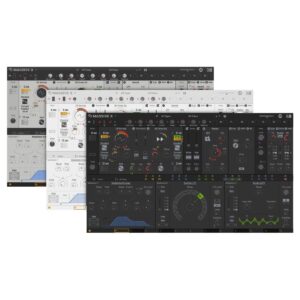
Native Instruments Massive X gives you the freedom of a modular setup, with drag-and-drop routing that makes it easy to connect oscillators, filters, and modulators in any order. This opens up space for creative sound design.
It comes with six oscillators – two wavetable, two phase modulation, and two for sub/noise – giving you plenty to work with. The modular environment also extends to insert effects and modulation routing, so you can experiment with everything from frequency shifting to self-modulating patches.
Then you have the multiband compressor, tuned specifically for synth sounds. You can sculpt the dynamics of your patch without needing extra plugins. It’s especially useful for taming harsh high-end frequencies or enhancing punch across the low end.
For performance and hands-on control, the Performer module lets you sequence modulation across parameters, synced to your track or triggered manually. Paired with 16 macro controls and full DAW automation support, you can manipulate sounds in real time – ideal for both stage and studio.
Massive X also comes preloaded with 1,300 presets. They’re tagged by mood, type, and style, so you can find the right sound quickly.
13. GForce M-Tron Pro IV – The versatile producer and musician
 Key features
- Features more than 200 tape banks, sampled from the original hardware for complete authenticity
- Gain access to the exact sounds that powered legendary artists from The Beatles to Trent Reznor and many others
- Onboard amp simulation, Tape Wow and Flutter to simulate the analog spirit of the original
- Enhanced preset browser lets you navigate through the extensive library with ease
- Extended playable keyboard range when compared to the original for a wider playable note range
- Onboard amplifier simulation, built-in effects and state-variable filter let you customise your sound without restriction
- No importing of your own samples into the engine
The GForce M-Tron Pro IV offers a deeply authentic recreation of the Mellotron M400 – a key instrument in shaping the sound of progressive rock, electronic music and beyond. Known as one of the earliest samplers, the Mellotron played its sounds from analogue tape, giving each note a character that was hard to replicate before M-Tron Pro IV.
With over 200 tape banks and 800+ presets, the M-Tron Pro IV opens up a broad palette of vintage textures. The newly enhanced interface and browser make it simple to find and shape the right sound, while features like undo, redo, and copy/paste keep your workflow fluid.
You can fine-tune each patch using tools like the state-variable filter, amp simulation, and ensemble effect. The Tape Wow and Flutter function adds natural imperfections for that unmistakably organic feel, and the extended keyboard range lets you explore even more tonal possibilities.
Whether you’re chasing the sounds of The Beatles or carving out something new, M-Tron Pro IV gives you the unmistakable charm of a classic Mellotron—refined for today’s studio. And if you want to go further, the Complete bundle adds even more depth to your creative toolkit.
What to look for in a synth plugin
When shopping for a new synth plugin, there are a few careful considerations you need to make. Primarily, compatibility. Ensuring that your new plugin works on your operating system, CPU, and your DAW is the first specification you need to know about.
Plugins come in three main formats: VST and VST3, AU, and AAX.
As a general rule, VST and VST3 are primarily used on Cubase, though are supported in most major DAWs. AU is a proprietary Apple format and will only work in Logic Pro and AAX is specific to Avid’s Pro Tools.
It’s also worth checking your computer processor. Newer Apple products using M1 to M3 processor chips may not be compatible with every plugin.
Types of synthesis
Synthesis comes in a plethora of types, each providing a unique approach to crafting sound. Subtractive synthesis, one of the most common forms, starts with a harmonically rich sound and filters out unwanted frequencies to shape the final output. This contrasts with additive synthesis, which builds complex sounds by combining multiple simple waveforms.
Virtual analogue synthesis emulates the hardware of classic analog synths digitally, offering the warmth and depth of vintage gear without physical limitations. Wavetable synthesis, on the other hand, generates sound by scanning through a series of waveforms in a table, enabling the creation of complex, evolving tones.
Frequency Modulation (FM) synthesis creates rich timbres by modulating the frequency of one waveform (the carrier) with another (the modulator). Sample-based synthesis uses recorded audio snippets as the basis to reshape the sound, allowing for realistic instrument emulations or experimental soundscapes.
Granular synthesis, meanwhile, breaks sound into tiny grains and reconfigures them, resulting in textures ranging from the familiar to the uncanny. Lastly, modular synthesis offers unparalleled flexibility, allowing various modules to be connected in any configuration to generate a wide range of sounds. Each synthesis type brings its unique flavour to sound design.
FAQs
What are synthesizer plugins?
Synthesizer plugins are virtual instruments used in a DAW to generate sounds. Eliminating the need for physical hardware, synthesizer plugins come in a variety of styles including recreations of vintage keyboards, granular synths, wavetable, FM, subtractive, additive, sample-based, and more.
What is the most powerful synth?
Arturia Pigments 6 is the most powerful synth for music production. Blending between four types of synthesis engines – Wavetable, Virtual Analog, Sample & Granular, and Harmonic – lets you achieve a near-limitless range of rich, complex sounds in an intuitive and colour-coded interface.
What synth did ABBA use?
ABBA used three main synthesizers, the Mellotron M400, Minimoog, and, most notably, the Yamaha GX-1. Heard across their debut and sophomore albums Ring Ring and Waterloo, the Mellotron M400 and Minimoog were used extensively. From 1979 onwards, the Yamaha GX-1 became the primary synth used.
Final thoughts
The multiple different synthesis techniques, each producing a distinctive sound, have given us a plethora of synth plugins on the market. Knowing what sounds you want to produce in your music and what features you need will dictate what to buy.
Fortunately, synth plugins are nowhere near the cost of what hardware once was, meaning that buying your favourite plugin for your workflow should be within reach! If you were stuck on which synth plugin to purchase, we hope our guide to the best synth plugins has helped.
Eager for more insights? We’ve also rounded up the best mastering plugins as well as top reverb plugins.




0 Comments