

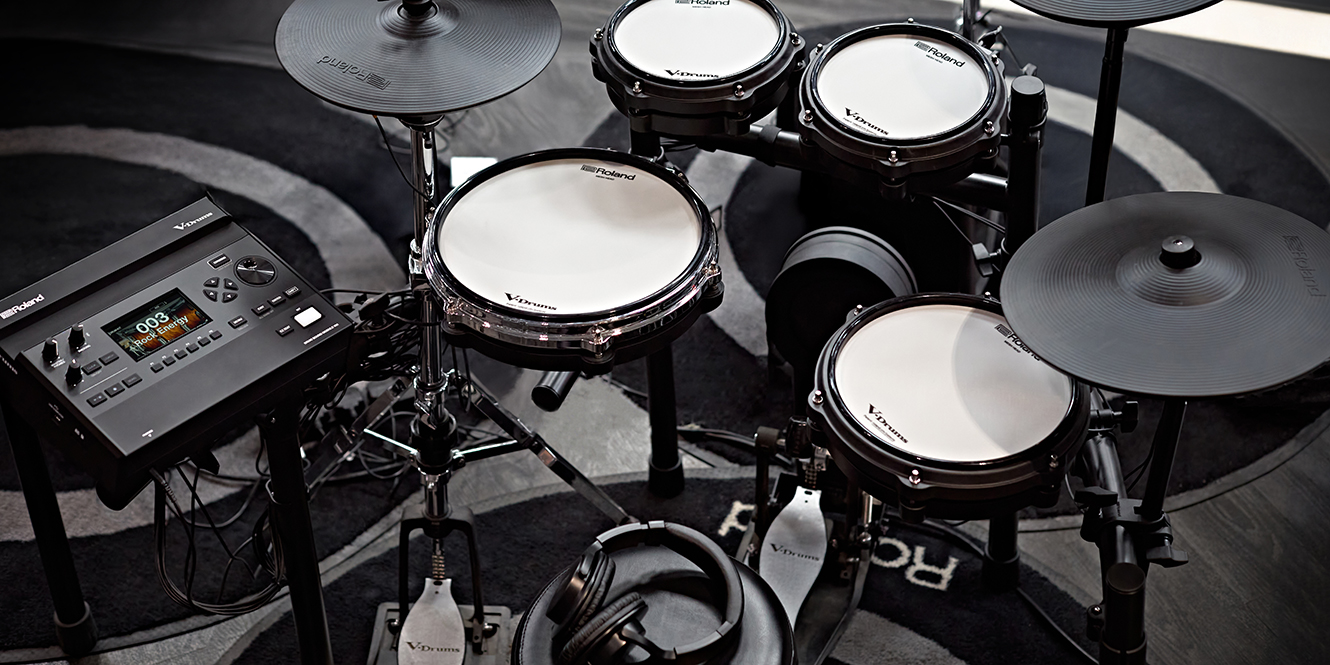

2025 has been a big year for Roland, with the launch of the V3 and V5 electronic ktis bringing plenty of budget-friendly options that pack the same power as their flagship kits. The TD316, Roland’s successor to the TD-17KVX2, is one we’ve been particularly looking forward to. Even as an acoustic player myself, I was genuinely curious about this one.
In this Roland TD316 review, I’ll break down what this intermediate-level model actually offers. I spent a good amount of time testing out the kit, so I’ll be sharing my thoughts on the sounds, the playability, and most importantly, whether it’s worth your money.

In a hurry? Here’s our verdict
The Roland TD-316 really impressed me. It’s compact, responsive, and powered by the same tech as the higher-end V71 module, just in a more affordable V31 version.
Its mesh heads felt great under the sticks, and the 200 built-in sounds had more realism than I expected. The only thing that held it back slightly was the use of analog pads. The snare can’t quite pull off consistent rim clicks the way Roland’s top-tier kits can (as they use digital triggers). That said, it’s a capable, expressive kit that fits easily into smaller spaces, and it’s one I’d happily keep playing.
| Pros | Cons |
|---|---|
| 200 onboard sounds and 70 user presets, with room to expand via Roland Cloud | Uses analog heads, so you won’t get the same nuanced response as Roland’s digital-triggered kits |
| Includes DW-sampled kits for a strong, acoustic-style sound | Doesn’t include a kick pedal or hi-hat stand, so you’ll need to use your own setup |
| Compact footprint is ideal for smaller spaces | |
| Responsive mesh heads offer a satisfying, realistic feel | |
| The coach mode with a full colour screen and notation support is great for improving timing, fills, and rudiments |

Roland TD316 review
Firstly, what is it?
 The Roland TD-316 is part of the brand-new V-Drums 3 Series, a compact kit designed to deliver an entry-level experience to the professional electronic drumming world. It replaces the TD-17KVX2 and marks a step forward in design, expression, and sound quality.
At its core is the new V31 module, which offers the same sounds and features found in the flagship V71. This includes 200 onboard sounds, 70 preset slots, and seamless access to the ever-growing Roland Cloud. It means you’re working with a pro-level sound palette right from the start.
The kit features dual-zone crash cymbals, a VH-10 dual-zone hi-hat, and dual-zone mesh pads for improved comfort and sensitivity.
There’s also a digital pad input, so you can expand your setup with a high-resolution snare, ride, or hi-hat later on.
Roland’s 3 and 5 Series kits share the same core engine as the premium 7 Series, so you’re not getting a scaled-down experience, but rather a more streamlined design. With upgraded hardware and a redesigned interface, the TD-316 is a compact kit with serious potential.
Initial thoughts
As someone who mostly plays acoustic kits, I was curious to see how the TD316 would compare. I know it’s never going to be identical, but I wanted to find out just how close it could get to an acoustic feel and sound. Naturally, the first thing I spotted was how compact it is. I quite liked that sort of design. If you’re limited for space, but still want to have a decent setup, this sort of kit will be perfect for you.
I started with the Studio 01 kit and was genuinely impressed. The sound had depth and clarity, and the mesh heads felt great – a bit more rebound than I’m used to, but still very playable. The module was also easy to use. I had a quick play around with the settings before diving deeper into each element, and I was amazed by how many features this module actually has. Overall, my first impressions were positive.
V31 module: sounds, preset kits, and performance
 There’s been a lot of excitement around the V31 module, mostly because it shares the same drum engine, sounds, and capabilities as the flagship V71. Visually, the main differences I noticed were the number of connection points and the front-facing design, which features fewer buttons to control effects, volume, and sounds.
This module is a simplified version, with the aim of providing the same experience in a less overwhelming design. The V31 keeps things compact, just like the kit it’s designed to support. Usability was a real highlight. I thought this module was a serious upgrade from the old TD-17 design. It had a decent build quality to it, and it looked really professional.
I liked the streamlined look of the V31 and thought the stick holder was a fun design element that can actually come in handy. I was also excited to see it had a large colour screen.
Roland have been criticised in the past for sticking with old-school LCD displays while others embraced colour screens, so it’s nice to see them joining the club with the V31. Having a screen like this made it super easy to navigate the module.
I tested around 30 kit sounds and was impressed by the level of detail in each one. There was plenty of variety, and you can really hear the depth of each drum component. Many of the kits are suitable for everyday playing and could easily be used for songwriting or recording. It was really easy to swap between sounds and add effects too!
Better still, you can adjust the sounds quickly using the EZ Edit button. It was easy to modify the pitch and dampening on the drums, and I could balance the levels to my liking.
There are some more experimental kit options, with percussive and electronic sounds that would suit producers or anyone looking to try something different. That’s not really my style, so I mostly stuck to the more traditional drum kit sounds, but it’s good to have the option.
I was particularly impressed by the DW kits and enjoyed browsing the available sounds on Roland Cloud. The TD-316 offers 70 presets, so there’s ample room on the module to explore and customise your setup.
Before going into this review, I’d heard good things about Coaching mode. I tried the Quiet Count, a metronome function that mutes the click track for several bars, forcing you to rely on your internal timekeeping. It instantly shows how accurate your timing is when the click returns, and it’s fun trying to earn a good score! Honestly, I think this feature is really useful if you’re still developing your playing.
I also tested Stroke Monitor, which provides feedback to help improve stick control and dynamics – another really enjoyable feature. These aren’t the only tools included in Coaching mode. Blast Beat Trainer is a new tool designed to improve accuracy and endurance, and Phrase Trainer helps you to develop stronger rhythmic placement.
There’s also Time Checker, an exercise tool that scores your playing against the metronome to show how consistent your timing is. And finally, there’s Advanced Metronome.
Drum pads and cymbals
 Roland have designed new pads for the V3 and V5 launch, and I was interested to see how they compare to the older models. Roland’s older models featured 10” pads with a plastic rim, which created only 8” of playing surface. The pads on the older kits are also the same size for every drum.
The TD-316 features all-mesh, analog dual-zone heads. The snare is a 12”, the two rack toms are both 8” pads, and the floor tom is a 10” pad. Visually, this feels like a real upgrade compared to the older Roland designs.
I was impressed by the rebound and overall feel while playing; they’re a bit bouncier than an acoustic kit, but still feel natural and comfortable. Latency was also near-perfect.
Each pad detected my dynamic changes with ease, and I could even play buzz rolls and open rolls that sounded true to the acoustic sound. The dual-zone PD-8H (rack) and PD-10H (floor) toms were easy to position and had a great feel playing-wise.
The PD-12P snare pad is a triple-sensor pad, which includes dual-zone capabilities. But due to its analog design, I did find it difficult to perform rim clicks on the snare without accidentally triggering the snare sound instead, which I wasn’t particularly keen on.
Analog pads aren’t for everyone, so if a digital snare suits your needs more, it’s worth checking out the Roland TD516, since this one comes with the upgraded digital PD-140DS snare, designed for an even more realistic acoustic feel. Alternatively, if you really like the TD316, you can always upgrade your setup by using the digital pad input. That way, you’ll get the upgraded snare with the compact kit setup.
The TD316 comes with two CY-12C-T dual-zone crashes and a CY-14R-T triple-zone ride. I don’t think electric cymbal pads will ever compare to the feel of acoustic cymbals, but it was still a comfortable playing experience, and I was a big fan of the triple-zone ride. The bell sounds really stood out, and it was super easy to trigger.
There are also dual-zone VH-10 hi-hats, and I really liked that they’re designed to mount on a traditional hi-hat stand. This adds a more realistic feel to the setup, which isn’t always the case with electronic drum kits. Triggering the hi-hat choke was easy, and overall, they felt fairly natural to play. However, the hi-hat stand isn’t included, so you’ll need to use your own – bear this in mind if it’s your first kit.
Overall, I was really happy with how this kit played. It felt natural under the sticks, and triggering different sounds on each pad was straightforward. The dual-zone analog pads won’t suit everyone, especially if you’re after something more nuanced. But if you’re mainly looking for a solid kit to practise with at home, this one is well worth considering.
Connectivity
 Roland’s TD316 offers the same core modern connectivity options as the flagship models, making it easy to integrate into a range of setups.
It includes a USB-C port for multi-channel audio and MIDI, allowing you to connect the kit directly to your computer or DAW. This makes it easy to record or edit without any extra gear. It’s a genuinely useful feature if you plan to use the kit for writing or recording sessions.
Bluetooth audio and Bluetooth MIDI are also included, so you can stream backing tracks straight from your phone and control the kit wirelessly with compatible devices. I had a lot of fun testing out the Bluetooth features. They’re definitely useful if you like playing along with backing tracks.
The TD316 also has built-in WiFi, allowing you to browse and download new content from Roland Cloud without needing any extra cables or adapters.
Physically, the module includes a standard headphone output, stereo master outs, a mix-in input, and a traditional 5-pin MIDI out. There are three trigger inputs too, including a dedicated one for adding a digital pad such as a high-resolution snare, ride, or hi-hat. You’ll also find an SD card slot for importing samples or tracks.
Overall, it has everything you need. I was particularly pleased with the WiFi connectivity, as it made browsing for new sounds on Roland Cloud really efficient. Everything was easy to navigate, so setup was quick and straightforward. I also love that you’re able to upgrade your kit with the dedicated trigger input for digital pads. It allows the kit to grow with you.
Roland TD316 V-Drums specifications
| Category | Specification |
|---|---|
| Sound Module | V31 Module (same sound engine as V71 and V51) |
| Pads | Snare: PD-12P |
| Tom 1: PD-8H | |
| Tom 2: PD-8H | |
| Tom 3: PD-10H | |
| Kick: KD-10 | |
| Cymbals | Hi-hat: VH-10 |
| Crash 1: CY-12C-T | |
| Crash 2: CY-12C-T | |
| Ride: CY-14R-T | |
| Drum Stand | MDS-Compact 2 |
| Extra Trigger Inputs | 2 (AUX/TOM 4 and CRASH 2) |
| Dedicated Digital Trigger In for one digital pad (e.g., snare, ride, or hi-hat) | |
| Connectivity | USB-C Audio/MIDI |
| Bluetooth Audio and MIDI | |
| Wi-Fi (Roland Cloud access) | |
| MIDI Out | |
| SD Card Slot | |
| Headphone Out | |
| Mix-in Input | |
| Stereo Master Out | |
| Accessories | Mounting plate set |
| AC adaptor | |
| Crash 2 connection cable | |
| Drum key | |
| Setup guide | |
| Owner’s manuals | |
| Preset Kits | 70 kits (expandable via Roland Cloud) |
| Sounds and Drum kits | Over 1,000 onboard drum, cymbal, percussion and SFX sounds, and 200 total drum kits. |
| Weight and Dimensions | 24.7kg |
| W: 1500 mm, D: 1100 mm, H: 1200 mm (including full setup) |

FAQs
What is the lifespan of an e-drum kit?
The lifespan of an electronic drum kit typically ranges from five to ten years with regular use and proper care. Several factors influence this, including build quality, how often the kit is played, and the environment it’s kept in. Higher-end kits are generally more durable and make it easier to replace worn parts when necessary.
Are electronic drums good for beginners?
Electronic drums are a solid choice for beginners, thanks to their versatility, volume control, and built-in learning features. Most kits include coaching tools and headphone support, which makes it easier to practise in shared or quieter spaces. Their compact design also makes them a good fit for home setups.
Can you connect e-drums to a computer?
Connecting electronic drums to a computer is straightforward, as most kits offer USB or MIDI outputs. This makes it easy to integrate with recording software, drum VSTs, and virtual studios for more flexible playability. It also supports digital practice and fits neatly into modern music production workflows.
Final thoughts
As an acoustic player, I was really looking forward to writing this Roland TD316 review to see how the comfort and playability compare, and this kit didn’t disappoint. With its sturdy build, upgraded pads and cymbals, and a professional-grade module, it’s a solid option for home practice, teaching or casual studio use.
I think it’d be a great fit for drummers looking for a compact mid-level kit that still offers professional-level features. It’s worth considering if you’re looking for a solid introduction to electronic drum kits. The mesh heads, small footprint, and USB connectivity give it the flexibility to suit a range of needs. As always, the right choice for you comes down to your playing style, the space you have, and how you plan to use the kit.


0 Comments