



Featured image: Premier 5A American Hickory Drumsticks with a Premier kit
You can’t hit a drum kit without drumsticks. Well, you can… but probably not very well. Drumsticks are one of the most impactful tools when it comes to your playing. Whether it’s the thickness needed for heavy-hitting rock and metal or a thinner stick suited to jazz and softer genres, the drumstick you choose will affect the playability and overall sound of your drumming.
They come in a range of sizes; some are great all-rounders, whereas others are designed for specific styles. But picking the right one can be confusing, especially if you’re just starting out.
In this article, we’ll break down the key differences between common drumstick sizes and what those numbers and letters mean. If you’re new to drumming or just curious about what might suit your style better, this quick overview will help you get to grips with the basics.
Need a list of recommendations? Our drumstick top picks are a great place to start. And to learn more about the different types of drumsticks out there, not just their sizes, check out our in-depth expert advice on choosing the right stick for you!

Drumstick sizes chart
| Drumstick Size | Length | Thickness | Genres/Styles | Our Recommendation |
|---|---|---|---|---|
| 5A | 16” | 0.565’’ | Versatile choice suitable for most genres | Vic Firth American Classic 5A Hickory Drumsticks, Wood Tip |
| 5B | 16” | 0.590'' | Various genres, including rock, pop, metal, jazz, and funk | Promark Classic Forward 5B FireGrain Hickory, Wood Tip |
| 2B | 16.3'' | 0.630'' | Heavy rock, hard rock, and metal | Premier 2B American Hickory Drumsticks |
| 3A | 16.25" | 0.586" | Rock, hard rock, punk, and pop-rock | Los Cabos 3A Hickory Wood Tip Drumsticks |
| 7A | 16.25” | 0.535'' | Jazz, classical, softer pop, and other nuanced styles | Meinl Standard 7A Wood Tip Drumstick |
How to choose the right drumstick size for you
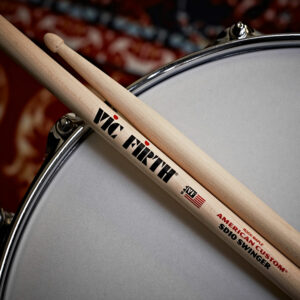 Picking the right drumstick size mainly comes down to two things: the kind of music you’re playing and what feels comfortable in your hands. So, you should find a stick that gives you the right mix of control, weight, and response.
The first thing you’ll notice is that drumsticks are categorised by numbers and letters. Numbers represent the thickness. The lower the number, the heavier and thicker the drumstick. And by the same token, the higher the number, the thinner and lighter the stick.
Letters were initially used to describe the playing styles and ensembles for which the stick was designed. “A” sticks were intended for orchestra, with a lighter feel suited to more delicate playing. “B” sticks were created for band use, offering extra weight and volume. These labels are less strict today but still provide a useful guide.
For example, a 7A is slim and light, often chosen for jazz. A 5B, on the other hand, is thicker and heavier, making it a good choice for rock. Sitting in the middle is the 5A, which offers a balanced feel that works across many styles.
If you’re just starting out, we recommend going for a pair of 5As. These will give you some good all-around playability, with a midweight, even feel that lets you explore different genres and ways of drumming. In fact, the Vic Firth 5As are the most popular sticks of all time!
If you prefer lighter genres, such as jazz, or play in unplugged, acoustic settings, try some 7As. These are thinner, which makes them perfect for gentle or quick playing styles. If you’re after power, you’ll probably prefer a 5B or even a chunky 2B. These sticks are heavier and tougher, great for rock or metal, but they require more effort to control.
At the end of the day, the best way to figure it out is to try a few! If you’re in Yorkshire, England, check out our showroom in York; our staff are happy to help you find your perfect drumstick.
Other considerations to make
 As well as size, the wood and tip shape of a drumstick have a big say in how it feels in your hands and how it sounds on the kit. These little details can change everything, from durability to tone.
Material-wise, the industry go-to is hickory. It’s durable, slightly shock-absorbent, and good for pretty much any style of music. It’s midweight, but if you want something lighter, we’d recommend maple.
Maple feels quicker and easier to move around the kit, which is great if you like speed and a bit more finesse. Another great choice is oak, which is super tough. It’s durable and works great for those heavier genres, but it’s heavier, which you’ll notice if you’re playing long sets.
Another thing to consider is the stick’s taper. This is the part of the stick between the shoulder and the neck where it narrows. It affects balance, rebound, and control.
A long taper shifts the weight towards the back, so the tip feels lighter. That extra rebound makes the stick respond faster, which is great for quick patterns or when you need a softer, more delicate touch. A short taper does the opposite. With more weight up front, the stick feels heavier at the tip and bounces less. This provides a firmer feel that’s better for louder, more powerful styles.
If you’re after something in the middle, a medium taper spreads the weight more evenly, delivering a response that works across different genres and techniques.
Finally, we have the stick’s tip. Wooden tips give you a warmer, more natural sound and feel really nice on cymbals. Nylon tips, on the other hand, are brighter and a lot more durable. These tips also come in all sorts of different shapes. I personally use sticks with oval tips as these provide a broad, rounded sound.
Teardrop and acorn tips sit nicely in the middle, with a mix of warmth and body, and barrel or round tips give more bite and definition, great if you’re into heavier styles.
FAQs
Are 5A or 7A drumsticks better for kids?
For most kids, 5A or 7A sticks are the go-to options. Out of the two, 7A sticks are usually the better choice. They’re lighter and thinner, which makes them easier for smaller hands to grip and control. You can also get dedicated junior sticks, which are really useful in those early stages.
Are 5A drumsticks heavy?
5A drumsticks aren’t heavy by drumming standards. In fact, they’re a good middle ground. They have a balanced weight that makes them super versatile, which is why they’re popular with both beginners and experienced players. Compared to other sizes, they’re a bit heavier than 7A sticks but lighter than 2Bs.
What is the most popular drumstick size?
The most popular drumstick size is the 5A. It’s the stick most drummers reach for because it hits a nice balance between weight and thickness, meaning it performs well across loads of different styles.
Final thoughts
Choosing the perfect drumstick sizes for you really comes down to feel and function. There are plenty of options out there, all with a variety of lengths, materials, tip shapes, and weights. The key is to go with what feels right and comfortable. It’s worth testing a few until you find the pair that clicks with your playing.
Hopefully, after reading this article, you have a clearer idea of what those letters and numbers mean and can choose the drumstick size that best suits you.


0 Comments