



If you’re a pianist who’s short on space or always on the go, a portable piano is a must-have. They’re smaller, lighter, and easier to take to and from gigs or rehearsals than a regular piano – and they often run on batteries, meaning you can set up anywhere (particularly great for busking or environments without mains power).
In this article, we take a look at some of the best portable digital pianos on the market, covering a range of price points, features, and technologies, so you can make an informed decision as to which one is best for you.

In a hurry?
Here are our top three portable digital pianos:
| Yamaha P225 Digital Piano | Features Iconic Yamaha CFX piano tone | Check the current price |
| Kawai ES120 Digital Piano | Has a responsive hammer compact action and a harmonic imaging piano engine | Check the current price |
| VISIONKEY-100 Portable Digital Piano | Velocity-sensitive synthetic keys | Check the current price |
Why we’ve chosen these digital pianos
We’ve chosen the following digital pianos for a number of reasons. First, we wanted to ensure our selection includes a wide variety of brands and price points, reflecting how models can differ depending on your budget and the features you’re after. But while the range covers different types of digital pianos, they all have one thing in common – compactness, regardless of price point.
Of course, the overarching commonality is that these pianos are all portable, meaning they’re easy to move, ideal for gigging, suitable for playing on the go, and simple to store. This portability presents itself in different ways: some models are lightweight, others are sleek and designed to fit in small spaces, and others can function via batteries rather than mains power.
Many models now offer multiple connectivity options. As you’ll see in the models below, Bluetooth has become a popular feature in many digital pianos, enabling audio playback through the piano’s speakers and connection to the various learning apps available with different piano brands.
Overall, we’ve chosen these models to give you a better idea of the different features, brands, and designs available. But ultimately, the main deciding factor behind this list is their portability.
The best portable digital pianos
1. Yamaha P225 Digital Piano
 Key features
- Yamaha’s flagship CFX piano tone
- Bluetooth connectivity
- Graded Hammer Compact keyboard
Pros
- Has an authentic-feeling key action
- Impressive piano sound, courtesy of the CFX
- The resonance of a grand piano’s strings and the sound reflection of a soundboard and lid have been reproduced
Cons
- 7W speakers don’t deliver as powerful a sound as other models
The Yamaha P225 weighs just 11.5kg and measures 272mm deep, meaning it’s compact enough to move easily between home, rehearsals, or performances. An optional soft case makes transport even more convenient.
It features Yamaha’s new Graded Hammer Compact (GHC) keyboard, designed to replicate the feel of an acoustic piano. The keys respond accurately across the full range, from delicate pianissimo to powerful chords, helping you develop proper finger control and dynamic technique that can be transferred to an acoustic.
In terms of sound, the P225 is powered by Yamaha’s renowned CFX concert grand piano tone. It uses VRM Lite technology to simulate the natural resonance you’d expect from a real acoustic instrument, creating an expressive playing experience with lifelike tonal variation between each note.
There’s also a broad range of built-in sounds, including 24 instrument voices and 20 rhythms, along with space for two-track recordings.
Plus, the two-way speaker system has been designed with carefully angled drivers that replicate the sound reflection of a grand piano’s soundboard and lid. This means you get clear highs and a rich low end, whether you’re practising in a small room or performing in a larger space. A Sound Boost function can also be activated for added clarity and presence when needed.
Connectivity-wise, you have Bluetooth for streaming music wirelessly from a phone or tablet, and you can use Yamaha’s Smart Pianist app via USB for control over voices, settings, and more than 300 lesson songs. It also supports recording tools and Yamaha’s Rec’n’Share video app and comes with three months of Flowkey Premium access.
2. Kawai ES120 Digital Piano
 Key features
- Responsive Hammer Compact action
- 20W speakers and spatial headphone audio
- Bluetooth audio and MIDI connectivity
Pros
- Shigeru Kawai EX grand piano tone – previously reserved for more premium Kawai pianos
- Harmonic Imaging technology ensures an incredibly detailed piano sound
- Easy connectivity for a range of setups, whether it’s streaming via Bluetooth or using MIDI functionality in your DAW
Cons
- It’s not battery-operated
The Kawai ES120 gives you premium features in a portable format, making it great for both home practice and stage use. Weighing 12.5kg and just 280mm deep, it’s compact enough to transport easily, but solidly built to withstand regular playing.
It features Kawai’s Responsive Hammer Compact (RHC) action, designed to mirror the natural feel of an acoustic piano. You’ll notice a graded response as you move across the keys, along with improvements to key cushioning, which help reduce release noise for a smoother, more refined touch.
Build-wise, the ES120 is sleek, with a polished panel and curved edges that create a subtle nod to traditional pianos, while keeping things modern. And yet, despite the compact size, the intuitive controls are large and tactile, with an indented volume slider that has been shaped for better grip.
The ES120 includes 25 tones, including three high-quality acoustic piano voices: the SK-EX concert grand, the Kawai K-60 upright, and a third voice shared with higher-end models. All voices use Kawai’s Harmonic Imaging technology to deliver depth and realism. And there’s a 192-note polyphony for full, rich, textured music.
You also have a wide range of effects to play with, including six types of reverb and a dedicated low-volume balance that allows for expressive playing at softer dynamics.
Its dual 10W speakers give you more output than many digital pianos in this category, with a noticeable boost in clarity and volume. Likewise, if you’re using headphones, the Spatial Headphone Sound system simulates the wider acoustic field of a real piano, reducing ear fatigue during longer practice sessions.
The beauty of this piano is that not only is it portable in size, but it’s also versatile in its connectivity, meaning you can use it for a range of applications. There’s Bluetooth audio for streaming backing tracks and MIDI connectivity for linking up to your computer and DAW in your studio. Plus, the ES120 comes with an F-1SP pedal and supports a range of other pedal setups for more advanced control.
Finally, you also get three-month trials of learning apps like Skoove and Tomplay.
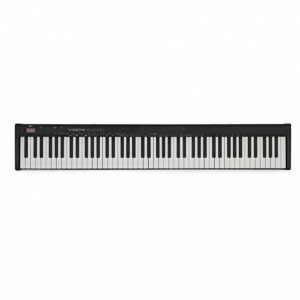
3. VISIONKEY-100 Portable Digital Piano With Bluetooth
 Key features
- 88 velocity-sensitive keys
- 129 sounds and 128 rhythms
- 30 songs
Pros
- Lightweight and space efficient
- Offers multiple ways to connect devices
- Can be placed on a range of surfaces
Cons
- Doesn’t have weighted keys
Weighing just under 5kg, the VISIONKEY-100 portable piano is impressively lightweight for an 88-key instrument. It’s compact too, making it a practical choice if you’re tight on space or want something that’s easy to store between sessions.
Its portability doesn’t mean compromising on playability. The full-size, velocity-sensitive keys respond to the dynamics of your touch, offering a more expressive playing experience, something you’ll appreciate if you’re building technique or exploring new musical styles. The only downside is that the keys aren’t weighted, which means they don’t respond quite as realistically as other pianos on the list.
The keyboard’s build strikes a nice balance between simplicity and functionality. There’s a clear LED display for navigating settings, and despite its slim design, it feels sturdy enough for everyday use at home or on the go.
There’s also an impressive 129 voices, covering everything from classical pianos and electric keyboards to strings, synths, and sound effects. You’ll also find 128 rhythms and 30 built-in songs to play along with, which makes practice varied and engaging. Plus, there’s Bluetooth connectivity, along with a music rest and a sustain pedal.
4. Keynote Compact Digital Stage Piano with Bluetooth
 Key features
- Fully weighted hammer action keys
- Removable legs
- DREAM sound engine
Pros
- 30 high-fidelity presets have been created with extremely detailed sampling techniques
- Reasonably high polyphony for a digital piano
- Space-savvy design, courtesy of the removable legs
Cons
- Not as many voices as other options
The Keynote Compact Digital Stage Piano is light enough to carry to gigs, yet stable and robust enough once set up. Weighing just 10.9kg without its legs, it fits neatly into a gig bag or the storage of a car.
Its 88 fully weighted hammer-action keys give you a responsive and expressive instrument that effortlessly mirrors the feel of an acoustic piano. This helps you gain good technique and dynamic control during both practice and performance.
It’s powered by the DREAM audio engine, a French-designed sound engine that uses detailed recordings and multi-layered synthesis to capture the character of each sound. You’ll have access to 30 voices, including pianos, organs, and strings, with 81-note polyphony ensuring your most expressive playing won’t get cut off. This is quite high polyphony for a digital piano of this price point.
Overall, the sound quality is where this piano really shines. It features built-in stereo speakers (2 x 15W) to deliver a clear output at home or on stage. And if you need to practise quietly, the headphone output gives you that option too.
The Bluetooth audio connectivity means you can stream backing tracks or play along with music apps directly through the piano’s speakers. If you’re looking for more connectivity options, it also has Bluetooth MIDI for wireless DAW control, along with USB MIDI and Aux In/Out ports, so you’re well covered for studio or live use.
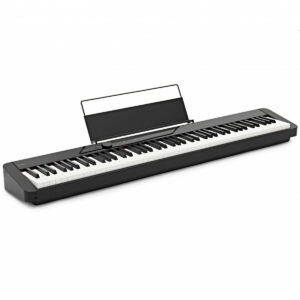
5. Casio PX S1100 Digital Piano
 Key features
- Smart scaled hammer action
- AiR sound source
- Bluetooth audio and MIDI
Pros
- Smart scaled hammer action
- AiR sound source allows for a detailed sound
- Dual oval speakers offer crisp highs and full lows
Cons
- If you’re an experienced pianist, you may not find the key action to be realistic enough
The Casio PX S1100 is a great choice if you’re a fan of the brand but want something compact and easy to transport. It brings together a slim design, natural tone, and easy portability – all in one sleek package. Weighing just 11.2kg and measuring only 232mm deep, it packs a lot in for a full 88-key hammer-action digital piano.
These smart-scaled hammer-action keys are individually weighted and highly responsive. You’ll feel the natural variation from bass to treble, just like on an acoustic grand piano. Similarly, with five levels of touch sensitivity, the PX S1100 offers detailed control over every phrase you play.
Casio’s AiR Sound Source powers its expressive tone, reproducing subtle details such as string resonance and damper noise to closely mimic the sound and response of a real piano. With a 192-note polyphony, it ensures you can perform complex, layered passages.
To deliver this impressive sound, the PX S1100 features built-in stereo speakers with mica-reinforced diaphragms. These provide clear highs and full-bodied lows, so whether you’re practising in a quiet room or performing for a small audience, you’ll hear every nuance in your dynamics. There’s even a surround sound mode that simulates the acoustics of a real performance space.
Additionally, the PX S1100 includes Bluetooth MIDI and audio via the included WU-BT10 adaptor, meaning you can connect wirelessly to learning apps, play along with backing tracks, or send MIDI data to your DAW.
Likewise, if you’re learning or teaching, the Casio Music Space app is especially helpful. It includes visual sheet music, a piano roll for playback, and a live concert simulator – all designed to make learning more intuitive.
6. Yamaha P145BT Digital Piano
 Key features
- Graded Hammer Compact (GHC) keyboard
- Yamaha CFIIIS concert grand piano sound
- Bluetooth audio
Pros
- Provides a high-quality sound through the careful placement and angle of the speakers
- Accommodates pianists from beginner to advanced levels
- GHC keyboard very closely resembles the weighted action of an acoustic piano
Cons
- Slightly smaller 7W speakers compared to other models
The Yamaha P145BT is expressive, easy to transport, and wonderful to play. With a Graded Hammer Compact (GHC) keyboard, it feels strikingly similar to an acoustic piano, accurately responding to your key presses with a wide dynamic range. And it weighs just 11.1 kg, meaning you can carry it to rehearsals or gigs without needing an extra pair of hands.
The piano delivers the sound of the Yamaha CFIIIS Concert Grand. It’s rich, detailed, and beautifully authentic, and there’s a version with modelled damper resonance for an even more natural tone.
Yamaha have redesigned the speaker system to enhance projection and replicate the soundboard reflections of a grand piano. This produces a balanced tone across all registers. Then there’s the Sound Boost feature for more punch when you need it.
Additionally, built-in Bluetooth audio makes it easy to stream tracks directly from your phone or tablet. You can practise with backing tracks, learn through video tutorials, or simply enjoy your favourite music through the piano’s speakers.
The P145BT is also compatible with Yamaha’s Smart Pianist app, which lets you adjust settings and explore features more intuitively from your device, and comes with a free three-month Flowkey Premium trial. Whether you’re starting from scratch or picking it up again after a break, the step-by-step learning tools can help support your musical progress.
7. Kawai ES60
 Key features
- Responsive Hammer Lite action
- Shigeru Kawai SK-EX piano sounds
- 20 W speaker
Pros
- Key action is designed for quiet key presses
- Powerful speaker system
- USB-MIDI ensures integration with a range of devices and DAWs
Cons
- Doesn’t feature Bluetooth like others on this list
The Kawai ES60 is a lightweight, compact digital piano that’s easy to move and store. Weighing just 11 kg, or according to Adam Wakeman, the weight of a baby giraffe, it’s one of the most portable models in Kawai’s ES range. Whether you’re heading to a lesson, rehearsal, or gig, the ES60 is designed to keep things simple.
Its Responsive Hammer Lite action provides the feel of an acoustic piano without the added weight. The keys are graded and cushioned, making them quiet to play while remaining responsive enough to capture a wide range of dynamics. This is particularly useful if you’re learning at home or practising late in the evening – you can play without disturbing others.
The ES60 delivers the sound of the Shigeru Kawai SK-EX concert grand piano, an instrument with a rich, detailed tone. There are 17 other instrument voices, too, including electric pianos, strings, organs, and the new Tine Electric Piano 2 tone for extra variety.
Despite its compact size, the ES60 doesn’t compromise on sound output. Two upward-facing 10W speakers help with projection when placed on a desk, while additional speakers at the base balance the sound when the piano is set on a stand. This makes it adaptable to different playing environments.
USB-MIDI connectivity allows for easy integration with music apps or DAWs. You can connect it to Kawai’s PianoRemote app for control over settings, access to scores, and use of built-in lessons. A Line Out is also included for connecting to external speakers or audio interfaces, ideal for studio or live use.
8. Casio CDP S110 Digital Piano
 Key features
- Scaled Hammer Action Keyboard II
- Battery-powered, with a 13-hour battery life
- MIDI-enabled
Pros
- Truly portable thanks to its 13-hour battery life
- Scaled Hammer Action Keyboard II system feels authentic
- Sleek design is great for small spaces
Cons
- Only features 10 built-in voices
The Casio CDP S110 is a compact, portable digital piano designed for beginners. Weighing just 10.5 kg and measuring only 232 mm deep, it’s ideal if you’re short on space or need something easy to carry between home, lessons, and rehearsals.
This model features Casio’s Scaled Hammer Action Keyboard II, which offers a realistic feel that closely mirrors the response of its acoustic counterpart. The keys are graded, with a heavier touch in the lower register and a lighter touch in the upper range. This helps you develop correct technique from the beginning, which you can easily transfer to an acoustic piano.
Even better, the keys feature a textured finish that improves grip and comfort, especially during longer practice sessions. This attention to detail also just adds that extra touch of class and realism; a fine-grain finish is unusual on a piano at this price point!
On top of that, the piano includes 10 built-in voices, ranging from concert grands to electric pianos and organs. You can also layer sounds and apply effects like reverb and chorus to shape your sound. For everyday practice and play, there’s enough variety to keep things engaging. And the projection of that sound comes from a speaker system of 8 W per side. While compact, it delivers a balanced and clear tone.
One of the CDP S110’s key strengths, though, is its flexibility. It can run on six AA batteries for up to 13 hours, freeing your performance from any mains power and making it truly portable. Whether you’re playing outdoors or away from home, it’s ready to go when you are.
Connectivity is simple. A USB Type B port supports MIDI, allowing you to connect to a computer or mobile device. The piano also integrates with Casio’s free Music Space app, giving you access to a library of songs, score-reading tools, and a virtual concert simulator. All of this makes the CDP-S110 a smart, accessible choice for learners looking to build solid fundamentals without compromising on portability.
9. Roland FP-10
 Key features
- PHA-4 keyboard
- Bluetooth and USB connectivity
- SuperNATURAL sound engine
Pros
- PHA-4 keyboard offers a fully weighted response
- SuperNATURAL piano sound engine for realistic sounds
- It’s lightweight and compact, yet has 88 full-sized keys and pro-level features
Cons
- Isn’t battery-operated
It might be compact, but the Roland FP-10 doesn’t compromise on feel or tone. It’s slim enough to fit into tight spaces, yet still offers a full 88-key range, giving you room to grow and refine your playing.
With a PHA-4 Standard keyboard, the FP-10 responds realistically to every key press, allowing for an expressive performance with a range of dynamics. The textured, ivory-feel finish of the keys makes them seem even more authentic to look at and touch. Better still, the key action is quiet – ideal for late-night playing.
Roland’s SuperNATURAL technology powers the FP-10’s sound, recreating the richness and detail of an acoustic piano. With it, you have dynamic, expressive tones that respond naturally to how you play. This not only sounds good but also supports a deeper musical connection as you learn and develop your technique.
Bluetooth MIDI and USB connectivity allow you to link the FP-10 with music apps or recording software. Whether you’re using Skoove for guided lessons or a DAW to capture ideas, setup is quick and straightforward.
There’s also Twin Piano mode for side-by-side playing, which is especially useful for lessons or duets. And at just 12.3 kg, the FP-10 is light enough to move around the house or take to rehearsals without difficulty.
The best portable digital pianos: jargon buster
Key action – “Action” refers to how much resistance you feel when playing the keys, and how they interact with the piano’s internal sensors. Most digital piano brands have developed their own key action technology, with the goal of replicating the realistic touch and response of an acoustic. Read our guide to semi-weighted and weighted keys to understand the differences between the two main types.
Polyphony – A piano’s polyphony is the number of notes it can produce at once. On an acoustic piano, you can technically play all the keys at the same time (with some help). With digital pianos, a higher polyphony count is better, as it allows for more complex pieces to be played without notes cutting off. It’s also important when layering different sounds.
Velocity sensitivity – “Velocity sensitivity” refers to how the piano responds to the speed and pressure with which you press a key. The harder or faster you play, the louder and more intense the sound, allowing for expressive, dynamic playing.
Graded hammer action – We know what “action” means, but “graded” means the keys are heavier in the lower register and lighter in the higher. It further mimics the feel of a traditional acoustic piano, which has natural weight variation.
How to choose the best portable digital piano for you
If you’re looking for a portable piano, the first thing to consider is its weight. You’ll want a model that’s easy to move around – so it shouldn’t be too heavy. All the pianos in the list above have been chosen partly due to their lightweight constructions.
Connectivity is another important factor. A piano with good connectivity options can significantly support your development and make it way more fun to play. Bluetooth functionality allows you to play along with your favourite songs, while MIDI and USB connections enable integration with external devices such as apps, recording software, or learning tools.
As with any instrument, build quality often reflects the overall standard. Whilst this is not always a dealbreaker, it is something to keep in mind, especially if you plan to move the piano frequently. So, even though you should look for a piano that’s easy to carry, you should balance this with a solid, robust build – one that can withstand the bumps that come with regular transport.
Think about what you want from the piano. Are you looking for a model packed with sounds and presets? Or is your main priority the piano sound itself? Choose whether you need creativity and flexibility or a solid-sounding piano.
This brings us to another important consideration to listen out for: speakers. Speaker quality is especially important if you’ll be playing the piano out loud, without a PA system. If you want the flexibility to play at home but also have the option to increase volume for a larger space, look for a model with enough output power to handle both scenarios.

FAQs
Should a beginner get a 61-key or an 88-key keyboard?
If you’re a beginner looking to learn the basics on an easy-to-manage keyboard, 61 keys are sufficient. This size will give you enough space to practise scales and chords. But if you want to play more complex pieces, we recommend having 88 keys.
Are portable piano keyboards any good?
Portable piano keyboards are considered good for beginners and musicians on the go. They offer convenience, a lightweight design, and increasingly realistic key action and sound quality. Also, many models now include weighted keys, touch sensitivity, and connectivity options, making them versatile and practical for a wide range of uses.
Which digital piano is closest to a real piano?
The digital piano that is closest to a real piano is one that features fully weighted keys with graded hammer action, high-fidelity sound sampling/modelling, and realistic pedal/escapement mechanics.
Final thoughts
There is a vast array of digital pianos on the market, and as we’ve learned in this article, you can find many portable options that don’t sacrifice features you may find on traditional and less portable models.
Portability comes in many different forms, including weight, size, build, and power source. Whichever feature defines what you want from your digital piano, hopefully, you can use this article to inform your choice and choose the best portable digital piano for you and above all, have fun.


0 Comments