



Shopping for a loved one who wants to learn a new skill? Or maybe they’re eager to get back into playing music?
There’s a huge array of digital pianos that are great for beginners. But with such a vast number of digital pianos on the market, how do you know which is right for them? Enter: our digital piano gift guide!
In a hurry?
At a quick glance, here are our top picks.
| Yamaha P145BT | The best piano for building technique. | Check the current price |
| Kawai ES60 | Authentic Kawai piano feel at an accessible price. | Check the current price |
| Kawai CX-202 | The best piano for an authentic feel. | Check the current price |
| Keynote Compact | An affordable introduction to piano playing for complete beginners. | Check the current price |
| Casio CDP S110 | Best portable piano for students. | Check the current price |
The best digital pianos for beginners
1. Yamaha P145BT Digital Piano
The best piano for building technique
 Specifications
- Number of keys: 88
- Keyboard Type: Graded Hammer Compact (GHC) Keyboard
- Polyphony: (Max.) 64
- Preset Voices: 10
- Effects: Reverb (4 Types)
- Modes: Dual, Duo
- Metronome Included?: Yes
- Sustain Pedal Included?: Yes
- Amplifiers: 7W x 2
- Speakers: (12cm x 8cm) x 2
- Weight: 11.1kg
Pros
- At just 11.1kg, this is a very compact and portable piano – great for taking to school or lessons
- Graded hammer action keys are great for building correct technique as they feel just like an acoustic
- Includes a sustain pedal
Cons
- Doesn’t come with a stand
- Limited connectivity options, but this is fine for a beginner
The Yamaha P145BT Digital Piano, formerly known as the P45, is renowned amongst piano teachers for its beginner-friendly features. And it’s affordable. This doesn’t mean it’s a cheap, flimsy piano – rather, it’s been designed to help you learn and develop your skills effectively. And what’s better than starting your piano career than doing it with the Yamaha name behind you?
Each of the P145BT’s 88 keys has a hammer inside – just like an acoustic piano. This means that when or if you move to the acoustic piano, it’ll feel familiar, and you’ll have the correct technique nailed already. The hammers are also graded, meaning they’re heavier in the low end and lighter in the high end – again, another example of authentic design. And despite being compact, the GHC keyboard (newly developed by Yamaha) is extremely comfortable to play.
It’s not just an authentic-feeling digital piano that beginners are on the hunt for, but one that sounds great, too.
The speakers of the P145BT have been angled very precisely to replicate the sound reflection you’d hear on a grand piano’s soundboard and lid, producing an exceptionally clear and powerful tone from the bass to the treble. Plus, there’s even a Sound Boost function for adding some extra punch to your sound!
To make life easier – for you and your neighbours – there’s a headphone input. So, you can practise at all hours without disturbing anyone.
The P145BT boasts numerous functions that a specially suited to beginners. Firstly, 10 different voices, ranging from grand piano to vibraphone, are accessible by the click of a button, and they’re sure to keep the piano fun and engaging to play.
Then there are the demo songs – something to ensure you’re always inspired. And one for your lessons: the Duo function, which splits the keyboard in half and allows you and your teacher to practise the same parts and duet together. Plus, there’s a metronome to keep you in time.
Finally, the Yamaha P145BT connects to the Smart Pianist app, which allows you to control the piano remotely and access 303 classical pieces to practise – ideal for beginners!
2. Kawai ES60 Digital Stage Piano
Authentic Kawai piano feel at an accessible price.
 Specifications
- Number of Keys: 88
- Keyboard Type: Responsive Hammer Lite (RHL) Action
- Polyphony: (Max.) 192
- Preset Voices: 17
- Effects: Reverb
- Metronome Included?: Yes
- Sustain Pedal Included?: Yes
- Amplifiers: 10 W x 2
- Speakers: 12 cm x 2
- Weight: 11 kg
Pros
- Responsive Hammer Lite action helps develop proper technique
- Authentic Kawai grand piano sounds
- Compact design makes it easy to transport
Cons
- Doesn’t include a stand by default
- Fewer advanced features than higher-end Kawai models
Learning piano is much more enjoyable when you’ve got an instrument that responds beautifully. And with the Kawai ES60 Digital Stage Piano, you get a taste of Kawai’s renowned craftsmanship without having to stretch your budget too far.
One of its best features is the Responsive Hammer Lite keyboard action. This recreates the resistance of the keys of an acoustic piano, helping you build finger strength and develop the correct technique from your very first lessons. It’s also designed to be quiet, so you won’t have to worry about distracting mechanical noises while practising.
Of course, a realistic keyboard deserves equally convincing sounds. The ES60 uses Kawai’s Harmonic Imaging technology to reproduce the character of an acoustic grand piano, giving you expressive control as your playing improves.
There’s also a selection of additional instrument voices to explore when you fancy something different.
And despite its impressive piano feel, the ES60 is portable. Its slim design makes it a practical choice for smaller rooms, while also being easy to take along to lessons or rehearsals.
3. Kawai CX-202
The best piano for an authentic feel
 Specifications
- Number of keys: 88
- Keyboard Type: Responsive Hammer Compact II
- Polyphony: (Max.) 192
- Preset Voices: 17
- Key Functions & Effects: Reverb (6 Types), Internal Recorder, Lesson Function, Metronome, 15 Songs
- Metronome Included?: Yes
- Sustain Pedal Included?: Yes
- Amplifiers: 20W x 2
- Speakers: 12cm x 2
- Weight: 37kg
Pros
- An upright digital piano with three pedals
- Nuanced, authentic-feeling keyboard action
- The lesson function supports you as you progress
- Great max. polyphony (192 notes)
Cons
- One of the more expensive pianos on this list
The Kawai CX-202 Digital Piano is a step up in terms of beginner pianos. It’s suited to pianists who want something a bit more high-end without breaking the bank.
The first thing you’ll notice about the CX-202 is that it’s an upright piano with three pedals: sustain, soft, and sostenuto, and they’ll help you learn the advanced techniques needed for an acoustic. There’s also the Responsive Hammer Compact II keyboard action, which gives you accurate resistance as you press down on the keys.
As expected with Kawai, you get the rich tones of the Shigeru Kawai SK-EX concert grand – and it sounds insanely realistic thanks to Kawai’s Harmonic Imaging. This patented technology ensures that all the nuances of the 9-foot grand piano are recreated. And this further adds to the authentic experience of the piano – not only does it feel like a true acoustic, but it sounds like one too.
Although this piano might not be affordable as a beginner’s first piano, if you can stretch the budget – you’ll notice the difference. It’s one that will stick with you as your skill progresses, teaming advanced technology with novice-friendly features. For example, there’s the Lesson function. This includes songs for you to learn from reputable music educators such as Alfred and Burgmüller.
In addition to this, there is a metronome, 15 demo songs, dual mode for layering voices, and Four Hands mode – which is like Yamaha’s Duo function and splits the piano in two so you can duet with your teacher.
Connectivity-wise, the CX-202 can be used as a MIDI device via a USB MIDI connector. Plus, it supports Bluetooth MIDI connectivity – and you can connect to Kawai’s PianoRemote and PiaBookPlayer apps for an extended range of sounds, settings, and scores.
4. Keynote Compact Digital Stage Piano with Bluetooth
An affordable introduction to piano playing for complete beginners.
 Specifications
- Number of Keys: 88
- Keyboard Type: Fully Weighted Hammer Action
- Polyphony: (Max.) 81
- Preset Voices: 30
- Features & Effects: Reverb, Dual, Layer, Split, Touch Response, Transpose, Record/Playback, Metronome, Favourites
- Bluetooth Included?: Yes
- Sustain Pedal Included?: Yes
- Speakers: 15 W x 2
- Weight: 13.45 kg (With Stand)
Pros
- Fully weighted hammer action keys offer satisfying resistance
- Detachable legs make it suitable for home and stage use
- Bluetooth connectivity offers more ways to practise
Cons
- Not as portable as smaller, unweighted keyboards
Who says a beginner piano can’t look good? The Keynote Compact Digital Stage Piano combines a stylish, contemporary design with the features you need to start learning, making it a great choice if you want something that looks just as good in your living room as it does on stage.
Despite its authentic keybed, the Keynote is actually very compact. The detachable legs allow you to transform it from a home piano into a portable stage instrument, with a lightweight design that makes it easy to move between locations.
And when it comes to playing, you have 88 fully weighted hammer action keys that recreate the resistance of an acoustic piano, giving you a satisfying playing experience. The DREAM audio engine also delivers rich, detailed instrument sounds, with 30 built-in voices to explore when you fancy something different.
And there’s Bluetooth connectivity. Connect to your learning apps or play along to music; just that simple wireless connection can make playing the piano so much more fun.
5. Casio CDP S110 Digital Piano
Best portable piano for students
 Specifications
- Number of keys: 88
- Keyboard Type: Scaled Hammer Action Keyboard II
- Polyphony: (Max.) 64
- Preset Voices: 10
- Effects: Reverb, Chorus
- Metronome Included?: Yes
- Sustain Pedal Included?: Yes
- Amplifiers: 8W x 2
- Speakers: [12cm x 6cm (oval)] x 2
- Weight: 10.5kg
Pros
- Lightweight and portable
- Authentic feel courtesy of the Scaled Hammer Action Keyboard II system
- Comes with a music stand
Cons
- Bass notes can sometimes get a bit lost in the mix
Now for something a bit easier to manage, the Casio CDP S110. This sleek digital piano weighs just 10.5kg and is only 232mm deep, which makes it a dream to take to and from lessons or performances. Granted, it’s not as easy to transport as say, a flute, but in the grand scheme of pianos, it’s a winner.
Excellent portability isn’t all this piano has to offer, it also boasts some very innovative technology that ensures you’re getting all the perks of a realistic-feeling piano at a wallet-friendly price.
The CDP S110 has been made for students. And to ensure it’s the ultimate learner’s piano, Casio asked over one hundred piano teachers what they believed to be the most important aspect of a digital piano.
It may come as no surprise that the majority (over 80%) said it was the feel of the instrument. And with that in mind, Casio designed the S110 with the Scaled Hammer Action Keyboard II system. This replicates the action of an acoustic piano, pushing a weighted hammer when you press a key.
Even the fine details have been considered; the keys boast a fine-grained finish which reduces slippage and adds a touch of class to the keyboard, making it look beyond the affordable price it’s set at.
The CDP S110 is also MIDI enabled and boasts a USB-B connection, allowing you to use the piano as a MIDI controller. Plus, it works with the Casio Music Space app, which can be used as a learning aid thanks to its vast catalogue of songs.
6. Casio PX 770 Digital Piano
An incredible range of textured, dynamic sound
 Specifications
- Number of keys: 88
- Keyboard Type: Scaled Hammer Action II
- Polyphony: (Max.) 128
- Preset Voices: 19
- Effects: Reverb, Chorus, Brilliance, DSP
- Metronome Included?: Yes
- Sustain Pedal Included?: Yes
- Amplifiers: 8W x 2
- Speakers: 12cm x 2, 4cm x 2
- Weight: 31.5kg
Pros
- Uses Casio’s Acoustic and Intelligent Resonator technology for resonant sound
- Boasts a Tri-Sensor II hammer action keyboard
Cons
- Slightly on the pricier side
- No Bluetooth connection
The Casio PX 770 Digital Piano is more of a premium Casio offering when it comes to beginner pianos.
Firstly, it includes the AiR sound source, Casio’s pioneering Acoustic and Intelligent Resonator technology. This means the sound stems from the incredibly detailed and thorough sampling of a 9-foot concert grand, giving you extremely resonant and realistic sound with a superb range of dynamics.
It’s this kind of expressive sound that invites new pianists to play and keeps them inspired.
Coinciding with the expertly sampled grand piano, the PX 770 also boasts Casio’s renowned Tri-Sensor II hammer action keyboard, designed to replicate the keys of an acoustic as closely as possible with the use of three sensors.
Ideal for beginners, there’s a choice of 10 classical melodies included in this piano, and you can play alongside a symphony orchestra whilst you learn – giving you the full piano-playing experience. Plus, the 770 works with the Casio Music Space app, further aiding your learning and skill progression.
7. VISIONKEY-100 Portable Digital Keyboard Piano with Bluetooth
An accessible introduction to piano playing with plenty of creative possibilities.
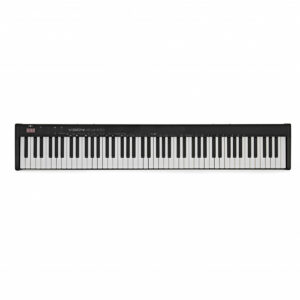 Specifications
- Number of Keys: 88
- Keyboard type: Velocity-Sensitive
- Polyphony: (Max.) 32
- Preset Voices: 129
- Built-In Rhythms: 128
- Built-In Songs: 30
- Bluetooth Included?: Yes
- Sustain Pedal Included?: Yes
- Weight: 4.85 kg
Pros
- Extremely affordable for an 88-key instrument
- Huge selection of sounds and rhythms to explore
- Lightweight design makes it easy to transport
Cons
- Keys aren’t fully weighted like an acoustic piano
Not everyone wants to spend hundreds of pounds on their first piano, especially when they’re still figuring out whether playing is for them. That’s where the VISIONKEY-100 Portable Digital Keyboard Piano comes in.
This affordable instrument gives you a full 88-key keyboard, so you can learn pieces written for a standard piano without running out of notes. The keys are velocity-sensitive, too, meaning the sound responds to how hard you press them. Although they’re not weighted like an acoustic piano, they’re a great introduction to playing with expression.
And there’s certainly no shortage of sounds to keep you entertained! With 129 instrument voices and 128 rhythms to choose from, you can experiment with different musical styles while developing your skills.
If you prefer learning by playing along to music, the VISIONKEY-100 has you covered. Its Bluetooth connectivity allows you to stream audio from a compatible device through the piano’s speakers, making it easy to practise alongside your favourite songs.
There’s also a handy LED display that makes navigating the different sounds and settings straightforward, even if you’ve never used a digital piano before.
Plus, weighing just 4.85 kg, it’s easy to move around the house or take to lessons. And with a sustain pedal included, you can start exploring more expressive playing techniques straight away.
8. SDP-2 Stage Piano by Gear4music, Stand Pack
The best all-in-one starter package for learning piano.
 Specifications
- Number of Keys: 88
- Keyboard Type: Weighted
- Polyphony: (Max.) 32
- Preset Voices: 8
- Effects: Reverb, Chorus
- Metronome Included?: Yes
- Sustain Pedal Included?: Yes
- Speakers: 10 W x 4
- Accessories: Stand, Bench, Headphones
Pros
- Complete package with everything you need to get started
- 88 full-size keys give you plenty of room to explore different pieces
- Built-in speakers and headphone connectivity
Cons
- Limited selection of instrument voices
- Lower polyphony than other weighted digital pianos
Getting started with piano can sometimes mean buying a lot more than just the instrument itself. You’ll need somewhere to put it, somewhere to sit, and probably some headphones if you don’t want to disturb everyone around you.
The SDP-2 Stage Piano by Gear4music Stand Pack comes with a stand, bench, sustain pedal, and headphones, so you can get straight into practising without worrying about buying extra accessories. It’s a particularly convenient option for beginners who want a complete setup at an affordable price.
But there’s plenty to enjoy about the piano itself, too. With 88 weighted action keys, you’ve got the full range of a traditional piano at your fingertips, giving you the freedom to explore everything from simple melodies to more challenging pieces as your confidence grows.
There are eight built-in sounds to choose from, including grand pianos, electric pianos, organs, a vibraphone, and a harpsichord. You can also add reverb and chorus effects to give your performances a little extra character. And with four built-in 10W speakers, your playing can really shine at home or in small performance spaces.
9. Korg SP-280 Digital Stage Piano
A digital piano with a wide range of sounds to try
 Specifications
- Number of keys: 88
- Keyboard Type: Natural Weighted Hammer Action
- Polyphony: (Max.) 120
- Sounds: 30
- Effects: Reverb, Chorus, Brilliance
- Metronome Included?: Yes
- Sustain Pedal Included?: Yes
- Amplifiers: 22W x 2
- Speakers: [8cm x 12cm (oval)] x 2
- Weight: 19kg
Pros
- Includes a vast range of sounds and demo songs
- Good maximum polyphony (120 notes)
Cons
- Not all pianists will be a fan of the rounded edge design
With a slightly unusual aesthetic courtesy of its rounded corners, the Korg SP-280 Digital Stage Piano is one for home, studio, and stage. It weighs just 19kg, making it suitable for taking to lessons and live performances – and its sleek, compact design certainly helps with this, too.
The SP-280 has been designed with beginners in mind, and it’s as versatile as possible to ensure it caters to all levels and styles of pianists.
One of the main things that set the SP-280 apart from the rest is its 30 sounds and 30 demo songs. From acoustic piano to electric grand to jazz organ, there’s a plethora of instrument voices to choose from, keeping you motivated to play and explore different sounds.
The SP-280 boasts Real Weighted Hammer Action and intuitive performance technology for a playing experience that is just like that of an acoustic piano.
What’s really clever is that the piano responds to your playing dynamics and will choose one of four piano samples to sound when you press the keys. This means that whether it’s soft pianissimo notes or booming crescendos, this piano will react accordingly and give you the best possible sound.
10. Yamaha YDP 146 Digital Piano
The feel and sound of an acoustic piano with digital convenience.
 Specifications
- Number of Keys: 88
- Keyboard Type: Graded Hammer Standard (GHS) Action
- Polyphony: (Max.) 192
- Preset Voices: 10
- Effects: Reverb (4 Types), Intelligent Acoustic Control, Stereophonic Optimiser
- Modes: Dual, Duo
- Metronome Included?: Yes
- Sustain Pedal Included?: Yes
- Amplifiers: 8 W x 2
- Speakers: 12 cm x 2
- Weight: 38 kg
Pros
- Realistic concert grand piano sound
- Included triple pedal unit helps you improve your playing
- Traditional upright design looks great in the home
Cons
- Limited sound variety compared to others
- Not designed to be moved around regularly
If you’ve always dreamed of having a beautiful upright piano in your home, the Yamaha YDP 146 Digital Piano might be just what you’re looking for. Part of Yamaha’s popular Arius range, it combines the traditional appearance of an acoustic piano with the convenience of a digital instrument.
And it certainly doesn’t disappoint when it comes to sound. At its heart is the sampled voice of Yamaha’s flagship CFX concert grand, giving you a rich, expressive tone that responds beautifully to your playing.
But there’s more to a piano than how it sounds. The YDP 146 features Yamaha’s Graded Hammer Standard keyboard, which recreates the heavier resistance of bass keys and lighter feel of treble keys on an acoustic piano. This is particularly useful for beginners, as it encourages good technique that will transfer naturally to an acoustic instrument.
You also get three pedals: sustain, soft, and sostenuto. These allow you to explore more advanced playing techniques as you progress, rather than having to upgrade your piano when you reach more challenging pieces.
Another handy feature is Duo mode, which divides the keyboard into two identical ranges for you and your teacher to play the same notes together.
The YDP 146 is also compatible with Yamaha’s Smart Pianist app, making it easier to explore the instrument’s settings and functions.
It’s a little more of an investment than some beginner pianos, but if you’re looking for something that feels like a permanent part of your home, the YDP 146 is a fantastic choice.
11. Roland FP 10 Digital Piano
An entry-level piano that’s great value for money
 Specifications
- Number of keys: 88
- Keyboard Type: PHA-4 Standard Keyboard with Escapement and Ivory Feel
- Polyphony: (Max.) 96
- Sounds: 15
- Effects: Ambience, Brilliance
- Metronome Included?: Yes
- Sustain Pedal Included?: Yes
- Amplifiers: 6W x 2
- Speakers: 12cm x 2
- Weight: 12.3kg
Pros
- An excellent keybed with touch-detection technology
- SuperNATURAL sound engine for a detailed, realistic sound
Cons
- No Bluetooth audio connectivity
The Roland FP 10 is an entry-level digital piano that doesn’t skimp on quality. It’s designed to be as streamlined and portable as possible, so it can fit into any space in your home without looking bulky or obtrusive.
As piano teachers recommend, it’s important to pick up good habits and technique in the early stages of your learning. That’s where Roland’s PHA-4 keyboard action comes in handy.
It’s designed with Roland’s latest touch-detection technology, allowing for incredible responsiveness. This means that whatever you play – whether it’s fast repetition, soft dynamics, or a quick change in playing styles – the keys will pick up on this and sound accordingly.
Plus, the hammer-action mechanism is quieter than Roland’s previous models, so you can focus on quality sound and progressing in skill. It’s also particularly beneficial when you’re practising with headphones – your family and friends won’t be disturbed by the annoying, repetitive sound of thudding keys absent of beautiful piano sound.
What’s even better is that not only do the keys sense every fine detail of your playing beautifully, but they also feel like acoustic ivory keys. It’s these small additions to an instrument that takes it to the next level – and, in this case, it means you have an experience similar to that of a real acoustic piano.
Now, does key coating seem like a meaningless feature? Well, what if it’s a moisture-absorbing material? This is what the white keys have been finished with. Even in hot environments, you’ll have an enjoyable, comfortable playing experience.
Roland’s renowned SuperNatural sound engine features in this piano, and it sets it apart from other digital pianos within this price range. As well as multi-layered samples, the SuperNatural engine means there’s also modelling technology. This recreates an acoustic piano’s dynamics by creating sounds between the sampled velocities for a smooth, natural sound at all dynamics.
The piano comes with the two helpful features you’d expect and need as a beginner: a metronome and Twin Piano mode (the mode that splits the piano for you and your teacher).
12. Roland F107 Digital Piano
An affordable take on Roland’s premium F701
 Specifications
- Number of keys: 88
- Keyboard Type: PHA-4 Standard Keyboard with Escapement and Ivory Feel
- Polyphony: (Max.) 256
- Sounds: 15
- Effects: Ambience, Brilliance
- Metronome Included?: Yes
- Sustain Pedal Included?: Yes
- Amplifiers: 8W x 2
- Speakers: 12cm x 2
- Weight: 34.5kg
Pros
- Brings premium sound and design to players on a budget
- Boasts Roland’s SuperNATURAL sound engine
Cons
- Controls are kept to a minimum – this is good for beginners but may be limiting for more advanced players
The Roland F107 is based on the F701, a piano at a much higher price point that won the 2021 Red Dot Design award. This more affordable take doesn’t sacrifice quality, and it welcomes a whole generation of new players that want a high-end model for their first, or even their second, piano.
Like the FP 10, the F107 has a SuperNATURAL sound engine for beautifully realistic sound and a PHA-4 keyboard for excellent responsiveness. And to ensure you relish the full expressive nature of the piano, there are sustain, soft, and sostenuto pedals built in.
Twin Piano mode features again for easy tuition with your teacher. And there are two headphone jacks, perfect for practising duets or letting someone listen to your playing.
In terms of connectivity, there’s built-in Bluetooth audio, USB ports, and MIDI, meaning you can effortlessly link the piano up to your smartphone, computer, or other device. Being able to connect to DAWs is a nice addition as it means you’re not limited to purely learning piano, you can explore music production too.
The F107 is compatible with the Roland Piano app, which allows you to control the settings of your piano remotely. You can also alter sound and record much more easily as it puts the control right in the palm of your hand. The app is also particularly useful for beginners as it includes lesson features and scores for the piano’s onboard songs – you can also add your own scores via Roland Cloud.
13. Alesis Concert 88-Key Semi-Weighted Digital Piano
A digital piano with incredibly powerful speakers
 Specifications
- Number of keys: 88
- Keyboard Type: Semi-Weighted with Velocity Sensitivity
- Polyphony: (Max.) 128
- Sounds: 10
- Effects: Reverb, Chorus
- Metronome Included?: Yes
- Sustain Pedal Included?: Yes
- Amplifiers: 20W x 2
- Weight: 7.1kg
Pros
- Powerful sound courtesy of 20W speakers and 128-note polyphony
- Keys boast adjustable touch response
Cons
- Keys aren’t fully weighted
If you’re after something easy to grasp, without all the bells and whistles that can be overwhelming for a complete beginner, the Alesis Concert is one for you. It boasts 88 keys, and although they aren’t fully weighted, you can adjust the touch response to add expression to your playing and prepare you for an acoustic.
It also produces full-bodied resonance thanks to its 128-note polyphony and sustain pedal. And there are two 20W speakers for some serious oomph.
Designed with beginners in mind, the Concert includes a Lesson mode, which halves the piano, giving you and your teacher the same note range. And of course, there’s a metronome to help you work on timing and rhythm.
If piano sounds just aren’t enough, don’t fret – the Concert has 10 built-in voices, ranging from acoustic piano to church organ to synth. Layer mode then lets you… layer these sounds, ideal for creating lush textures or unusual instrument combinations, whilst Split mode assigns one voice to your left hand and one to your right.
14. Keynote Junior Digital Piano & Stool
The perfect first piano for younger children.
 Specifications
- Number of Keys: 61
- Polyphony: (Max.) 32
- Preset Voices: 10
- Sustain Pedal Included?: Yes
- Speakers: 6 W x 2
- Weight: 13.6 kg (With Stand)
Pros
- Designed especially for younger beginners
- Compact size makes it ideal for bedrooms and playrooms
- Matching stool included for a complete setup
Cons
- Smaller playing range than a full-size 88-key piano
Finding the right first piano for a young child can be tricky. A full-size instrument might be a little intimidating, while a basic toy keyboard might not offer the playing experience you’re looking for. The Keynote Junior Digital Piano provides a nice middle ground.
Designed specifically with younger players in mind, this compact piano makes learning feel much more approachable. Its smaller proportions are better suited to children, helping them feel comfortable as they discover their first notes and melodies.
And unlike many beginner keyboards, the Keynote Junior has the appearance of a traditional upright piano. Its attractive finish makes it a lovely addition to a bedroom or playroom, while the included matching stool completes the setup.
The built-in speakers also mean there’s no need to connect external equipment before getting started. Simply switch it on and begin exploring the keyboard.
Although it isn’t designed to replace a full-size piano as children progress to more advanced pieces, the Keynote Junior offers a fun and inviting introduction to music. And who knows? Those first few notes could be the beginning of a lifelong passion!
Benefits of digital pianos
So, we’ve gone through our top 14 digital pianos, but what are the benefits of them over an acoustic?
There’s no need to tune them
One major benefit of digital pianos is that there’s no need to tune them. An acoustic piano will need to be tuned after it has ‘settled’ in your home and about once a year thereafter – this costs money and means there’ll be times when your piano isn’t sounding its best as it needs to be tuned. Digital pianos, on the other hand, are good to go as soon as they’re set up, saving you money and making life that little bit easier.
Silent practice
They also allow for silent practice courtesy of a headphone output. Sometimes, you just want to work on a few bars over and over again to get it perfect – you can do this in peace without bothering other people if you have a good pair of headphones.
Digital pianos save space
This might seem obvious, but the size of a piano can be make-or-break for some people. Digital pianos come in different sizes, and many are super sleek and compact without compromising key size. This is ideal if space in your home, rehearsal room, or on stage is limited.
Affordability
Granted, digital pianos come in at different price points – but, overall, the cheapest digital piano will be cheaper than the lowest-priced acoustic. We’ve kept the pianos on this list below £900, and there are plenty more within this price range. As you get more skilled, you may decide to splash the cash on a more expensive model that includes a wider range of features.
Many digital pianos come with additional accessories
One very convenient selling point of a digital piano is that many come with the accessories you need to get started. A music stand, pedal, and power supply are all vital, and some pianos also come with headphones and a stool. We have digital piano packages that include everything you need to begin playing right out of the box.
They include features to help you learn
Digital pianos are particularly great for beginner pianists, and that’s partly due to the onboard features that really aid you in your learning. A metronome, for example, is essential for practising timing and rhythm. Even once you’ve learned a piece, it can be easy to speed up whilst you’re playing as you know the piece so well – I struggle with this! Playing along to a metronome to keep you in time is incredibly helpful.
Some pianos, like the Yamaha P45 and Kawai KDP120, are also compatible with certain tuition apps, offering scores for you to play along to, feedback, and exercises for you to warm up with.

Why do piano teachers recommend digital pianos?
Piano teachers recommend digital pianos because they can really help build technique and skill and deter beginners from picking up bad habits.
Digital pianos with weighted keys are particularly recommended as they encourage good wrist posture, dexterity, and finger strength – something that is needed for an acoustic. This means that when it comes to a piano exam or recital, you won’t have any unwelcome surprises – the acoustic piano will feel just like the digital you’ve been learning on.
Digital pianos with responsive keys also help you practise dynamics – something that is transferrable to an acoustic. Plus, they’re usually comparable to teachers’ pianos. You don’t want to be learning on a keyboard at home to then go to your tutor’s house and struggle with playing a full-size digital.
Similarly, many digital pianos come with a duo/dual/split mode which halves the keybed so that you and your teacher can play side by side, each with the same note range. This means you can watch your teacher’s technique when playing a passage and copy them exactly.
Finally, a sustain pedal is usually included with a digital piano. Being able to use a pedal is very important as you’ll need it for phrasing and, you guessed it, sustaining notes.
Things to consider
When choosing the right digital piano for you, I recommend looking for one that has 88 keys rather than 61 or 76. This means you have the full keybed to play with and you can learn all kinds of pieces without limitations.
You should also look for a keybed that is at least semi-weighted. As we’ve mentioned, teachers recommend this as it encourages you to develop correct playing techniques.
You’ll also want it to sound good! That’s why it’s important to look for a piano that has well-recorded samples – go for quality over quantity when it comes to instrument voices.
To ensure it fits perfectly in your home, the piano’s size is very important. Make a note of the measurements of your space and whether or not the piano will disturb others – if so, purchase a pair of headphones. To narrow your search, check out our guide to the best piano headphones.
One major but quite obvious thing to consider is whether or not your chosen piano comes with a stand. Many models are packaged as just the keyboard, so you’ll need to purchase a stand that suits your space – whether that’s an X-frame stand for performing live or more of an upright digital piano stand for home use.
We recommend the modul Universal Wooden Keyboard Stand as it’s suitable for all 88-key keyboards and pianos, and it looks extremely sleek!

What are weighted keys?
Weighted keys are keys that have been designed to replicate the resistance you feel when you press the keys of an acoustic piano. This is known as ‘action’ and means they respond to fast, agile passages of music.
Some keybeds are also ‘graded’: the bass notes are heavier than the treble end – just like an acoustic.
You can read more about pianos with weighted keys and different types of key action here.
FAQs
Are digital pianos good for beginners?
Digital pianos are good for beginners, and they’re recommended by piano teachers. Models with weighted keys will help you with technique, and many include a metronome, demo songs to play along to, and wireless connectivity for linking to piano tuition apps.
Which digital piano is closest to a real piano?
The Kawai ES120 Digital Stage Piano is most like a real piano as it includes Kawai’s Responsive Hammer Compact action which is just like the keys of an acoustic piano. It also has samples of the SK-EX grand piano and the K-60 upright – so you’re getting premium acoustic sound with all the benefits of digital design.
How much should a beginner spend on a digital piano?
A beginner should spend no more than £800 on a digital piano. The higher up the price range you go, the more features you’ll find – some will help with learning and some will just overcomplicate things when you’re first starting out. Once you get to grips with the basics, you can always splash the cash on a more premium instrument.

Final thoughts
Phew! That was a long guide to the best digital pianos for beginners! Hopefully, our list has helped you decide on the right one for you or at least enlightened you on the different features out there and what brands have to offer.
Once you’ve chosen your digital piano, why not read our tips on how to play piano?
Already have a keyboard and want to upgrade? Learn about the different pianos and how to best switch to a digital piano here.


0 Comments