

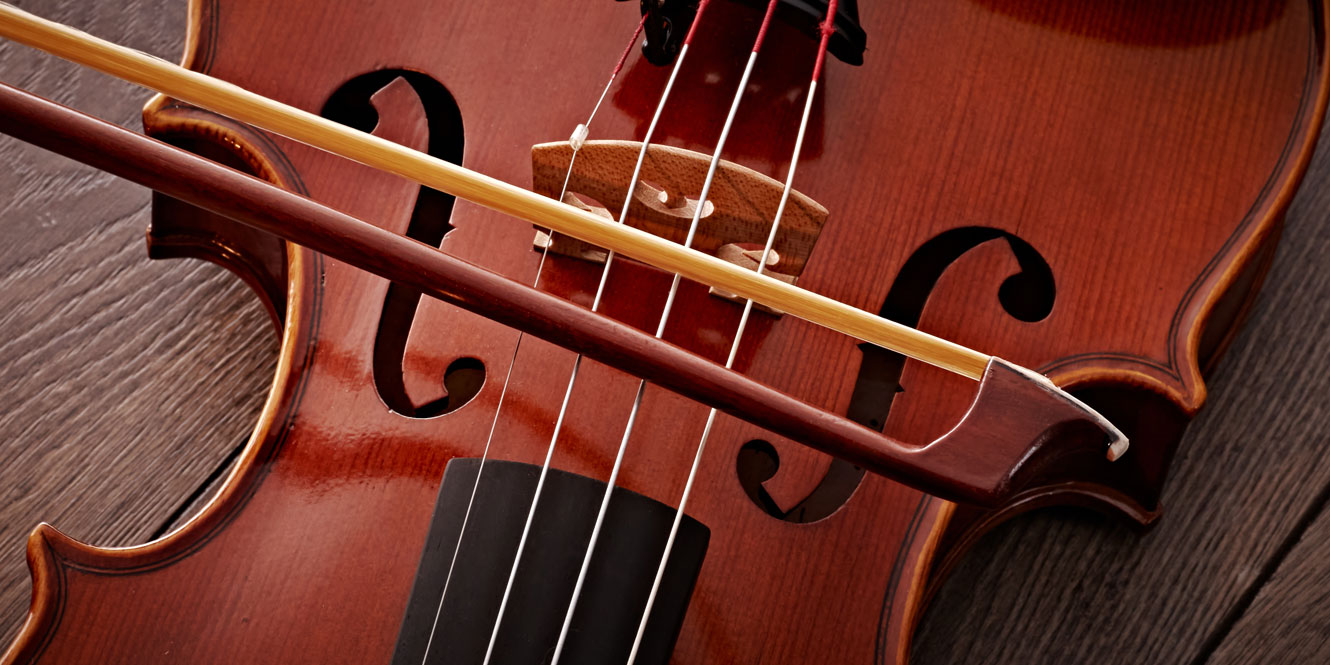

Have you ever wondered whether a carbon-fibre or wooden bow is better? The material of the bow you use for your string instrument is very influential — it can change how the bow responds and feels in your hand, so it’s worth knowing what your options are.
In this guide to bows for string instruments, we’ll break down how a bow is made, the differences between materials, and what to look for when choosing one. By the end, you’ll have a clearer idea of which type is right for you.

Key takeaways
- A bow’s stick, hair, frog, and other parts work together to provide a comfortable and balanced playing experience.
- Wooden bows offer a traditional feel, but their response can vary because of natural differences in grain and density.
- Synthetic bows provide greater consistency and resist changes in temperature and humidity.
- A well-made carbon-fibre bow can offer excellent response and control, although some players still prefer the individual feel of wood.
- Horsehair offers traditional grip and tonal response, while synthetic hair provides a consistent, animal-free alternative.
- The best bow depends on your playing style, experience, environment, and preferred feel.
The anatomy of a bow
To start, let’s run through the different parts of a bow. The stick forms its main body, giving you the precise balance needed to control your playing; the hair runs beneath the stick and, with the help of rosin, grips the strings to set them vibrating.
At the player’s end, the frog holds one end of the hair and provides a secure contact point for the bow hand. The winding and thumb grip help with comfort and balance, while the screw moves the frog backwards or forwards to adjust the hair tension. At the opposite end, the tip plate protects the bow’s head and helps secure the other end of the hair. These parts work together to give the bow its balance and control.

What are bows made of?
Wooden bows
Wooden bows have been used by string players for centuries, but not every type of wood gives you the same playing experience. Pernambuco is probably the most recognisable. It’s used for its combination of strength and elasticity, which allows the stick to flex while still responding quickly to your movements.
Another option is bulletwood, which is a dense tropical hardwood used for more accessible wooden bows. You may also see the broader term ‘brazilwood’, which can cover several woods used as alternatives to premium-grade Pernambuco.
So, why does the wood matter when you’re actually playing? Its density, stiffness, and flexibility all contribute to how the bow feels and responds, influencing how easily you can control changes in direction, articulation, and dynamics.
Balance is important, too. A bow that feels well balanced in your hand can make longer strokes easier to control and help with quicker techniques that rely on the bow responding naturally to the strings.
It’s also worth remembering that wood is a natural material, so no two pieces are exactly alike. Grain and density can vary between bows, meaning two made from the same type of wood may still feel slightly different when you play.
Synthetic bows
If you want a bow that’s super durable and consistent, a synthetic bow may suit you better. These kinds of bows are generally made using carbon fibre, fibreglass, or a combination. Each has slightly different characteristics.
Carbon fibre is particularly popular because it’s lightweight yet still has plenty of strength and stiffness. This helps with controlled changes in direction, articulation, and quicker bow strokes.
Fibreglass is another common material, particularly on more affordable bows. It tends to produce a slightly heavier, less responsive stick than carbon fibre, but its strength and predictable feel are great for learning and developing your bowing technique.
You may also come across bows that blend carbon fibre with other synthetic materials. These composites allow manufacturers to fine-tune characteristics such as weight, stiffness, and balance, giving the bow a particular feel and response.
The reason why synthetic bows are so consistent in design and manufacturing is that, unlike natural wood, they don’t have variations in grain or density, so bows can be manufactured with more uniform properties. They’re also less susceptible to changes in temperature and humidity, helping the stick maintain its shape and playing characteristics.
Which material should you choose?
Choosing between wood and synthetic materials largely comes down to how and where you play, as well as the response you prefer. At a high level, modern carbon-fibre bows can now offer comparable quality to wooden bows, so neither material is automatically the better choice.
If you prefer the traditional feel of wood, there are some great options, such as the H. Walter Zapf Pernambuco Violin Bow and Conrad Goetz Pernambuco Violin Bow, which are suited to players looking for high-quality but affordable Pernambuco bows that contain that perfect balance of qualities I mentioned before.
Synthetic bows are particularly useful if you regularly travel or gig outdoors. Carbon fibre resists changes in temperature and humidity better than wood, so professional players who prefer wooden bows may still take a synthetic bow abroad.
Earlier synthetic bows could struggle to match the acoustic response of wood because the epoxy resin within their construction dampened vibrations. Modern manufacturing can use much thinner resin layers, allowing high-quality carbon-fibre bows to offer a response much closer to wood.
If you’re looking for a higher-level carbon-fibre bow, the CodaBow Diamond NX and Musing L6 are options to explore. The P&H Carbon Fibre Violin Bow offers another great choice, and the Coruss Carbon Violin Bow combines carbon construction with synthetic hair for a fully vegan build.
For beginners, you don’t necessarily need to focus on premium materials straight away. An accessible bow such as the Violin Bow by Gear4music can help you build your technique before deciding which characteristics matter most to your playing.
Bow hair materials
The bow’s hair actually contacts the strings, so it is an essential element when considering how you want your instrument to feel and sound.
Bow hair is traditionally natural horsehair, since it has a naturally textured surface that holds rosin well. This ensures your bow has enough friction to set the strings vibrating. The quality and thickness of the hair are important, since they affect the grip and response. These aspects can make the bow easier or harder to control.
There are two types of natural bow hair: White and black. White hair is generally finer and is widely used for violin, viola, and cello bows. Black hair is usually coarser and offers a stronger grip, which can suit the heavier strings of a double bass. Some bass players use a ‘salt and pepper’ mixture to balance smoothness and grip.
The alternative to horsehair is synthetic bow hair. Synthetic fibres are less affected by changes in humidity and temperature, helping the hair maintain a more consistent response. Plus, it’s an option if you prefer an animal-free material.
Whichever material you choose, the quality of the rehair and the evenness of the hair ribbon matter enormously. A good stick with worn, stretched, or uneven hair won’t perform at its best.
The craftsmanship behind a bow
It takes a lot of hard work to make the bow the precision tool it is. For a traditional wooden bow, the maker begins with a suitable straight-grained piece of wood with the correct balance of strength and elasticity.
The wood is then carefully cut and tapered, with the maker working along the grain to form the bow’s profile. The stick starts out straight, so it still needs its familiar inward curve.
This curve, known as the camber, is shaped by gradually heating the stick over a flame until the wood becomes pliable. The bow maker then bends it by hand, carefully adjusting the curve to influence the bow’s flexibility and response.
Carbon-fibre bows take a very different route. Fine carbon filaments are formed into a fabric and combined with epoxy resin, creating a composite material that can be precisely shaped.
These layers are placed into moulds designed to form the bow stick before being cured using heat and pressure. The result is a strong, flexible stick with carefully controlled dimensions. You can see how the two bow materials require differing processes to shape them, but they are both in aid of the same goal.
FAQs
What do string players put on their bows?
String players put rosin on their bows to create friction between the bow hair and strings. This grip helps the strings vibrate and produce the clear tone we all love. You can learn more in our guide to rosin.
Is Pernambuco wood illegal?
Pernambuco wood is not illegal, but its international transportation is strictly regulated. It’s important to check what documents would be necessary when shipping Pernambuco bows abroad.
Is there a vegan bow for violin?
There are multiple options for vegan violin bows now, with Coruss bows being one of the best. They ensure all their bows are completely animal-free while still providing an exceptional playing experience.
Final thoughts
Ultimately, choosing between different bows for string instruments comes down to personal preference. Two seemingly identical bows may feel different to you due to subtle variance in the grain or manufacturing.
Your instrument and technique will influence what works best for you. Trying several bows is the easiest way to discover which combination feels most comfortable and responds naturally to your playing.


0 Comments