



So, you’ve made the brave decision to become the most important member of the band. Well done. Playing electric guitar will be one of the most fun and rewarding things you ever do in your life. As such, you’ll want to start out with the right gear. Choosing the best electric guitar for a beginner is no mean feat – you’ll need to look out for every aspect, from design quality to components.
There’s a world of choice out there when choosing your first electric guitar. Sometimes this can seem daunting, but that’s where I come in! With this handy guide, you’ll be able to get the perfect model with which to begin your journey and one which boasts plenty of quality features for the price.
You’re about to see a list of the best electric guitars for beginners! The reason these models have been picked is that they have something extra special – this could be pickups, smooth necks, or tremolo systems – compared to the plethora of other options. So, without further ado, let’s dive in!
Our top 3 picks
If you’re in a hurry, have a gander at our top three guitars from the list below! Together, they cover the range of genres and styles you might want to explore. Each one excels in a different area – but is also dynamic enough on its own to be used by virtually any beginner.
| LA Electric Guitar by Gear4music | The LA Electric Guitar by Gear4music is widely considered one of the best beginner guitars on the market due to its affordability and quality. With a comfortable neck, stylish design, and versatile pickups, it's an excellent choice for novice players looking for an instrument with a classic rock sound and modern features. | Check the current price |
| Squier Affinity Stratocaster MN | Get the full Fender experience in a beginner-friendly guitar with a beginner-friendly price tag. With three single-coil pickups, a 2-point synchronised tremolo bridge, and 21 frets, it's perfect for starting out on. | Check the current price |
| Yamaha Pacifica 112J | An incredible all-rounder with humbucking and single-coil pickups. Get meaty tones and sparkling twangs - this is the instrument for beginner guitarists who don't yet know which style they'll play. And there's a tremolo system for adding some vibrato to your chords. | Check the current price |
The best electric guitars for beginners
1. LA Electric Guitar by Gear4music
 Body Material: Paulownia
Neck Material: Maple
Scale Length: 25.5″
Pickups: 3 x Single Coil, White
Bridge: Vintage 6 Screw Bridge
Pros
- One of the most affordable electrics available
- Wealth of accessories included
- Tremolo system for vibrato
Cons
- Limited to single-coil tones
Coming in strong with the vintage look, this LA Electric is universally an excellent beginner guitar. In fact, it has a bunch of good reviews from the likes of Music Radar, Guitar and Bass Magazine, and Play Music Magazine.
Three single coils make up the sonic palette of this tone machine. They’ll deliver a sharp, crisp twang which is perfect for helping chords shimmer and lead lines to stand out. And with three, you’ll be able to experiment to your heart’s content. It’s one of the best beginner guitars for players on a tight budget, as it keeps up with its competition well.
It plays really well too! With a nicely carved maple neck and double cutaway shape, it allows you to sail up and down the fretboard with ease. Plus, it’s comfortable to hold, thanks to its incredibly light paulownia body.
And then there are the included accessories which come with every model – a gigbag, strap, picks, cable and more! This only ups the value for money further, making this model one of the most attractive options out there for any beginner.
2. Squier Affinity Stratocaster MN
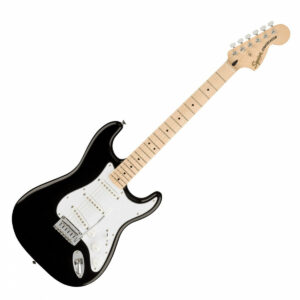 Body Material: Poplar
Neck Material: Maple
Scale Length: 25.5″
Pickups: 3 x Ceramic Single-Coil
Bridge: 2-Point Synchronised Tremolo with Block Saddles
Pros
- Feels like a genuine Fender
- Three pickups allow for a range of tonal options and dynamics
- Satin-finished neck feels really smooth
Cons
- Not the best for hard rock and metal
- Only has 21 frets
Squier guitars are often the go-to for beginners. This Squier Affinity Stratocaster is one of the best electrics for beginners because it offers the full Fender experience, staying true to the elements of a classic Fender Stratocaster.
Its trio of single-coil pickups are perfect for getting to grips with changing between pickup positions, as you’ll have five different combinations to play with! This lets you open up your guitar tone and really experiment with the different sounds this model has built-in.
It’s also incredibly well made for the price, meaning it’ll easily get you through your formative years as a guitar player!
With 21 frets, it may have slightly fewer than some of its counterparts. But, if we’re being honest, these missing frets are probably the ones most guitar players would use the least – you certainly won’t miss them (I find it really hard to fit my chubby fingers onto the 23rd and 24th frets at the best of times). And the excellent playability from the smooth, satin-urethane-finished maple neck more than makes up for it anyway.
Most Squiers are made in Indonesia, which is well known for producing midrange to high-end guitars. This, again, sets the Affinity apart from its competitors, many of which are made in China with slightly lower build standards and setups.
Some genres you might want to use this for range from pop and rock to blues. Anything heavier than that, and it might sound a little thin. That being said, it’s a great all-rounder and is guaranteed to kickstart your guitar journey in style.
The single coils produce a bright, twangy tone which is really good for making your chords sound crystal-clear. They’re also really dynamic – and with three, you’ll have lots of voicings to play with.
3. Yamaha Pacifica 112J
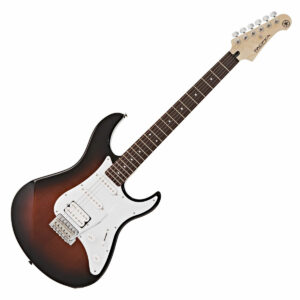 Body: Alder
Neck: Maple
Scale Length: 25.5″
Pickups: 1 x Ceramic Humbucker, 2 x Ceramic Single Coil
Bridge: Vintage Style Tremolo
Pros
- Has humbucker and single-coil pickups
- Tremolo system lets you use a whammy bar
- Great for all genres
Cons
- May detune with extensive whammy bar use
Sometimes, you don’t know what style or genre you want to play when you’re first starting out. You just want to play guitar! If that’s the case, the Yamaha Pacifica 112J will see you right.
This is another all-rounder which boasts the bragging rights of a humbucker and two single-coil pickups. You can access meaty, high-output tones and thinner single-coil twangs from the same guitar. Unlike the Squier Affinity, this opens the guitar up to almost all genres and styles, allowing you to go into the world of hard rock and metal should you wish.
At its core, the Pacifica 112J is a really comfortable guitar, with 22 frets and a deep cutaway for accessing those higher frets. This is great for learning some simple solos, and you’ll be hard pressed to find a more dynamic beginner instrument.
Not only will it take you through the very start of your journey, but also into the intermediate and even higher levels (although you’ll probably have upgraded to a more specialist guitar by then).
This is a great guitar for beginners who want to use a whammy bar too. The bridge features a tremolo system, which you can press down (with the bar) to add some vibrato (‘wobble’) to your riffs and chords.
It’s probably best to use the whammy bar sparsely, as it can lead to tuning issues if you’re bending and pulling like a maniac all the time (less so on a high-end guitar), but it can really add something special to your playing experience.
All in all, you’ll find this very enjoyable to play. Also made in Indonesia, the build quality is good straight out of the box, and it’s a very robust guitar for the price.
4. Squier Sonic Stratocaster HSS MN
 Body Material: Poplar
Neck Material: Maple
Scale Length: 25.5″
Pickups: 1 x Humbucker (Bridge), 2 x Single-Coil (Middle & Neck)
Bridge: 6-Saddle Vintage-Style Synchronized Tremolo
Pros
- Versatile HSS pickup configuration
- Bright, bold Tahitian Coral finish
- Lightweight poplar body
Cons
- Fewer finish options than some Squiers
- Tremolo use may affect tuning stability
If you want a beginner guitar that looks like summer and sounds fantastic, whatever style of playing you throw at it, the Squier Sonic Stratocaster HSS in Tahitian Coral is a brilliant pick. It has the iconic Stratocaster shape that’s been a staple on stages for decades, but with a modern twist, courtesy of its vibrant finish.
What really makes this guitar a great starter is the HSS pickup configuration – that’s a humbucker in the bridge and two single coils in the middle and neck positions. This gives you the best of both worlds: fat, powerful tones for rock and heavier styles from the humbucker, and bright, glassy single-coil sounds for pop, funk, and clean playing. A simple five-way switch makes it easy to explore all the combinations.
It’s built from lightweight poplar, so you won’t feel weighed down during long practice sessions or gigs, and the maple neck with a comfortable “C” shape profile makes chords and scales feel effortless under your fingers. The six-saddle vintage-style tremolo lets you add some vibrato to chords or riffs – just go easy at first, as heavy use can nudge the tuning.
All in all, the Sonic Strat HSS is a colourful, versatile, and confidence-boosting first electric guitar. Whether you’re learning your first riff or playing your first gig, it’ll have you covered for a wide range of genres while looking seriously cool doing it.
5. Epiphone SG Special P-90
 Body Material: Mahogany
Neck Material: Mahogany
Scale Length: 24.75”
Pickups: 2 x Epiphone P-90 PRO Soapbar
Bridge: Lightning Bar Compensated Wraparound
Pros
- Iconic design
- Versatile with 2 P-90 pickups, each individually controlled
- Comes with a gig bag
Cons
- One of the more expensive in the list
- Only available in Cherry Red
If you’re a fan of rock and heavy music, the Epiphone SG Special P-90 is a great place to start practising the attitude as well as the riffs! Inspired by the original 1960s Gibson model but without the hefty price tag, it combines a lightweight mahogany body, comfortable neck, and versatile pickups to give you plenty to work with as you develop your playing.
One of its biggest advantages for beginners is the neck, which has a relatively slim profile (called the ‘60s SlimTaper) that makes moving between chords and practising scales feel comfortable. The double-cutaway body also gives you easy access to the higher frets, which is particularly useful when you start learning solos.
Sound-wise, you’re getting two Epiphone P-90 PRO pickups, which deliver a distinctive combination of warmth, clarity, and punch. P-90 pickups are particularly well-suited to blues and rock, offering clean tones for practising chord progressions and a gritty sound when you add some overdrive.
It has a fixed bridge that keeps your setup simple, as well as good, solid tuners at the other end of the strings. This ensures your guitar stays in tune well and practice sessions aren’t a chore!
You also get a premium gig bag, which is handy for taking your guitar to lessons or rehearsals. Overall, it’s a comfortable, characterful instrument with enough versatility to keep you interested well beyond your first few months of playing. In fact, it’ll carry you through to the point of playing to other people – plenty of experienced musicians trust Epiphone.
Epiphone are owned by Gibson, one of the biggest names in the guitar world (Epiphone are to Gibson what Squier are to Fender). This SG offers a lot of the magic of Gibson’s original, and the quality is what you’d expect from a company that’s been making great guitars since the 1950s!
6. PRS SE CE24 Standard Stoptail
 Body Material: Mahogany
Neck Material: Maple
Scale Length: 25″
Pickups: 85/15 “S” (treble & bass)
Bridge: PRS stoptail with brass inserts
Pros
- A range of great colours to choose from
- Professional quality at a great price
- Coil-split option makes it very versatile
Cons
- More expensive than other beginner guitars
If you’re looking for your first electric guitar and want something that will keep up as your skills develop, the PRS SE CE24 Standard Stoptail is ideal. It combines comfortable playability, versatile electronics, and dependable hardware, giving you a solid foundation for learning.
The mahogany body produces a warm, resonant tone, while its shallow violin carve makes the guitar comfortable to hold. You’ll also find a bolt-on maple neck that’s wide enough across the fretboard that you won’t struggle to find the right string, and thin enough to be comfortable in your hand. In fact, it’s called the Wide Thin profile! It’s comfortable for practising scales, chords, and more.
With 24 frets and a 25-inch scale length, there’s plenty of room to develop your lead playing, too.
One of this guitar’s biggest strengths is its tonal versatility. The two PRS 85/15 “S” humbuckers deliver clear, full-bodied sounds that work particularly well for rock, blues, and heavier styles. But you’re not limited to humbucker tones. A push/pull tone control lets you split the pickup coils for a brighter, single-coil-style sound, giving you more opportunities to experiment as you discover your preferences.
Another beginner-friendly feature is the PRS stoptail bridge. Its fixed design helps to keep your tuning nice and stable and makes string changes relatively straightforward. It allows you to concentrate on improving your technique rather than adjusting your hardware!
There’s even an included gig bag for transporting your guitar to lessons and rehearsals. With its straightforward controls, comfortable neck, and flexible sound, the SE CE24 Standard Stoptail is a guitar you can confidently learn on and continue enjoying as you progress.
7. Ibanez GRX40 GIO
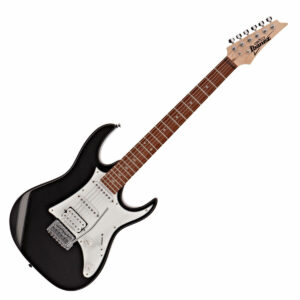 Body: Poplar
Neck: GRX Maple
Scale Length: 25.5″
Pickups: 1 x Infinity R Humbucker, 2 x Infinity RS Single Coils
Bridge: T106
Pros
- Includes humbucker and single-coil pickups
- Includes tremolo system
- Very affordable
Cons
- Frequent use of tremolo may detune strings
- Doesn’t fully show off Ibanez’s uniqueness
You may have heard the name Ibanez – especially if you’re a rocker or metalhead. This Japanese company is very well known in the guitar world, and their GRX40 GIO is symbolic of their quality guitar design even at the lower levels. This sleek, sharp six-string sports the classic Ibanez shape, with pointed horns for an extra ‘metal’ look.
Now, whilst most Ibanez guitars are geared towards rockers and metalheads, this one is a little more diverse, with an Infinity humbucker and Infinity single-coil pickups. These deliver a wide range of tones that will cover anything from metal to blues. Being an Ibanez, though, its sound is still more geared towards those who want to play the heavier genres – if you’re using distortion, you’ll love it.
Made from poplar, it’s a lightweight guitar, which takes a great strain off your shoulders when you’re playing standing up. It’s also got a handy tremolo system, which once again lets you add vibrato to your riffs and chords by pushing on the whammy bar.
Ibanez are known for their razor-thin necks, which are typically seen on their higher-end, prestige models. It facilitates really fast playing – or shredding. You’ll be pleased to know that this guitar sports a strong maple neck which, whilst not thin, still feels really smooth and easy to play.
All in all, the sharp aesthetics and powerful humbucker make this a great guitar for open-minded metalheads who want a few more options when it comes to exploring different genres.
8. Jackson JS11 JS-Series Dinky
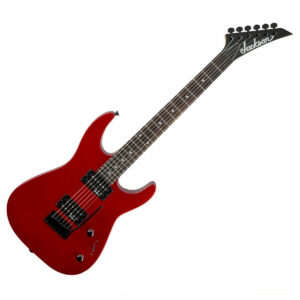 Body Material: Poplar
Neck Material: Maple
Scale Length: 25.5″
Pickups: 2 x Jackson High-Output Humbuckers
Bridge: 2-Point Fulcrum Tremolo
Pros
- One of the most affordable big brands
- Perfect for metal
- Fast-playing neck
Cons
- Body may feel a little large
- Not the best for non-metal genres
If you’re on a budget, or if you’re a rocker through and through, the Jackson JS11 could easily be the best guitar on the list. And I’m not saying that because I’m a biased metalhead.
The insanely low price tag belies this guitar’s immense quality. A pair of Jackson’s own high-output humbucking pickups deliver that output-rich, heavy tone which is essential to heavier genres – this thing roars like a dragon!
And it doesn’t look shabby either, with a regal finish exuding a high-end aesthetic. The body may be relatively thick, but it’s made from poplar, so it has a nice, lightweight feel. You’ll have no trouble handling it – and that goes for the neck as well. Finished in satin urethane – meaning it’s really smooth – sliding your hand down its surface really is a breeze.
Even the build quality is superb – the JS11 has been made to handle aggressive playing, so it can be thrown around a bit without trouble (although this is not advised!). It also has a tremolo system for adding vibrato. However, this may well detune the strings after some use, so it’s best to use it sparingly.
From AC/DC to Iron Maiden and Architects, this metal machine has been made to have technical, aggressive riffs hammered onto its fretboard. With 22 frets, there’s more than enough room to learn those blistering solos – although many metal guitars boast 24 frets. It’s unlikely you’ll miss those two extra tiny frets, though.
Jackson are owned by Fender, so you know you’re getting good build quality as standard. All in all, this one just feels immensely satisfying to play.
9. Jet Guitars JT-300 Roasted Maple
 Body Material: Basswood
Neck Material: Canadian Roasted Maple
Scale Length: 25.5″
Pickups: 2 x Ceramic Single-Coil
Bridge: Fixed
Pros
- Vintage look
- Beautiful roasted maple neck and fretboard
- Lightweight basswood body
Cons
- Only has single coils
- Could be noisy with gain turned up
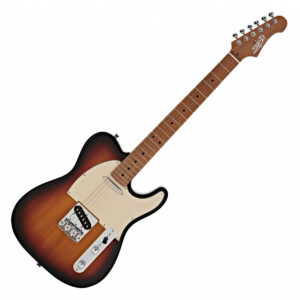
Another one for vintage lovers! This Jet JT-300 is shaped like a very iconic guitar from the past (wink wink). But, once again, the price tag is more than attractive. Build quality is great, with a sturdy fixed bridge for maintaining decent tuning stability.
The two ceramic single-coil pickups provide that vintage, twangy sound which is synonymous with the guitar tones of old (that’s not to say you can’t make modern music with them, though).
Ceramic magnets are some of the most powerful around, so even though these are single coils, they still pack enough of a punch for rock and blues. They probably won’t suit hard rock or metal and will sound noisy with lots of gain, but they still give this guitar a really dynamic tone.
One feature which really sets this guitar apart is the roasted maple neck and fretboard! The roast gives this normally light, bright wood a darker aesthetic, and you usually only find this on much pricier guitars. It also helps the wood resist moisture absorption, which can damage it over time.
The Modern ‘C’ shape of the neck allows it to fit into your hand with ease. This is one of the most dynamic neck shapes, suiting virtually any playing style. As such, you’ll be able to explore a plethora of styles with this workhorse of an instrument.
10. VISIONSTRING Electric Guitar Pack
 Body Material: Paulownia
Neck Material: Maple
Scale Length: 25.5″
Pickup: 1 x single-coil
Bridge: Fixed Chrome, Top Loader
Pros
- It’s a complete starter pack!
- Comfortable and lightweight, ideal for beginners
- Simple and uncomplicated setup
Cons
- Limited tonal versatility
- You may want to upgrade as you progress
If you’re just starting out on electric guitar, the VISIONSTRING Electric Guitar Pack gives you everything you need to get playing without having to buy all the bits and pieces separately. It’s an affordable, beginner-friendly package that keeps things simple, letting you concentrate on learning your first chords and riffs.
The guitar itself features a lightweight paulownia body, making it comfortable to hold during practice sessions. Its maple neck is shaped to a profile that’s designed to help you move between notes and form chords comfortably as you develop your finger strength.
You’ll also find a double-cutaway body with 21 frets, giving you easy access to the higher notes when you’re ready to start learning the fiddly bits. Handy fretboard markers help you find your way around the neck, too.
Sound-wise, the VISIONSTRING keeps things straightforward with a single bridge-position pickup and one volume control. This simple setup means there’s very little to get to grips with, while the included 10W amplifier lets you experiment with clean and distorted sounds using its gain, tone, and volume controls.
One of the biggest advantages, though, is the accessory bundle. Alongside the guitar and amplifier, you get a gig bag, strap, picks, cable, and headstock tuner, so there’s no need to worry about missing any essentials. Everything you need to start your journey as a guitarist is right there in the box.
For complete beginners, the VISIONSTRING is a practical starting point. Its comfortable design, uncomplicated controls, and included accessories make it easy to get stuck into learning without spending a fortune on your first setup. What more could a new guitarist want?
11. G4M 529 Standard Electric Guitar
 Body Material: Ash
Neck Material: Roasted Maple
Scale Length: 25.5″
Pickups: High-Output 529 Series Humbucker
Bridge: Two-Point Tremolo
Pros
- Comfortable to hold and play
- Two humbuckers offer powerful tones
- Modern, quality hardware
Cons
- Tremolo bridges can lead to tuning issues
- No tone control
The G4M 529 Standard gives you modern playability and plenty of room to develop your skills. Its comfortable design, powerful pickups, and practical hardware are particularly great for rock and metal.
One of its biggest strengths is the thin roasted maple neck, which features a smooth satin finish that helps your hand move freely along the fretboard. You’ll find 24 stainless steel frets, giving you a whole two-octave range on each string. Those frets also have rounded edges, making it comfortable to practise.
Plus, with an armrest, tummy cut, and generous cutaway, it’s designed to sit comfortably against you while providing easy access to the higher frets. The more comfortable it is, the longer you’ll want to practise!
Sound-wise, the G4M 529 features two high-output humbuckers that deliver a powerful, full-bodied tone, particularly suited to distorted riffs and lead playing – we said it’s good for rock and metal. A three-way pickup selector and single volume control keep things straightforward, so you can focus on developing your technique.
There’s also a two-point tremolo bridge, allowing you to experiment with vibrato and pitch effects as your confidence grows. Locking tuners help maintain tuning stability and make restringing easier, although the tremolo system may require some familiarisation.
And, with its distinctive Black Burl Burst finish, it certainly looks the part.
What to consider when buying an electric guitar
The style of music you’ll be playing
The music you’re most into and want to play should be one of the main factors in guiding your choice of guitar.
Whilst most electrics, as you’ll see from the above list, cater to a vast array of styles, there are still lots of smaller details which will tilt them towards specific genres. A guitar with two humbuckers, for instance, is undoubtedly geared towards rock and metal, whereas one with three single coils could be better for jazz and pop.
Give careful consideration to this, and also look at the types of guitars your favourite players are using for their music. This may give you the best place to start if you’re a total beginner guitarist. You may have fallen in love with the Fender Mustang shape because Kurt Cobain played it or the Gibson Les Paul from Matt Heafy’s thunderous playing in Trivium.
Generally, the styles of guitar that your heroes are playing will work well for you as well.
Guitar shape
The shape of a guitar mainly affects its aesthetic and feel. For many years, the two most iconic electric guitar shapes were the Fender Stratocaster and Gibson Les Paul – everyone recognises these. But now, there’s a vast array of guitar shapes available to you.
This gives you a lot of choice. If you can, it’s best to try out some different shapes in your local music shop and see which one you like the look and feel of. After all, you may find one more comfortable than the other or that another shape has better balance.
Nearly all electric guitars have at least a single ‘cutaway’ (and often a double cutaway) – a chunk cut out of the body which lets your hand reach the highest frets. Apart from that, the shapes can vary dramatically. You’ll also want to think about how body shape can affect the weight of a guitar – those which are thicker will inevitably be heavier – although the tonewood will also help to determine this.
Most importantly, pick a guitar shape which inspires you, one which makes you want to touch that guitar all over and give it a good strum on the regular!
Pickups
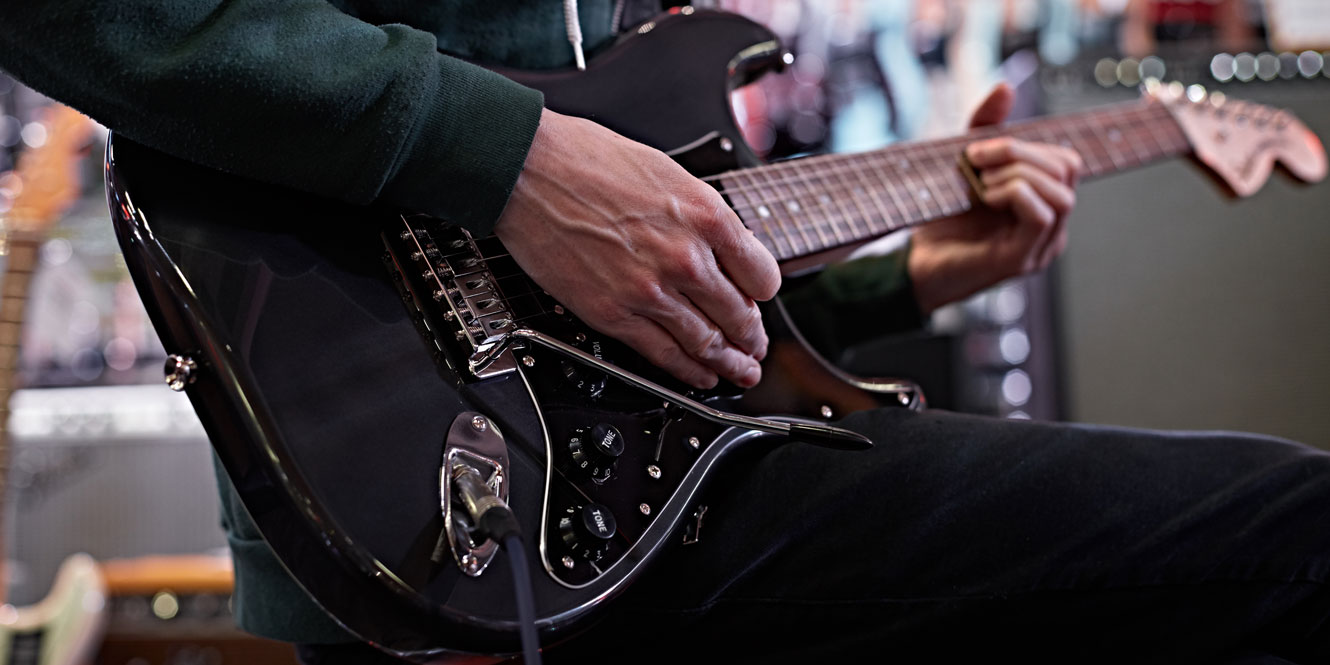
Pickups are arguably the most important part of any electric guitar. They’re the rectangular metal blocks that sit underneath the strings, and they’re always made from magnetic metal. Electric guitar strings are also made of magnetic metals. Do you see where this is going?
When you hit the strings, they pull on the magnetic field of the pickups – this is what generates the electric signal that makes electric guitars, well, electric! This signal then runs through your instrument cable and then into an amplifier, which then boosts it and adds volume. So, the ‘tone’ of your guitar – the way it sounds compared to other guitars – comes almost solely from the pickups themselves, not the wood, bridge, neck, or anything else.
Now, there are two main types of pickups:
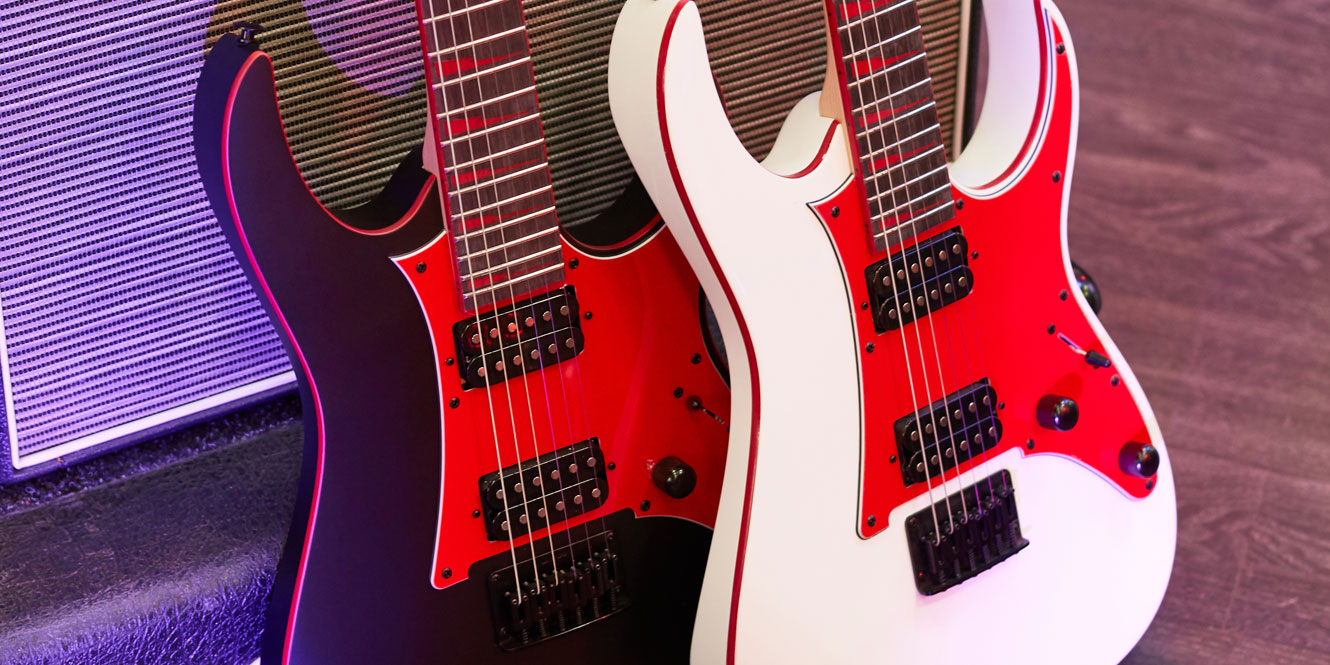
- Single coil: This looks like a single row of metal ‘dots’ all in a row. They have a bright, ‘twangy’ sound which won’t overpower any other instruments. Single coils have historically been prone to high noise levels, especially when the gain (distortion) is turned up, so it’s best to use these for lighter genres like blues, jazz, and pop.
- Humbucker: This looks the same as a single coil, but doubled in width. In fact, most of these look like two single coils stuck together, because that’s sort of what they are. Unlike single coils, humbuckers don’t produce any unwanted hum – they cancel it out. This makes them very ‘clean’-sounding. But, ironically, they’re usually used for ‘dirtier’ genres like metal because of their higher output – they produce a more powerful sound.
Pickups should absolutely be one of your primary considerations when choosing your first electric guitar. Remember: single coils for lighter genres, humbuckers for heavier, and a mixture of both if you want to explore numerous genres.
Hardware
The bridge, pickups, tuners, and nut are some of the main pieces of hardware on an electric guitar. They hold a guitar together and help it do its job. The tuners and bridge, for example, hold your strings in place and help them stay in tune whilst you play. On beginner guitars, especially those with lower build quality, the hardware can be a bit shaky, which can lead to regular tuning, noise, and playability issues.
That’s why it’s important to research the guitars you’re looking at (by reading articles like this, well done you), and even try them out if possible. There are plenty of forums in which people regale their experiences with certain guitars, as well as official reviews.
The perfect beginner electric guitar will have sturdy hardware which helps it perform at its best. Your tuning should stay fairly regular, and your sustain (how long your notes ring out for) should be fairly long. Whilst construction standards nowadays are much better compared to 30 years ago, you may still find the odd guitar which has sharp fret edges, poor intonation, or flimsy tuning machines.
Brands
The age-old question – which brands are best? Once again, this mostly depends on which genres and styles you’ll be playing as a beginner electric guitarist. If you’re after a good all-rounder, Fender Squiers are always a good bet. If you know you want to explore rock and metal, then Ibanez could well be the way to go.
If you’re looking for a more midrange guitar from the get-go, PRS are a great place to start, or go for a Jackson or Epiphone for more metal-focused guitars. You really can’t go wrong with any of these, but always remember that different brands often cater to different players.
Squier, for example, cater mainly towards those who want to explore rock, blues, and pop – they tend to be really versatile. Ibanez, on the other hand, are unashamedly geared towards metal, although they do have more versatile models too.
All brands will have their own little stylistic quirks which help them stand out from each other, so look out for these too!

How do I learn guitar?
You can learn guitar in many different ways, and all guitarists follow a different path. Here’s a list of some of the most popular ways to learn.
Private lessons
Private lessons are the most obvious place to start. Finding a guitar teacher who knows what they’re doing is the most effective and fastest way to learn guitar.
They’ll be able to show you exercises and guide you through your journey to masterdom. This personal guidance is incredibly valuable and something the other methods lack, but, of course, this is the most expensive option as well. Remember that you can find guitar tutors online too!
YouTube
Something many guitarists these days say is “I was taught by YouTube” (myself included). YouTube is completely free and there are tonnes of incredible videos from experienced guitarists to help you learn.
Just take a look at Justin Sandercoe’s Finger Gym, an absolutely essential exercise which will help any beginner improve immediately. And there are plenty of videos for intermediate and advanced players too, so you can continue to learn forevermore.
Books/DVDs
Old-fashioned but not irrelevant, guitar books and DVDs can go a long way in helping you master the instrument.
They tend to contain useful practice patterns and licks which are easy to follow, and some will, once again, be geared towards different genres. These will give you more of a roadmap to guide yourself through guitar playing compared to YouTube videos, where you have to find all the materials yourself.
Websites/tabs
There are plenty of websites out there which have tonnes of resources on guitar for beginners, from online causes to sites that offer guitar tabs, which are invaluable to beginners. Tabs, or tablatures, are guitar riffs written down fret-by-fret and are how the majority of beginners learn riffs. Websites like Ultimate Guitar are the go-to (it also provides courses and lessons).
There’s no age limit!
You’re never too old to start learning guitar. Never. Whether you’re starting at nursery or picking it up for the first time in a nursing home – there’s only one thing you need to remember: start slowly.
Don’t rush the lessons, don’t rush your practice. Never try to run before you can walk. Take it one step at a time, set small goals (such as learning a particular part of a song), and focus on learning what you love. This will help you stay motivated and make big steps towards success. Believe in yourself; if others can do it, so can you!
FAQs
What brand of electric guitar is best for beginners?
There are a number of different brands which are suited to beginners:
- Squier: More affordable Fenders
- Ibanez: Guitars for metalheads
- Yamaha: Great all-rounders with superb build qualities
- Epiphone: Gibson’s budget-friendly range which still packs loads of quality
Which electric guitar is easiest to play?
The easiest electric guitar to play is any 3/4 size model. They have a shorter scale length, which makes the spacing between the frets smaller, and thus each fret is easier to reach. They’re also easier to handle due to their smaller size, which makes them well-suited to smaller players and children.
How do I choose an electric guitar for beginners?
There are some key considerations to make when choosing an electric guitar for beginners:
- Genre: Which type of music are you wanting to play with your guitar?
- Pickups: Single coils for a lighter sound, humbuckers for heavy tones.
- Price: What can you feasibly afford.
- Look: Will this guitar inspire you?
Final thoughts
If you’ve made it this far, hopefully you can see why these are some of the best electric guitars for beginners. From elite pickups to additional features (like tremolo systems), each of the 11 models on this list offers something which makes it stand out from the crowd.
Remember that, ultimately, the choice is down to you. Most importantly, you should pick a guitar which inspires you and makes you want to continue learning. Whether this is down to the pickup tone, playability, or aesthetics – there’s no wrong answer when deciding.
Here we are, at the end of the article. I’m not crying, I just chopped some onions. And played a really emotional riff.
Now, go forth into the world of guitar, and melt some faces.


0 Comments