


Looking for an affordable PA system to get you up and running?
There’s a lot of solid kit out there these days. Some are simple, all-in-one setups you can plug in and forget about. Others give you a bit more control, which is handy if you’re planning to play gigs or expand your setup over time.
It really comes down to how you’re using it. A busker won’t need the same thing as a duo playing pubs will, and a quick speech setup is different again. But the good news is you don’t need to spend a fortune to get something reliable that sounds decent.
In this guide, we’ll run through some of the best budget PA systems and where each one actually makes sense. Let’s get into it.

In a hurry?
If you can’t stick around, here’s a short list and a quick explainer for you:
| SubZero SZPA-815 | Best for: Beginners, bands, all-in-one setups Why it stands out: This full bundle with 8-channel mixer, mics, stands, and cables covers everything in one go with enough inputs for group use | Check the current price |
| LD Systems MAUI 5 | Best for: Solo performers, duos, small venues Why it stands out: It's a compact column system with wide, even sound coverage. Quick to set up and easy to transport. | Check the current price |
| JBL EON ONE Compact | Best for: Portable gigs, higher-quality setups Why it stands out: This PA system delivers refined sound with strong output for its size, flexible inputs, and battery-powered convenience. | Check the current price |
Why we’ve chosen these PA systems
First things first, we’ve kept all the options on this list under £700. But there’s still a lot of choice within this budget. So, we’ve picked a proper spread. Some are simple, affordable setups that are ideal if you just want something easy to get started with. Others step things up a bit, with better sound and more control, holding up in small gigs and regular use.
Everything here is still beginner-friendly, but none of it feels like a dead end. You can learn on these, use them in different settings, and not feel like you need to replace them straight away.
We’ve also mixed in different types of systems. That includes full bundles, compact column setups, and battery-powered options. It’s less about one being “better” and more about what fits how you’ll actually use it.
The best budget PA systems
1. SubZero SZPA-815 300W 15″ PA System with Microphones and Stands
 Key features
- 15″ passive speakers with a powered 8-channel mixer
- Bluetooth, USB playback, and built-in digital delay
- Includes microphones, speaker stands, and cables
Pros
- Proper all-in-one package
- Plenty of inputs for a beginner setup
- Good fit for small gigs and events
Cons
- Bulkier than more compact systems
The SubZero SZPA-815 is a proper starter rig that gives you everything in one go. You’re getting the speakers, an eight-channel powered mixer, microphones, stands, and cables, so there’s no need to piece a system together.
Having eight channels means there are enough inputs for multiple microphones, instruments, and a backing track source all at once, which gives you room to grow into it rather than outgrowing it straight away.
The mixer is really simple, but it gives you enough connectivity for a multitude of different uses, and allows you to connect and mic up a small band with eight mic preamps and additional stereo functions. There’s Bluetooth and USB playback for music, RCA input for external sources, built-in digital delay, and EQ control to shape your sound. It’s all laid out in a way that’s easy to get your head around.
In terms of use, it’s well-suited to bands, small gigs, rehearsal spaces, pub sets, and events where you need to manage a few different sources. You’ve got enough power and flexibility for group setups, not just solo use.
It is on the larger side, so it’s not the one you’d pick for regular carrying over long distances. But if you want something reliable that covers vocals, instruments, and playback in one system, it more than does the job.
2. LD Systems MAUI 5 Column PA System
 Key features
- Compact column PA with subwoofer and array
- Wide sound dispersion with slim design
- Simple setup with minimal cabling
Pros
- Very clean, room-filling sound
- Compact and easy to transport
- Wide coverage without needing multiple speakers
Cons
- Not as flexible for multiple inputs as mixer-based systems
The LD Systems MAUI 5 takes a compact column-style approach to portable PA systems, built around even sound coverage and quick setup. Column systems work a bit differently from traditional speakers. Instead of one box on a stand, the system is a vertical array that spreads sound more evenly across a room, so people at the front and sides hear a more consistent mix.
This is one of the smaller column systems, so it’s geared towards portability and ease of use. The subwoofer acts as the base, and the column sections slot in above it, which keeps the setup quick and tidy with minimal cabling.
The MAUI 5’s sound is smooth and balanced. Vocals sit clearly, and the low end is controlled rather than overpowering – perfect for smaller venues where you want coverage without having to think too much about speaker placement.
Input options are more limited than a full mixer setup, so it’s better suited to simpler rigs. Think solo performers, acoustic duos, or light backing tracks rather than full band use.
If you want something that’s easy to carry, quick to set up, and fills a room evenly without much effort, this kind of system makes a lot of sense.
3. JBL EON ONE Compact All-In-One Portable PA Speaker
 Key features
- Battery-powered PA with built-in four-channel mixer
- Bluetooth audio streaming and app control
- Compact design with professional-grade sound
Pros
- Strong, clear sound for its size
- More inputs than most portable systems
- Feels more “pro” than entry-level options
Cons
- More expensive than simpler alternatives
A strong contender for the top portable PA speaker, the JBL EON ONE Compact sits closer to the higher end of this category. It’s still easy to carry and quick to set up, but it feels more complete than a lot of similar systems.
You’ve got a four-channel mixer built in, and the physical inputs are where this stands out. There are two XLR/TRS combo inputs for microphones or instruments, a dedicated 6.3mm hi-Z input for guitars, and a 3.5mm aux input for devices like phones or laptops. On top of that, you’ve got Bluetooth for wireless playback, so it covers most setups without needing extra gear.
That flexibility makes a difference in real use. You can run vocals, guitar, and backing tracks all at once, or adapt it easily depending on what you’re plugging in.
This is a really good unit in terms of sound. It delivers a surprisingly powerful output for a speaker this size, with more low-end and headroom than you might expect. It holds up well in small gigs and busking setups where you need something compact but capable.
Battery power keeps it flexible, so it works just as well outdoors as it does in smaller venues. It’s still a single-speaker setup, but it covers more ground than most in this category.
It does sit at the higher end of the budget range, but you’re getting a more polished system in return. If you want something portable that still feels capable in more demanding situations, this is a strong option.
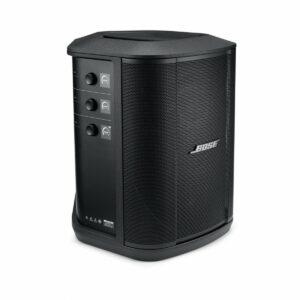
4. Bose S1 Pro+ Multi-Position Battery-Powered PA System
 Key features
- Battery-powered portable PA
- 3-channel mixer with ToneMatch processing
- Multi-position design with built-in sensors
Pros
- Extremely portable and easy to carry
- Battery use makes it ideal for busking or outdoor use
- Clear, balanced sound for vocals and acoustic instruments
Cons
- Price is higher than similar-sized systems
A pioneering design in the world of portable PA, the Bose S1 Pro+ is built around simplicity and flexibility. It’s the kind of system you can carry in one hand, set down, and be up and running in minutes.
There’s a three-channel mixer on the back, which is enough for a typical solo or duo setup. That could be a vocal mic, an instrument, and a backing track via Bluetooth. Each channel has its own level control, and Bose’s ToneMatch processing helps shape the sound automatically depending on what you plug in.
Sound-wise, it’s clean and well-balanced, especially for vocals and acoustic instruments. It doesn’t try to do too much, but what it does, it does properly.
The only downside is that it’s on the pricier side for what you get in terms of inputs and power. But part of that comes down to build quality and the wider Bose ecosystem. If you decide to expand later, it pairs neatly with Bose wireless accessories and subwoofers, so you can build a more complete setup over time.
Plus, the multi-position design with Auto EQ is genuinely useful. You can tilt it back, stand it upright, or use it as a monitor, and it adjusts the sound to match.
It’s not the one for full band setups, but for solo performers, busking, and portable use, it’s a very easy system to rely on.
5. Yamaha Stagepas 400BT Portable PA System
 Key features
- 400W stereo PA with detachable powered mixer
- 8-channel mixer with EQ and built-in effects
- Bluetooth audio streaming
Pros
- Very reliable all-round system
- Plenty of inputs for small bands
- Clear, balanced sound with usable effects
Cons
- Requires mains power
A classic Yamaha design, the Stagepas 400BT uses a modular setup that’s easy to understand and work with. It’s a system that’s been around for a while, but still holds up well against more modern options.
Two passive speakers deliver a clean, controlled tone, and there’s enough headroom for small venues, pubs, and events without it feeling strained. A detachable powered mixer is also included.
You’ve got eight channels to work with, which gives you enough flexibility for a small band, a duo, or a more involved setup with multiple mics and instruments. And there’s built-in reverb and EQ, so you can shape your sound without needing extra gear.
Bluetooth is a useful addition here, too. It makes playing backing tracks or music between sets straightforward, without needing extra cables or devices.
It does need mains power, so it’s not one for busking or off-grid use. But if you’re playing regular gigs or rehearsals and want something that can handle a full setup without fuss, this is a really solid choice.
6. Mackie Showbox Battery-Powered PA Speaker With Mixer
 Key features
- Battery-powered PA with built-in multi-channel mixer
- Detachable mixer control panel
- Multiple inputs for mics, instruments, and playback
Pros
- Very flexible for solo performers and small setups
- Battery-powered for portable use
- More control than most compact systems
Cons
- Not as powerful as larger, mains-powered rigs
A newer take on the all-in-one portable PA, the Mackie Showbox is built to give you more control without making things too complex. It sits somewhere between a simple busking amp and a more complete PA setup.
One of the best features is the detachable mixer control panel. Thanks to this, you won’t be stuck adjusting everything on the back of the speaker; you can take the control section off and have it on a stand or nearby, which makes it much easier to tweak levels while you’re performing.
You’ve got multiple inputs to work with, so running vocals, instruments, and backing tracks at the same time is pretty straightforward. It’s a step up from the usual two- or three-channel systems, which makes it more usable as your setup grows.
Being battery-powered keeps it flexible. It works well for busking, outdoor sets, and smaller gigs. At the same time, it still feels structured enough for more organised setups.
It also ties into Mackie’s wider ecosystem. If you want to build it out later, you can pair it with the Mackie Sub Go for more low-end, which gives you a bit more depth without changing your whole setup.
Sound-wise, it’s clear and focused, with enough volume for small crowds and intimate venues. It’s not designed for larger rooms, but that’s not really what it’s aiming for.
7. Hartwood Portable Singer-Songwriter PA System with Bluetooth
 Key features
- Compact PA designed for vocals and acoustic instruments
- Built-in mixer with Bluetooth connectivity
- Lightweight, portable design
Pros
- Simple and focused for solo performers
- Easy to carry and quick to set up
- Good value for a dedicated singer-songwriter setup
Cons
- Limited headroom for larger spaces
The Hartwood Portable Singer-Songwriter PA is very much aimed at acoustic players who want a clean, hassle-free setup.
If you’re a solo act or part of a duo, you probably typically only work with a mic input and an instrument input. Vocals and guitar are covered in this system without needing anything extra. Bluetooth also gives you an easy way to bring in backing tracks or interval music.
The mixer side is kept simple, but it still gives you control where you need it. You can adjust levels, shape your sound with basic EQ, and get everything balanced quickly.
Better still, it’s light enough to carry easily, and setup is quick, so it suits open mics, café gigs, busking, and smaller venues where you don’t want to spend time setting up gear. Don’t expect it to push into larger rooms or handle a full band – that’s not what it’s designed for.
If your setup is just you or you and one other, and you want something that works without fuss, this is a really practical option.
8. Alto Professional Busker Portable Battery-Powered PA Speaker
 Key features
- Battery-powered PA with built-in mixer
- Multiple input channels with Bluetooth streaming
- Lightweight design with carry handle
Pros
- Designed specifically for busking and street performance
- Good balance of portability and control
- Louder and fuller than smaller portable units
Cons
- Not the loudest or clearest
Busking is in the name, so you can guess what this is built for. The Alto Professional Busker is aimed at quick, simple setups where portability matters just as much as sound.
It’s quite similar to a few other systems on this list, but this one leans more towards the entry-level side. It’s more compact, easier to carry, and keeps things stripped back so you can get set up without overthinking it.
You’ve still got enough to work with. A couple of input channels let you run vocals and an instrument, and Bluetooth covers backing tracks if you need them. You also get built-in effects like reverb, which helps add a bit of space to vocals and stops things from sounding too dry, especially in outdoor settings.
The smaller size does mean less power and low-end compared to bigger systems, so it’s best suited to quieter spots, smaller crowds, or environments. It’s not designed to push sound across a busy street or large space.
If you want something lightweight, affordable, and easy to get going with, this is a solid starting point. It keeps things simple and does exactly what it needs to.
9. Behringer B1C Battery-Powered Portable PA System
 Key features
- Battery-powered PA with built-in mixer
- 3-channel digital mixer with Bluetooth
- Lightweight design with app control
Pros
- Very affordable for what it is
- Easy to carry and quick to set up
- App control adds some flexibility
Cons
- Doesn’t stand out compared to similar systems
If you want something incredibly affordable and straightforward to use, the Behringer B1C is ideal. It doesn’t try to go beyond its price point – but that’s fine, as you get a three-channel mixer built in, so you can run a mic, an instrument, or a second mic, and Bluetooth for backing tracks. It’s a familiar setup, and it works, but it doesn’t really offer anything you won’t find elsewhere on this list.
The app control is a nice touch, letting you adjust levels and settings from your phone rather than reaching around the unit. It adds a bit of convenience, especially if the speaker isn’t right next to you.
This is really about keeping things affordable. If you just need something portable that works and don’t want to spend much, it makes sense. But if you’re looking for something with more character or flexibility, there are better options in a similar space.
How to choose the best PA system for you
Choosing a PA system comes down to how you actually plan to use it. The same setup won’t suit everyone, so think through your typical use before deciding. I’ve listed a few scenarios and setups that you might find yourself relating to:
Solo performers and singer-songwriters
If you’re playing solo, your setup is usually simple: one vocal mic, one instrument, maybe some backing tracks.
You don’t need loads of channels here. A two- to four-channel system is plenty, as long as it has the right inputs. Look for:
- XLR for vocals
- Jack input for guitar or instrument
- Bluetooth or aux for backing tracks
Portability matters more in this case. Smaller, battery-powered systems make life easier, especially for open mics, small gigs, or busking. You’re trading raw power for convenience, but in most small spaces, that’s a fair trade.
Duos and small acoustic acts
Once you add another person, things change slightly. You’ll likely need:
- Two vocal mics
- One or two instruments
- Possibly backing tracks
This is where having a few extra channels helps. A four- to six-channel system gives you enough flexibility without overcomplicating things.
You’ll also benefit from a bit more power and spread. Column systems work well here because they fill the room evenly without needing much setup. Alternatively, a compact speaker and mixer setup gives you more control if you want to shape your sound.
Bands and more involved setups
For bands, you need more than just volume. You need control.
That means:
- Multiple XLR inputs for vocals
- Line inputs for instruments or DI boxes
- Enough channels to handle everything at once
This is where systems with proper mixers come into their own. An eight-channel setup, like the Stagepas or SubZero system, gives you room to run vocals, instruments, and playback together.
You’ll also need more headroom. Even in small venues, a band pushes more sound, so a more powerful, mains-powered system makes sense here.
Busking and outdoor use
Playing outside changes things completely. You lose the natural reflections of a room, so sound doesn’t carry as easily.
Battery power is essential here. You don’t want to rely on finding a plug socket. Look for:
- Good battery life
- Enough volume to project in an open space
- Simple setup
Portability is key, too. If you’re moving between spots, weight and size matter just as much as sound.
Events, speeches, and general use
If you’re using a PA for speech, presentations, or events, clarity is more important than power.
You’ll likely need:
- One or two microphone inputs
- Simple controls
- Reliable, consistent sound
In this case, ease of use matters more than flexibility. An all-in-one system that sets up quickly and just works is usually the best fit.
Inputs and connectivity
It’s always worth checking what you can actually plug in. The most common ones are:
- XLR for microphones
- 3mm jack for instruments or line-level gear
- 5mm aux for phones and laptops
- Bluetooth for wireless playback
If you’re planning to expand later, having a couple of spare inputs makes a difference.
Portability vs. power
There’s always a trade-off here.
Smaller, battery-powered systems are easier to carry and quicker to set up.
Larger, mains-powered systems give you more volume and control.
Neither is better. It just depends on whether you prioritise convenience or performance.
Thinking ahead
It’s easy to buy what you need right now, but it’s worth thinking a step ahead.
If you’re likely to add another mic, play bigger venues, or expand your setup, choosing something with a bit of extra capacity can save you from upgrading too soon.
FAQs
What does “PA system” stand for?
A PA system stands for “public address system”, which is designed to amplify sound so it can be heard clearly by a group of people, whether that’s for music, speech, or events in small venues, outdoor spaces, or larger rooms.
What are some common PA system problems?
Common PA system problems include feedback, poor sound balance, not enough volume, and incorrect setup, which are often caused by microphone placement, gain levels, or using a system that isn’t suited to the size of the space.
What should you look for when buying a PA system?
When buying a PA system, you should look at input types, number of channels, power, portability, and how you’ll use it, making sure it fits your setup now while giving you enough flexibility for future use.
Signing off
So, we’ve covered the best budget PA systems for getting started, from simple all-in-one bundles to more flexible setups and portable, battery-powered options.
Some are built for quick, no-fuss use, while others give you more control and room to grow. It all comes down to how you play, what you’re connecting, and where you’re using it.
Pick something that fits your setup, and you’ll be in a good place from the start.
If you found this useful, have a browse of the rest of our blog, where you can find more guides, tips, and advice to help you get the most out of your gear.


0 Comments