

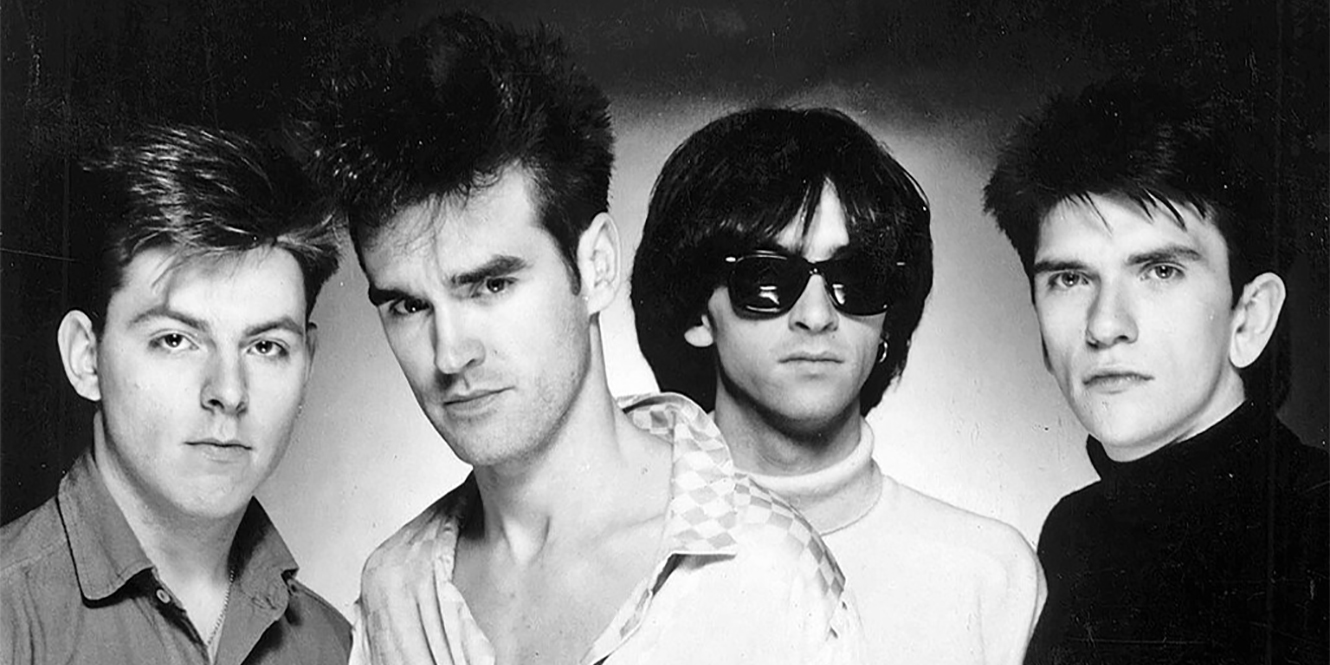

Featured image: Creative Commons License by Paul Cox; distributed by Sire Records
When people talk about the musical legacy of The Smiths, the conversation is usually about Morrissey and Marr… but not one of those iconic records would have sounded right without the impeccable basslines of Andy Rourke providing a foundation for, and counterpoint to, Marr’s guitar. The Smiths’ bassist played a key role in shaping their sound.
And that leaves us with the question of exactly how he got the sound that supported The Smiths’ finest tunes. His playing is clearly the most important factor, but his gear also played an essential role. So, here’s our rundown of Andy Rourke’s bass setup.

In a hurry?
| Gear Type | Model |
|---|---|
| Bass guitar | Guild B-301 |
| Squier Precision Bass | |
| Yamaha BB2000 | |
| Fender Precision Bass | |
| Fender Jazz Bass | |
| Amp | Peavey Mark III bass head |
| Trace Elliot GP-11 | |
| Effect | Boss CE-2 chorus |
| Boss GE-10 equalizer | |
| Boss flanger |
Andy Rourke’s basses
Guild B-301
Way back in the beginning, in early 1983, Andy Rourke played a Guild B-301. It’s a lovely, simple bass with a bright, punchy sound that lent itself beautifully to his playing style. In fact, with a single pickup close to the bridge, it may well have helped shape the way Rourke played as he chased that lively tone! It was used both for early recordings and gigging.
By spring of 1983, however, he’d moved on. First to an Antoria Precision Bass copy, before quickly progressing to the real thing. Well, nearly.
Squier Precision Bass
Moving on from his P-Bass copy, Rourke got himself a Squier. It’s a little unclear whether he used a variety of Squier P-Basses or simply enjoyed modifying the one he had. Either way, the Squier he started playing at gigs in July 1983 was the starting point of a love affair with the feel and sound of the Precision Bass.
The video for “This Charming Man” sees Rourke playing a black Squier P-Bass with a black scratch plate and maple fretboard. This remained his main bass for the rest of 1983 and into 1984. He also played a similar Squier, albeit with a rosewood board, on Top of the Pops in June 1984.
Yamaha BB2000
Stepping away from the P-bass for a moment – don’t worry, we’ll get back to it shortly! – Rourke also had a Yamaha BB2000 for what he called “the funky stuff.” The fantastic line that makes “Barbarism Begins at Home” so good? That’s the Yamaha.
As well as recording with it, Rourke took the Yamaha on tour from 1984 onwards, using it for a single song (“Meat is Murder”) at each show on the 1985 Spanish tour. It also went on The Smiths’ Scottish tour the same year. As late as April 1987, just months before The Smiths came to an end, Rourke used the Yamaha on a live performance for The Tube.
Fender Precision Bass
This is the big one, Rourke’s main love, the bass he used more than any other, the first true electric bass guitar ever made: the Fender Precision Bass.
His main Precision was a 1964 model bought at Manny’s Music in New York after the band signed with Sire:
“I picked out this old beat-up bass because its label said 1964 – same year I was born. It has a really warm sound. When you crank it, it has a good growl that I don’t think you can get from any other bass.” – Andy Rourke.
But that’s not the whole P-Bass story. Rourke also had a 1962 Fiesta Red model and an Olympic white ’66. These three Precision Basses were used for the vast majority of recording and touring throughout 1984 to 1986, and into the early part of 1987.
Following the ending of The Smiths, Rourke used P-basses regularly for session and live work.
Fender Jazz Bass
Clearly a devotee of Fender basses, Rourke moved from his trusty Precision to a Jazz Bass with a sunburst finish that was used for TV appearances early in 1987. In fact, it was the last bass that Rourke used in The Smiths. As with his Fender Precision basses, he went on to use Jazz Basses for session work and live performances after The Smiths.

Creative Commons License by Vladimir
Amps of choice
Peavey Mark III bass head
Early on, Andy Rourke used a Peavey Mark III bass head. The Mark III is a punchy, aggressive-sounding amp with a strong midrange presence, ideal for melodic basslines that need to cut through a mix.
To emphasise this midrange, Rourke ran the head through an OHM 4×10 cabinet, as well as a 1×15 that gave him the bass thump he needed live. It’s a popular bass cab setup, and it was one he used throughout his career.
Trace Elliott GP-11
As the band toured and recorded, Rourke moved from the Peavey to a Trace Elliott GP-11. The GP-11 name refers to the amp’s Graphic Preamp with an 11-band EQ, something that set the amp apart and made it extremely versatile. It seems very likely that this was a big part of what led to Rourke making the switch.
Again, he ran it through the classic 4×10 and 1×15 pairing, though he chose to use matching Trace Elliott cabs with the GP-11.
Andy Rourke’s effects
Boss CE-2 chorus
The bass underpinned the achingly atmospheric and swirling textures of The Smiths’ work, and careful use of chorus helped to widen the bass sound on tracks like “This Charming Man” and “Barbarism Begins at Home”. While Rourke never went overboard with effects, the subtle use of chorus helped create that full, lush sound we associate with The Smiths.
Boss GE-10 equalizer
As a bassist with a very clear idea of how he wanted his instrument to sound, Rourke made use of a Boss GE-10 equalizer. This 10-band EQ pedal was primarily part of his touring rig, helping to ensure he was able to recreate his recorded sound live.

Creative Commons License by Paul Cox; distributed by Sire Records
FAQs
What bass did Andy Rourke use?
Andy Rourke used several basses throughout his career, but his main instrument was a 1964 Fender Precision Bass. Prior to that, he used a Squier Precision bass and an Antoria copy of the same instrument. In later years, he also used a Fender Jazz Bass.
How did Andy Rourke tune his bass?
Andy Rourke tuned his bass up a full step to F# for early recordings, moving to standard tuning (E-A-D-G) for later albums. He also used drop-D for some songs. He used lighter gauge strings for the higher tuning to reduce tension. On later tours, he kept a bass tuned to F# for older songs.
Did Andy Rourke use a pick?
Andy Rourke regularly used a pick, playing close to the bridge of his bass. This enabled him to get a very bright tone that suited his playing style and basslines. That bright bass tone, combined with his choice of gear, produced his instantly recognisable sound.
Final thoughts
As always, the key to a player’s sound is the way they play… but getting the gear right can get you well on the way. Hopefully our guide to Andy Rourke’s bass setup has given you some insight and perhaps some inspiration!


0 Comments