



Featured image: Creative Commons License by Raph_PH
Thinking of learning the bass? Great! It’s almost guaranteed that your local music scene needs good, reliable bassists. But what’s the first step? A lot of new bassists already play guitar, which gives them a head start. If you’re starting completely from scratch, though, it’s important to know a little about the types of bass guitar before you start. So, here’s our guide…

Key takeaways
We’re going to go into quite a bit of detail in the guide, but the key points are:
- Consider what you want to play – there’s no point buying an acoustic bass to play in a hardcore band
- Make sure you play as many basses as you can before buying. It’s the best way to learn what feels comfortable for you
- Start with the basics and get them sounding good before trying the more challenging stuff to avoid getting disheartened
- Enjoy it – playing bass is fun!
The anatomy of a bass guitar
If you want to learn the bass, it’s useful to know what the bits are and what they do.
The three basic parts are the body, neck, and headstock. The headstock sits at the end of the neck and holds the tuning machines, which adjust the pitch of each string. Where the headstock and neck meet, the nut keeps the strings evenly spaced.
Moving to the neck, the slab of wood on the front of it is the fretboard. The frets are carefully positioned pieces of metal wire that let you quickly and accurately play a specific note. You’ll find different basses have different neck profiles (the cross-section shape), which can change how they feel to play.
The biggest part of the bass is the body. This is where the strings are anchored at the bridge, as well as where the pickups are mounted on an electric bass.
The pickups translate the vibration of strings into an electrical signal that your amplifier turns into a really satisfying noise. You’ll generally have a volume and tone control, and sometimes more detailed EQ controls to get exactly the tone you want.
Mounted on the body, the pickups capture the string vibrations and turn them into an electrical signal for your amplifier. Many basses include volume and tone controls, while some also have EQ controls that let you shape your sound in more detail.
And, with that look at the basics out of the way, let’s get into the detail.

What to consider before buying one
Buying your first bass is a big decision, but focusing on a few key areas will help you narrow down your options and find something great. Think about the music you want to play, what your budget is, and the features that matter to you, then play as many as you can to find out what feels right in your hands.
Music genre
Different basses naturally suit different styles of music. If you’re into rock, pop, punk, or indie, a versatile four-string electric bass will cover almost everything you’ll need, while players interested in jazz, funk, metal, or progressive music may eventually benefit from a five-string or fretless model. If you want to play a primarily acoustic style of music, then an acoustic or semi-hollow bass may suit you better.
Budget
There’s no need to spend a fortune on your first bass. In the past, cheap basses often sounded and felt cheap, but things have moved on! Many affordable models now offer excellent build quality, reliable hardware, and decent tone. A carefully chosen beginner’s bass now will take you from your first lesson to your first gigs easily.
Style and comfort
You’ll spend plenty of time holding your bass, so it should feel comfortable as well as look the part. Consider the body shape, overall weight, neck profile, and scale length, as these all affect how natural the instrument feels while you’re practising or performing.
This is where your local guitar shop is your friend – they’ll usually be happy to let you try different models to learn what feels right. After all, if you get hooked, you’re more likely to be back with your bank card in hand!
Your favourite bassists
Looking at what your favourite bass players use can be a helpful starting point. It won’t make you sound like them, but it can give you a better idea of the pickups, body styles, and configurations that suit the music you enjoy.
Remember that their instrument is only one part of their sound. Their amplifier, effects, playing technique, and years of experience all contribute to the tone you hear on a recording. That said, there are some great signature models out there, from players as diverse as Mike Dirnt, Geddy Lee, and Flea!
Ultimately, the right bass is the one that encourages you to keep playing. If it looks good, suits your budget, and sounds right, that’s great. If you want to pick it up every time you walk past it, that’s better. Go with what feels good.
Types of bass guitar
There are a lot of basses out there. Like, a lot. You’ll need to consider which one does what you need.
Electric bass
The electric bass is the most common choice. It uses magnetic pickups to send your signal to an amplifier. It’s incredibly versatile, and suitable for… well, pretty much any style or genre.
Acoustic bass
You’ve seen an acoustic guitar. That, but longer and with four strings. An acoustic bass is a hollow-bodied instrument that produces sound without an amplifier. It’s quieter and simpler than an electric, but less suitable for most bands. It has a beautifully warm tone that can sound great on recordings.
Semi-hollow bass
The best of both worlds? Possibly. A semi-hollow bass combines a solid centre block with hollow chambers inside the body. This gives you some of the warmth and resonance of an acoustic instrument while having the power of an electric, making it suitable for louder live performances.
Fretless bass
A fretless bass is exactly what it sounds like. It has a smooth fingerboard with no frets. This allows gorgeously expressive playing with perfectly smooth slides between tones, but it’s probably better suited to accomplished bassists.
Short-scale bass
If you have small hands and you want an instrument that’s a little easier to play, a short-scale bass may be just what you need. The scale length is the distance between the nut and the bridge. Most basses use a 34-inch scale length; a short-scale bass generally uses a 30-inch scale. Short scale length means a shorter reach between notes.
5-string and 6-string basses
These are great if you need additional range. Five-string basses add a low B, while six-string models include both a low B and a high C. For new bassists, though, it’s probably best to master four strings before adding more. If you want to play down-tuned metal, though, you may need to look at one.

Creative Commons License by Sven-Sebastian Sajak (Sven0705)
Neck shapes compared
We’re not going to write much here. Not because it doesn’t matter, but because it’s a topic that’s best explored by playing different basses and finding out what feels right in your hands. The most common profiles are:
C-shape
The most common profile you’ll come across. Its rounded shape feels balanced and comfortable, making it a popular choice.
D-shape
This has flatter shoulders, giving it a slimmer, more modern feel. Great for more technical playing styles.
U-shape
A chunkier profile that fills the hand. You’ll often find it on vintage-inspired basses, and many players appreciate the extra support it provides.
V-shape
This has a more pronounced ridge running down the centre of the back of the neck. It’s less common on bass guitars than on electric guitars, but some players enjoy the way it naturally positions the thumb, especially when playing with a traditional grip.
What to know about bass tonewoods
The wood used to build a bass guitar can influence how it sounds and feels. While pickups, strings, and your amplifier have a bigger impact on the sound you get, the choice of tonewood can still play a part, so it’s worth exploring here.
Poplar
Poplar is a popular choice for beginner and mid-range basses because it’s lightweight and affordable. It produces a balanced sound without emphasising any particular frequency, making it suitable for a wide range of musical styles. The lightness of the wood is important – remember that you’ll probably be wearing it on a strap, and a heavy bass can be uncomfortable.
Basswood
Basswood is another lightweight wood. It delivers a warm, even response with a smooth midrange, making it a good match for basses with powerful pickups that provide plenty of character.
Okoume
Okoume has become increasingly common on modern bass guitars thanks to its low weight and resonant feel. Tonally, it shares some similarities with mahogany, offering warm lows, clear mids, and a slightly softer top end.
Nyatoh
Nyatoh is a dense hardwood often used as an alternative to mahogany. It generally provides a warm, full-bodied sound with strong sustain, while its added weight can give the instrument a solid, reassuring feel. You’re likely to feel that added weight if you’re playing for a long time, though.
Nato
Nato is also compared to mahogany because of its balanced warmth and pronounced midrange. It’s commonly used for bass necks as well as bodies, offering strength, stability, and a tone that works well across many different genres.
Alder
Alder has long been one of the most respected bass body woods, particularly on classic designs. It’s fairly light and produces a balanced sound, making it a favourite for players who want an instrument that adapts well to different genres.
While it’s interesting to compare tonewoods, don’t let them become your deciding factor at this stage. The overall design of the bass, its electronics, the setup, and, most importantly, how it feels to play will have a much greater impact on your experience as a beginner.
Because of this, we’d suggest prioritising comfort when buying your first bass. A bass that feels balanced and enjoyable to play will encourage you to practise more. As you develop, you’ll have plenty of opportunities to experiment with different sounds and tonewoods.

Creative Commons License by Bucky Parrish
Pickups explained
Pickups turn a vibrating string into a musical note, via your amplifier. They matter. As such, understanding the different types will help you choose a bass that suits the music you want to play.
Types of pickup
Single-coil pickups produce a clear, bright, and articulate sound with plenty of definition. They’re especially well suited to funk, jazz, indie, pop, and classic rock.
One thing to keep in mind is that single-coil pickups can pick up electrical interference, creating a slight hum in some environments, particularly if you want to add a little gain for a grittier, more modern tone. This is completely normal and is often outweighed by their detailed, expressive sound. If you don’t like it, however, then you may want to look at humbuckers.
Humbuckers use two coils instead of one, cancelling unwanted electrical noise while producing a fuller, more powerful sound. They typically deliver stronger low-end, thicker mids, and higher output, making them a popular choice for rock, metal, hard rock, and other heavier styles.
Their increased output also works well with overdrive and distortion, although plenty of players appreciate humbuckers for clean tones as well.
Popular pickup layouts
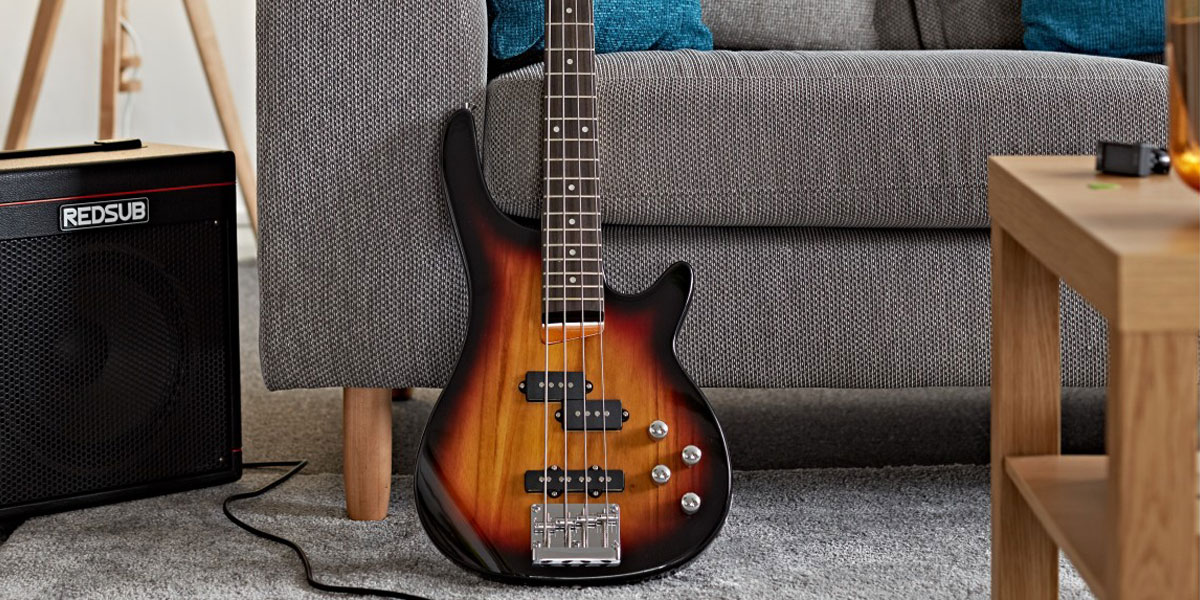
A Precision Bass (P Bass) uses a split single-coil pickup in the middle position. Despite its construction, it operates like a humbucker, delivering a punchy, warm sound with strong low-end and focused mids. Its versatility has made it one of the most widely recorded bass pickup designs ever.
A Jazz Bass features two single-coil pickups, one near the neck and one closer to the bridge. You can blend the two to achieve everything from deep, rounded tones to brighter, more defined sounds, making it a favourite for funk, blues, and pop. As well as jazz, obviously.
Some basses feature dual humbuckers, giving you two high-output pickups with a wide range of tonal options through pickup selectors or blend controls. This setup is particularly popular with modern rock and metal players, although its versatility makes it capable of covering almost any genre.
Choosing the right brand
Every bass manufacturer has its own approach to design, sound, and playability. While there’s plenty of variety, getting familiar with a few of the biggest names can help you narrow down the type of instrument that suits your style.
Fender/Squier
Fender pretty much created the blueprint for the electric bass guitar with the Precision Bass back in 1951. Both the P-bass and Fender’s follow-up, the Jazz Bass, remain hugely popular today. Alongside these classics, you’ll also find models like the Mustang Bass, which offers a shorter scale length, as well as acoustic basses.
Fender and their more accessible sister brand, Squier, are great for anyone wanting a classic design that’s versatile, reliable, and instantly familiar.
Ibanez
Ibanez is well known for building basses with fast-playing necks and modern styling, available for a wide range of budgets. Many feature the brand’s signature double-cutaway body shape, striking finishes, and powerful humbuckers, while higher-end models often include active electronics.
They’re particularly popular with rock and metal players, so if you want to rock, an Ibanez bass might fit the bill.
Gibson/Epiphone
Gibson basses have plenty of character, combining distinctive looks with rich, powerful tones. Iconic models like the Thunderbird stand out thanks to their unique styling.
If classic rock, blues, or hard rock are your go-to genres, Gibson’s warm, punchy sound and strong visual identity are well worth exploring. For a first bass, an Epiphone offers the style and the basic sound at a much more budget-friendly price point.
Rickenbacker
Few basses are as instantly recognisable as a Rickenbacker. Their distinctive body shape is instantly recognisable, and they’ve been used by artists as diverse as Paul McCartney and Lemmy!
It must be said that Rickys are… well, not cheap. A brand that’s worth knowing about, but probably not a first bass.
Music Man/Sterling
Music Man basses are modern, sleek, and practical. They prioritise player-focused design, combined with some amazing finishes. These basses often feature active electronics that require a battery and offer much greater control over your tone. They’re very versatile, particularly the two-pickup versions, and popular across a wide range of genres.
While Music Man basses are expensive, the Sterling range offers a lot of the benefits at a lower price.
There are a lot of other brands out there, but this selection of brands is a good starting point as you look for a bass that’s right for you.
Is the bass easy to learn?
Well… yes. But also, no (in a good way).
On the one hand, the bass is often considered one of the more approachable instruments for beginners. You can start playing simple basslines with just a few notes, helping you build confidence while developing essential skills like timing, rhythm, and finger coordination. You can even play with other people fairly quickly, which is brilliant for anyone dreaming of starting a band.
Once you master the basics and look at what else is possible, though, you’ll realise there’s a huge amount to build on. As with any instrument, the limit is how much you’re willing to put in!
As you progress, you’ll learn more advanced techniques and improve your accuracy. You’ll discover how important the bass is in a song, locking in with the drums to form the foundation everything else rests on. In that context, you’ll also learn when to sit back and keep things simple, and when to move forward in the mix with more intricate lines and fills that add to the song.
One of the best things you can do as a beginner is to focus on playing in time rather than playing fast. A simple bassline played with solid timing will always sound better than a complicated one that’s rushed or inconsistent. The basics build better bassists.
It’s also worth learning songs you genuinely enjoy. Playing along with your favourite bands keeps practice engaging, and you’ll naturally pick up new techniques and playing styles as you expand your repertoire. Of course, if you’re a fan of the Red Hot Chili Peppers, you may want to wait a while before trying this…
Most importantly, be patient with yourself. Every bassist starts somewhere, and steady, regular practice will take you much further than occasional long sessions. Even 15 to 20 minutes a day can make a noticeable difference, helping you build confidence and develop the skills that will stay with you as your playing improves.
FAQs
What kind of bass guitar should a beginner use?
Realistically, the best bass for a beginner is the simplest – a 4-string electric bass with passive pickups, built by a reliable brand. With that said, it’s important to test a variety of instruments before buying in order to find out what feels comfortable for you, as different basses can feel very different.
What is the most common bass guitar mistake for beginners?
The most common bass guitar mistake for beginners is failing to mute strings you aren’t playing. That can lead to an unpleasant and unwanted rumble. Use the fingers of your fretting hand to mute higher strings, and your picking hand thumb to mute lower strings, depending on where you’re playing.
Can I teach myself to play bass guitar?
Yes, you can teach yourself to play bass guitar – but you’ll probably find it easier with a teacher, or at least some online tutorials. It’s widely thought to be one of the easiest instruments to start learning, but the more you learn, the more scope you’ll find to develop greater technique.
Final thoughts
As you’d expect, there’s a lot more that could be said about the types of bass guitar available, but hopefully this gives you the bass-ics (I’m absolutely not sorry for the pun). After all, part of the fun when you learn a new instrument is learning about that instrument.
Go forth and rattle some foundations with thunderous bass!


0 Comments