
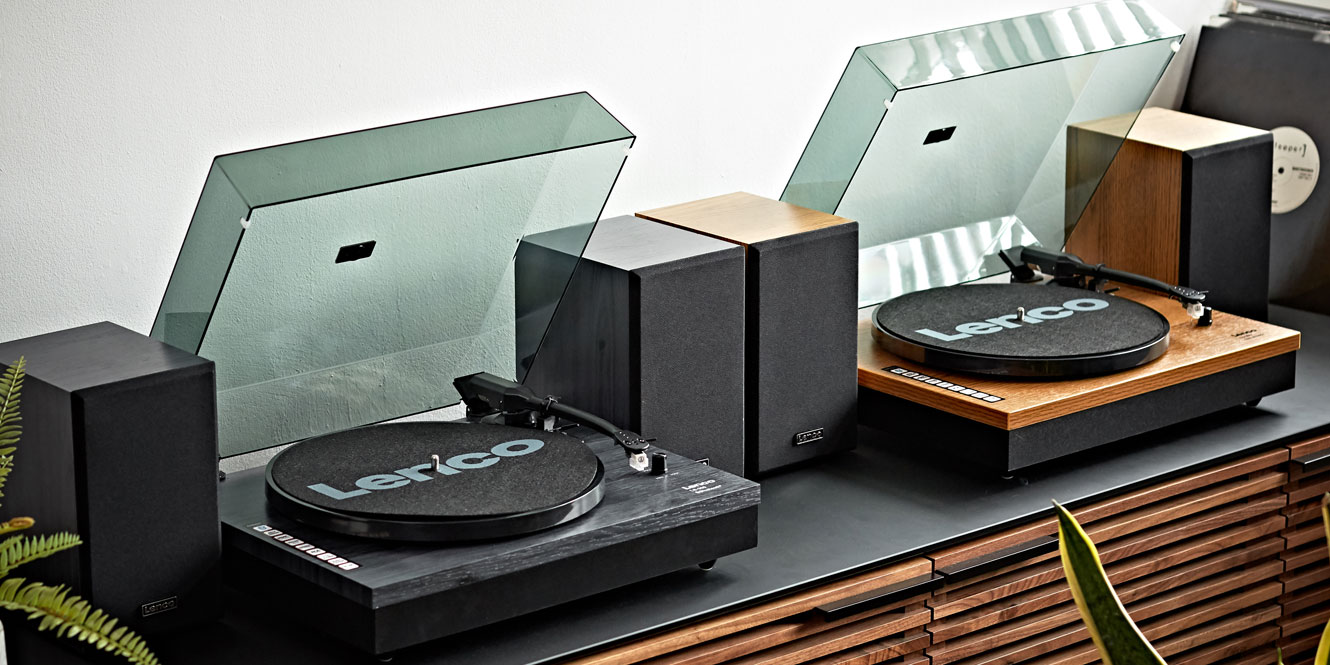

Are you dusting off an old collection of LPs and 7” singles? Following “trendy new artists” who boycott streaming services and want all their music pressed to wax? Or are you frequently in record shops, scrambling for those hidden gems at the bottom of the bargain crate?
Vinyl has made a strong return over the last decade. What was once a niche format is now firmly back in the mainstream, with new releases and reissues landing every week.
People are coming at it from all angles. Some are revisiting old collections, while others are starting fresh. Spending time in record shops, digging through crates, and finding something unexpected is part of the appeal.
I myself spend hours digging through second-hand crates looking for something interesting, and in just over two years, I’ve built up hundreds of records. It doesn’t take long before it starts to add up.
Vinyl records bring a physical side to music that helps you engage with it more. You put a record on, drop the needle, and listen with intent. It’s a different experience from streaming, and that’s a big part of the appeal.
In this guide, we’ll walk through a range of the best beginner turntables that are easy to set up and simple to use. We’ll also cover what to look for, how to choose the right one for your space, and how to keep your records in good condition over time.

In a hurry?
If you can’t stick around, here’s a shortlist of three turntables from this article.
| Pro-Ject E1 Phono Turntable | Strong build and sound for a proper hi-fi setup | Check the current price |
| Lenco LS-300 | Complete system with speakers, easy to set up | Check the current price |
| AVCOM Standing Turntable with Bluetooth | Versatile all-in-one option with multiple listening options | Check the current price |
Why we’ve chosen these turntables
For this guide, we’ve picked a range of beginner turntables to suit different ways of listening.
You might want something simple with built-in speakers and Bluetooth. Or you might be looking for something more solid, with better build and sound, that you can build a system around.
We’ve focused on models that are easy to set up, and of course, assessed how they perform once you start using them properly. In some cases, that means keeping things convenient. In others, it means giving you room to upgrade later.
The aim is to help you find a starting point that fits how you want to use your setup.
The best beginner turntables
1. Kanto OBI3 Turntable with Bluetooth
 Key features
- Built-in phono preamp
- Bluetooth connectivity
- Adjustable tonearm with counterweight
Pros
- Easy to set up and use
- Flexible connections for different setups
- Clean, modern design
Cons
- No 78 RPM support
Kanto are best known for their entry-level speakers, so the OBI3 feels like a natural extension of that. It’s designed with simple systems in mind – a sensible place to start if this is your first hi-fi venture.
The OB13 has a proper tonearm with a counterweight and pre-fitted cartridge, offering reassuring build quality at this level. It reduces some of that manual setup, but still gives you something that’s built more like a traditional turntable than a basic all-in-one unit.
The built-in phono preamp then keeps things flexible. You can plug straight into active speakers using RCA, or switch it off if you’re using a separate phono stage. There’s also a ground connection to help keep noise down if you go that route.
If you’re a beginner who wants an extra layer of convenience, there’s Bluetooth, allowing you to stream from your phone when you’re not using records. It makes the turntable more useful day to day.
The OB13 isn’t the most feature-heavy option, and the lack of 78 RPM support might be an issue if you have older records. But for most people starting out, it covers the essentials.
It works well as a first step into vinyl, especially if you want something that feels closer to a proper hi-fi setup without needing loads of extra gear.
2. Lenco LS-300
 Key features
- Built-in amplifier and speakers
- Bluetooth connectivity
- Audio-Technica moving magnet cartridge
Pros
- Complete system in one box
- Simple to set up
- Decent cartridge for the price
Cons
- Limited upgrade potential
The Lenco LS-300 is built for convenience. And as it’s part of a bundle with speakers included, you don’t need to think about extra gear to get started.
Everything is designed to work together. The speakers are powered by the turntable, and setting up is super simple. Plug it in, connect the speakers, and you’re ready to go.
On the turntable itself, you get an Audio-Technica moving magnet cartridge – at a beginner level, this is an impressive feature to have. It helps give you a more balanced and reliable sound compared to cheaper bundled options.
Plus, Bluetooth is built in for streaming music if you want a simpler way of listening.
This turntable isn’t really aimed at upgrading or building a full hi-fi system over time. It’s a straightforward unit that would fit nicely in a living room, bedroom, or office, and it does the job well.
3. Crosley Voyager Portable Turntable with Bluetooth
 Key features
- Built-in speakers
- Portable suitcase design
- Bluetooth connectivity
Pros
- Everything you need in one unit
- Compact and easy to move
- Very simple to use
Cons
- Basic build and sound
Not many people want to invest in a full hi-fi system when they’re just starting out. We’ve shown you some great, easy-to-set-up turntables, but sometimes, a portable suitcase turntable with built-in speakers is all that’s needed.
Crosley are one of the most recognisable brands in this category, and the Voyager is one of their best all-in-one record players. It has everything you need to start listening straight away.
The compact design uses a 7-inch platter, but it can also play 10-inch and 12-inch records. And thanks to a built-in speaker, there’s no need to connect external equipment.
There are some trade-offs – the main one being that the build quality is fairly basic and the controls are placed quite close together. And as expected with built-in speakers, they’re not the loudest or clearest available.
That said, it’s not intended to be a high-end hi-fi turntable. The Voyager is a simple and affordable way to start listening to vinyl, whether that’s a stack of older LPs or a new record you’ve just picked up.
4. AVCOM Standing Turntable with Bluetooth
 Key features
- Built-in speakers and amplifier
- Bluetooth, USB, and aux connectivity
- Three-speed playback
Pros
- Very versatile
- No extra equipment needed
- Multiple ways to listen
Cons
- Limited upgrade potential
AV.com produces a great range of well-designed audio products, and this AVCOM Standing Turntable is aimed at keeping things simple while covering a lot of ground.
It follows a more traditional layout, but adds a lot of built-in features. You get a full-size platter, three speed options, and several ways to connect, including Bluetooth, USB, aux input, and a headphone output.
Like the Voyager, there are built-in stereo speakers for immediate listening – just remember that these are more for convenience than high fidelity playback, though there are RCA outputs for connecting external speakers. The turntable also supports 33, 45, and 78 RPM playback, so it works with a wide range of records.
The detachable legs give you some flexibility with placement. You can use the whole thing as a freestanding unit or remove the legs for tabletop use. There’s also a locking dust cover to keep things clean, and a carry handle, which makes it easier to move around.
The only downside to the AVCOM turntable is that it has limited upgrade options, so it can’t really be used as a stepping stone into a full hi-fi system. The focus here is more on convenience and having everything in one place.
In that sense, it works well as a starting point. You can set it up quickly and start playing records without needing to think too much about extra gear.
5. Pro-Ject E1 Phono Turntable
 Key features
- Ortofon OM 5E cartridge
- Belt-drive motor
- Anti-resonant platter design
Pros
- Strong sound quality
- Solid, well-built design
- Good upgrade potential
Cons
- Requires external speakers and a phono stage
Stepping up a level, the Pro-Ject E1 is closer to a traditional hi-fi turntable. It’s a good option if you want to focus more on sound quality from the start.
Pro-Ject are known for keeping things simple and well-built. The E1 follows that approach, with a clean design and a focus on getting the basics right. It comes fitted with an Ortofon OM 5E cartridge on a straight tonearm. This helps with accurate tracking and gives you a clearer, more detailed sound than more basic entry-level options.
The belt-drive motor and anti-resonant platter are designed to reduce unwanted vibrations and keep playback stable while allowing the cartridge to pick up more of what’s in the record.
However, there are fewer built-in features here than in other options on the list. You’ll need a separate phono preamp and speakers to get going. But if you’re looking to build a proper hi-fi setup over time, this gives you a strong starting point with better long-term potential.
6. Numark PT01 Scratch Portable Turntable
 Key features
- Built-in speaker
- Adjustable pitch control
- Integrated scratch switch
Pros
- Very portable
- Fun, hands-on features
- Useful for crate digging
Cons
- Not focused on hi-fi listening
Turntables are not only used for listening at home; they’ve also played a big role in DJ culture, and the Numark PT01 Scratch comes from that background.
It’s designed mainly for 7-inch records and hands-on use. If you’re a budding DJ, this is a great place to start – you get pitch control and a built-in scratch switch, which lets you try basic techniques.
Despite that focus, if you’re just after a portable listening option, the PT01 is for you, too. There’s a built-in speaker, a headphone output, and RCA connections if you want to hook it up to something else.
What I think is most useful, though, is that it’s small enough to take into record shops, so you can check records before buying.
If you like the idea of something you can take with you, or want to try a more hands-on approach to vinyl, the Numark PT01 is something a bit different from the rest of this list.
7. Korg handytraxx play
 Key features
- Built-in speaker
- Switchable cartridge types (MM and ceramic)
- Built-in effects and looper
Pros
- Portable and lightweight
- Creative features
- Can be used in larger setups
Cons
- More expensive than most portable turntables
From the long-established music equipment manufacturer Korg, the handytraxx play is another portable turntable with a few exciting twists.
It’s a compact unit designed for both listening and creative use. The tonearm and cartridge lean more towards a professional style than many portable players, which gives you a more refined sound. You can also swap the cartridge out for a different one if you prefer, and it has a switch to choose between either moving magnet or ceramic cartridges.
The rugged yet lightweight build means you can take the turntable anywhere, and there’s a built-in speaker for personal listening or small gatherings. If you want to connect it to a larger system, though, the RCA outputs allow you to do so.
Where the handytraxx play really shines is in its use as a tool for making and performing music, not just listening. It includes built-in effects, looping functions, and pitch control. You can match the speed of a record to other music, capture a section with the looper, and shape the sound using the onboard effects.
It is relatively expensive for a portable turntable. However, it offers a mix of portability, playback, and creative control in one unit.
The history of vinyl records
Vinyl records have been around in one form or another since the late 1800s. Early developments came from inventors like Thomas Edison, but it was Emile Berliner who introduced the flat disc record, which is much closer to what we use today.
Before vinyl as we know it, shellac records were the standard. These played at 78 RPM and were the first widely produced physical music format. They were used in homes, on early record players, and in radio broadcasting, making recorded music more accessible than ever.
As technology improved, new formats were introduced. The 12-inch LP, played at 33 1/3 RPM, allowed for longer recordings and became the standard for albums. The 7-inch single, played at 45 RPM, was smaller and more affordable, which made it ideal for individual tracks and jukebox use.
These formats helped shape how music was released and consumed. Albums became more than just collections of songs, and singles became a key part of music culture. Records also played a big role in performance. DJs began using turntables as instruments, developing techniques like scratching and beatmatching, which became central to hip-hop and electronic music.
Even with the rise of cassettes, CDs, and digital formats, vinyl never fully disappeared. In recent years, it has seen a strong comeback, with both new releases and reissues continuing to grow in popularity. For many people, it’s not just about the sound. It’s the physical format, the artwork, and the experience of playing a record that keeps it relevant.

How to choose the best turntable for you
The key things you’ll want to think about when buying your first turntable are your budget, how much you’re going to use it, the sort of music you’ll be listening to, the equipment you already have, whether or not you’ll expand your setup, and the space you have to display and store it.
That’s a lot! But really, when it comes to beginner turntables, most people usually fall into one of two situations: potential hi-fi enthusiasts or casual listeners wanting to enjoy old records.
If you’re really into your music and you like to use high-quality streaming services, you may want to spend a little bit more and build a full setup with a turntable, amp, and speakers. This gives you a more complete listening experience and leaves room to build on your setup over time.
On the other hand, if you just want to play records that you haven’t listened to in ages, or you want a quick and easy solution, a cheaper all-in-one turntable makes more sense. These are simple to set up and have everything built in.
These are two ends of the spectrum when it comes to beginner turntables. Most options will sit somewhere in between, so it’s worth thinking about where you fit.
From there, you can evaluate a turntable’s utility, performance, ease of use, and price, and find something that works for you.
Direct drive vs. belt drive
For a record to spin, the platter needs to be driven by a motor. The challenge is doing this without introducing unwanted noise or vibration that can affect how the stylus tracks the record. There are two main ways this is handled: belt drive and direct drive.
Belt drive uses a rubber belt to connect the motor to the platter. This keeps the motor physically separated, which helps reduce noise and vibration. It also provides a steady and simple rotation, which is why it’s commonly used in hi-fi and listening-focused turntables.
There are some downsides. The belt can wear down over time, and because it’s always in contact, small speed variations like wow and flutter can occur.
Direct drive works differently. Instead of a belt, the platter is driven directly by an electronic motor using electromagnets. This means there’s no physical connection in the same way, and the platter can spin with more torque and stability.
This is why direct drive turntables are often used for DJing. They start up quickly, hold their speed well, and respond better to hands-on use. Designs like the Technics SL-1200 are a good example, and have played a huge role in shaping DJ culture.
The trade-off is that the motor sits directly under the platter. If it’s not properly designed or shielded, it can introduce noise or interfere with the cartridge.
Some high-end direct drive turntables are built to avoid this and work well in hi-fi setups. In most cases, though, belt drive is still the more common choice for listening, while direct drive is preferred for performance.
Record care and storage
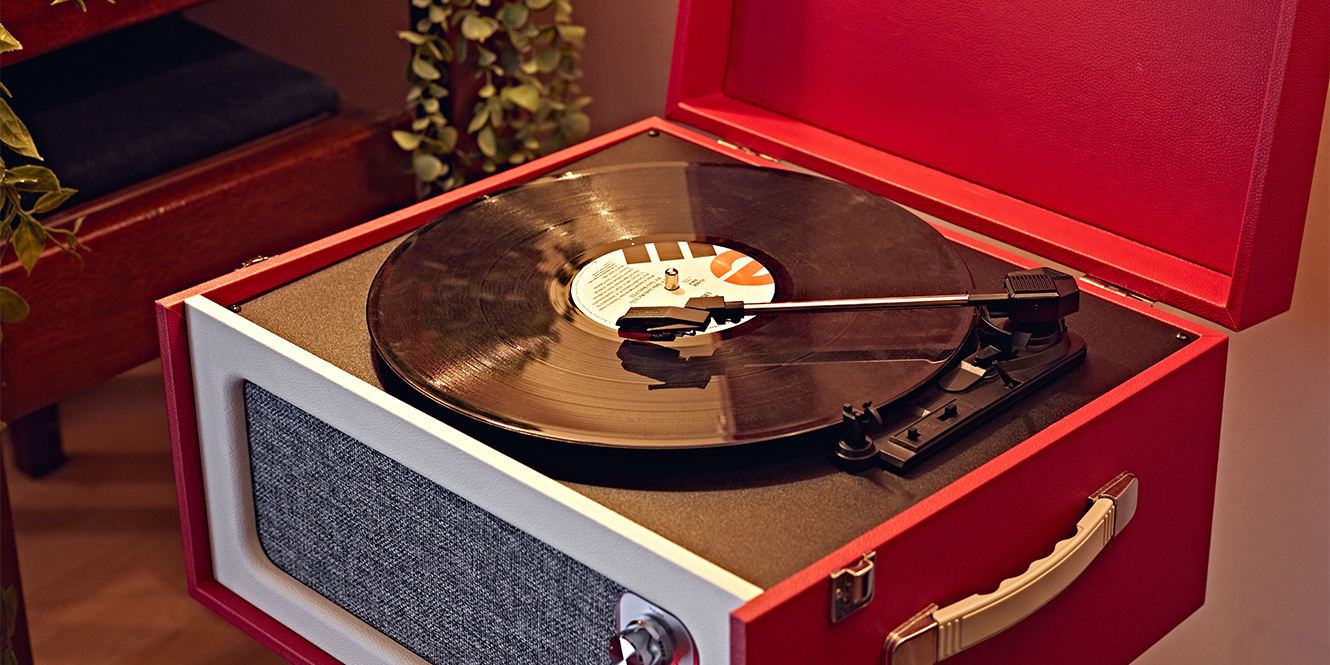
Whether you have two records or two thousand, looking after them is important. If dirt gets onto your vinyl, it can settle into the grooves or even scratch the surface. There are plenty of ways to clean records, but for most people, it’s best to stick with simple, proven methods.
Start by using a carbon fibre brush to remove dust and loose dirt before playing. This helps prevent scratches and keeps surface noise down.
For a deeper clean, apply a record cleaning fluid and gently wipe the surface with a static-free cloth. This helps remove anything stuck in the grooves.
It’s important to use the right products. Strong cleaning solutions or rough cloths can damage your records rather than protect them. A slipmat is also worth having. It gives your record a soft surface to sit on while playing and helps reduce wear during use.
How you store your records matters as well. Always keep them upright, rather than stacked, to avoid warping over time. A stable shelf or crate works well, as long as they’re not packed too tightly. Protective sleeves also help. Inner sleeves protect the surface of the record, while outer sleeves keep the cover in good condition.
It’s also worth thinking about where your turntable sits. Keep it on a stable surface, away from heat sources and direct sunlight. Too much heat can warp records, and vibrations can affect playback. A bit of care goes a long way. If you keep things clean and stored properly, your records will last for years and continue to sound as they should.
Essential accessories and furniture
To display your records, keep them organised, and get the best out of your setup, you need the right furniture and a few key accessories.
AVCOM Active Bookshelf Speaker Pair
A good pair of speakers makes a big difference to how your records sound. The AVCOM Active Bookshelf Speakers are easy to set up and don’t require a separate amplifier, which keeps things simple. They deliver clear, balanced audio and are a solid step up from built-in turntable speakers.
Show And Listen LP Frame 4 Pack
The Show And Listen LP Frame lets you turn your record collection into part of your space. You can display your favourite albums on the wall, and the quick-access design means you can take a record out, play it, and swap it back in without hassle.
UDG Ultimate Record Case 80 Vinyl
Records can get heavy and awkward to move, so having a proper case helps. The UDG Ultimate Record Case holds up to 80 records and keeps them protected when stored or transported. It’s a practical option if your collection is growing or you like to move records between rooms.
A dedicated unit helps bring everything together. The AVCOM Record Collectors Unit gives you space for your turntable, speakers, and records in one place. It’s designed to keep records stored upright, which helps prevent warping and keeps your collection easy to browse.
AVCOM Five Piece Record Care Set
Keeping your records clean helps maintain sound quality over time. The AVCOM Five Piece Record Care Set covers the basics, including tools for removing dust and cleaning the surface. It’s a simple way to look after your collection.

FAQs
What do you need to use a beginner turntable?
A beginner turntable usually needs speakers and sometimes a phono preamp to work properly, depending on the model. Many entry-level options include a built-in preamp or speakers, which makes setup quicker and reduces the amount of extra equipment required.
How much should you spend on a beginner turntable?
A beginner turntable setup usually costs between £100 and £300 if you are buying both the turntable and speakers. Spending more within that range tends to improve build quality and sound, but there are still simple options if you just want to get started.
Can you connect a beginner turntable to Bluetooth speakers?
Many beginner turntables can connect to Bluetooth speakers if they have built-in wireless support. This makes it easier to integrate into modern setups, although wired connections usually provide more consistent sound quality and reliability.
Final thoughts
So, we’ve covered the best beginner turntables, from simple all-in-one options to more traditional hi-fi setups, along with what separates them and how they fit different ways of listening.
Hopefully you’ve found the right one for you!
If this guide was useful, we’ve got plenty more on the Gear4music blog, covering setup advice, buying guides, and ways to get more out of your gear.


0 Comments