

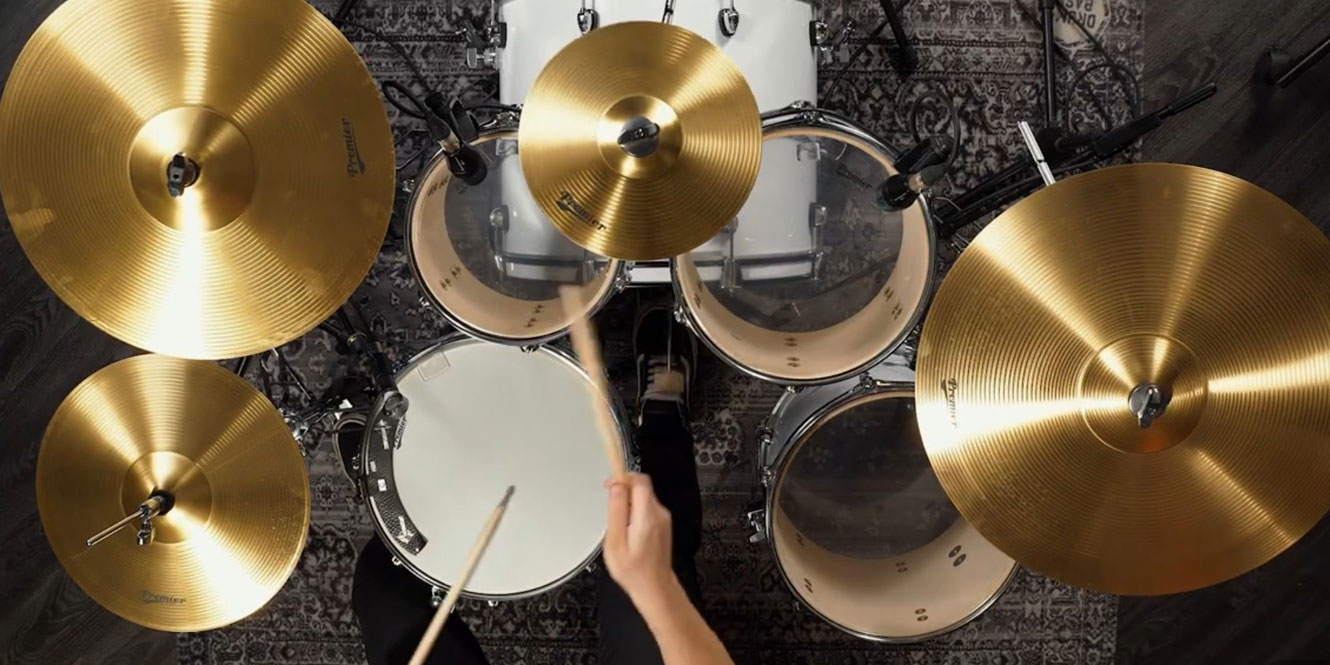

We’ve all seen some great drum solos over the years, and luckily, with a bit of patience and practice, they’re surprisingly achievable to craft and perform yourself. A good drum solo shouldn’t just be a flashy moment in the middle of a tune. It should feel like it belongs there. If you’re thinking about creating your own solo, we’ve put together some practical tips to help you get started.
In this article, we’ll explore what really makes a drum solo work, both musically and practically. We’ll look at iconic examples and break down what makes them stand out. The focus is on keeping things straightforward, with advice on staying in the pocket, knowing when to hold back, and making your solo feel like a natural part of the performance.

Key takeaways
- Focus on musicality, not speed
- Use a clear structure
- Tell a story through rhythm
- Play with dynamics and space
- Repeat with variation
- Adapt to your setting
- Involve the audience
- Control your technique
Examples of good drum solos
There are tons of famous drum solos out there you can take inspiration from. Here are some of our favourites:
Neil Peart “YYZ” (Rush)
A masterclass in precision and phrasing, this solo shows off Peart’s unique, compositional approach to drumming.
John Bonham “Moby Dick” (Led Zeppelin)
Raw, powerful, and packed with energy. A defining moment in rock drumming that still holds up.
Keith Moon “Won’t Get Fooled Again” (The Who)
Full of explosive fills and unpredictable phrasing, Moon pushed the boundaries of what live drumming could be.
Steve Gadd “50 Ways to Leave Your Lover” (Paul Simon)
Subtle, groove-heavy, and creative. This solo is all about restraint and feel.
Alex Van Halen “Hot for Teacher” (Van Halen)
That lightning-fast intro is instantly recognisable. Technical, rhythmically complex, and still incredibly catchy.
Terry Bozzio “The Black Page #1” (Frank Zappa)
A famously tough piece that puts coordination, timing and interpretation to the test.
Danny Carey “Chocolate Chip Trip” (Tool)
Atmospheric and intense, blending electronics with live drumming for a cinematic, layered solo.
Phil Collins “In the Air Tonight”
Possibly the most iconic drum entrance in pop. Sparse, powerful and timed to perfection.
Joey Jordison Drum Solo (Live with Slipknot)
Fast, theatrical and full of energy, especially during those rotating drum riser moments.
The Surfaris “Wipe Out”
One of the earliest catchy drum solos in rock. Instantly recognisable and still a favourite for beginners and fans alike.
No matter what genre you listen to, there is a drum solo out there for you. These are just a handful of our favourites, but if you want to learn about some other legendary solos, check out our article on best drum solos of all time.
Why are they so good?
What sets the best drum solos apart isn’t just speed or complexity. It’s musicality. The most memorable ones, like those from Neil Peart or Steve Gadd, mix technical skill with thoughtful phrasing, structure, and feel. They’re not just impressive; they actually tell a story.
Great solos are also played with intention. A lot of them follow a kind of narrative arc: a clear beginning, a build-up to a high point, and a resolution. That structure helps keep people listening and gives the solo a sense of direction. You can hear that approach in tracks like “YYZ” or “The Black Page”, where new ideas keep coming in without losing sight of the main theme.
Dynamics matter too. Drummers like Phil Collins and Larnell Lewis are great at using shifts in volume and intensity to create contrast and build tension. Softer sections make the louder moments feel bigger, and leaving space between phrases gives everything room to breathe.
Of course, technical ability is part of the appeal, but it’s not about showing off for the sake of it. The focus is on control, groove, and clarity, which is what makes even the trickiest parts feel musical and grounded. Stage presence plays a big role as well. Drummers like Joey Jordison and Benny Greb know how to draw the crowd in, whether that’s through visual energy or a simple call and response rhythm.
Finally, the best solos have personality. They’re not just displays of skill, they’re musical statements that feel personal, expressive and engaging from start to finish. That’s what makes them stick with you.
How to create a great drum solo
Start with a simple rhythm
Creating a drum solo takes time, so it’s best to start simple. Begin with a basic groove or rudiment, something like a paradiddle or a single stroke roll. That gives you a solid foundation to build on. There’s no need to impress anyone right away. Play something that feels natural and comfortable. When you’re relaxed and in control, the solo tends to flow much more smoothly.
Once you’ve found a rhythm that sits well, start developing it. Add some accents. Move around the kit or try shifting the dynamics. You don’t need to rush it; instead, let the solo grow bit by bit. The goal isn’t to cram in everything you know. It’s to shape something musical that evolves in a way that feels intentional. Simplicity at the start gives you more room to explore as you go.
Starting with your simple rhythm will be comfortable to play, but it’ll also make it easier to connect with. It gives the listener something to latch onto, and when you start to change it up, the contrast hits harder. Keep it clear, keep it musical and give your ideas room to breathe right from the start.
Develop your “hook”
The key part of any good solo is a catchy hook. This is a short, repeatable phrase that gives your solo a clear identity and helps the audience connect with what you’re playing.
The hook doesn’t need to be complicated. In fact, the simpler it is, the better. It might be a short tom pattern, a snare accent or even a rhythmic motif you tap out on the rims. What matters is that it’s memorable, something you can come back to throughout the solo.
Introduce your hook early, ideally right at the start. Then build around it, leave it for a while, and return to it later for impact. This creates a sense of structure and familiarity, guiding your listener through the journey. Think of it as the theme of your solo, a musical thread that ties everything together.
Use dynamics
Dynamics are one of the most effective tools for shaping your solo and keeping it interesting. By moving between soft, medium, and loud playing, you can build tension, create contrast, and tell a more engaging musical story.
Starting quietly and gradually increasing the volume helps build anticipation. You can also drop suddenly to a softer level to add surprise. These shifts help the solo feel alive, not just a stream of notes at the same intensity.
Techniques like ghost notes, cross sticks, and rimshots rely heavily on dynamic control. Using different stick positions or cymbal surfaces also adds texture and variety. Without dynamics, a solo can feel flat, almost mechanical. But by exploring volume, you showcase the full potential of your kit and create a solo that breathes and moves.
It’s not just what you play. It’s how loudly, softly, or suddenly you play it that makes the difference.
Create a clear structure
The most memorable drum solos have a beginning, middle, and end. Without that sense of direction, even the most technical performance can feel aimless or go on too long.
Start by laying the groundwork. Introduce a motif or groove to give the solo a foundation. As you move into the middle, build intensity with faster rhythms, call and response phrasing or by playing across different voices on the kit. This is the section where the tension builds.
Save the biggest, boldest playing for the end. A strong finish lets your audience know the journey is over and gives fellow musicians a clear cue to rejoin if you’re playing live. Using call and response is a great way to shape your structure. A simple phrase, the call, followed by a variation, the response, helps create flow and keeps your ideas connected.
With structure in place, your solo becomes more than just drumming. It becomes a performance.
Focus on musicality, not speed
Fast solos might look impressive, but speed without musicality quickly loses impact. A great solo isn’t about cramming in as many notes as possible. It’s about choosing the right ones and letting them breathe.
Start slow. Instead of jumping straight into complex fills, focus on phrasing. Think like a singer or a horn player. The grooves need time to “breathe”, so leave space between ideas so they feel connected and intentional. Use the whole kit to explore different tones and pitches. Toms, cymbals, and even silence can help shape a solo that sounds musical rather than mechanical.
You can even try singing a short phrase and then recreating it on the drums. It’s a great way to approach the instrument more melodically. Once you’re confident in your ideas, find the tempo that suits the groove best. Some solos thrive on energy, but many sound more powerful when they’re relaxed and deliberate.
Adapt to your setting
Before crafting your solo, think about where you’re playing and who you’re playing for. A solo at a stadium gig won’t need the same approach as one in a small jazz club.
If you’re playing a stand-alone solo, you’ve got room to explore dynamics, build slowly, and stretch out your ideas. But if the solo is part of a song, you’ll probably have a set number of bars to work with, so clarity and timing become more important.
Consider the venue’s acoustics too. In echoey rooms with hard surfaces, it’s better to keep things tight and avoid overusing cymbals. In drier spaces, you might need to project more to fill the room. You can also watch your audience as you play. If they’re lively, you can push the energy a bit more. If they’re quieter or more reserved, a softer, more nuanced solo might connect better.
And remember, most people listening aren’t drummers. Simple, well-phrased grooves are often more engaging than constant technical runs.
Record yourself practising or performing
One of the most effective ways to improve your drum solo is to record yourself. Whether it’s during a gig or a home practice session, watching the playback gives you a clear sense of what’s working and what isn’t.
You might notice your timing slips in certain spots, or that a phrase doesn’t land quite how you imagined. It’s also a good chance to check your stage presence. Do you look like you’re enjoying yourself? If not, add a bit more energy to your body language.
Recording helps you keep track of your progress, too. You’ll spot patterns that could turn into useful hooks, and pick up on any habits that might need adjusting. Plus, you’ll have a record of ideas you can revisit or develop later.
FAQs
What are the key elements of a drum solo?
The key elements of a drum solo are rhythmic creativity, dynamic control, structure, and technical skill. A strong solo shows how well a drummer can build tension, shift tempo, and keep the listener engaged using patterns, accents, and improvisation. Transitions and recurring motifs also play an important role in tying everything together.
What is the most iconic drum solo?
One of the most iconic drum solos of all time is John Bonham’s “Moby Dick” with Led Zeppelin. It features powerful grooves, sections of hand drumming and an evolving structure that highlights his unmistakable style. It’s still seen as a benchmark for solo drumming in rock music.
What’s the difference between a fill and a solo?
The difference between a fill and a solo comes down to purpose, length, and complexity. Fills are short transitions that help bridge sections of a song, while solos are longer moments that showcase a drummer’s skill and creativity. Solos often stand on their own, while fills are there to support the flow of the arrangement.
Final thoughts
A great drum solo includes a combination of skill, creativity, and structure. It engages the audience and brings real energy to the room. In this article, we’ve looked into how dynamics, phrasing, groove, and space can help to shape a solo that holds attention without losing its musical feel.
When creating your own, try to remember that there’s no single formula. Play to your strengths. Some drummers lean into speed and complexity, while others focus more on feel and texture. The key is to serve the music, not just the technique. Whatever your style, build on what suits your playing and the setting you’re in.


0 Comments