



If you want the feel and sound of an acoustic piano in a modern, feature-rich format, Yamaha are the way to go. From graded hammer-action keyboards to Grand Expression Modelling, the technology included in Yamaha’s digital pianos is designed to offer comfortable, realistic playability and natural, clear, detailed audio.
Some are entry-level models, others are more premium, but they all have the stamp of Yamaha quality that has made the brand renowned for so long.
In this article, we take a look at the best Yamaha digital pianos on the market. We’ll discuss the pros and cons of each, who they’re suited to, and how to choose the right one for you.

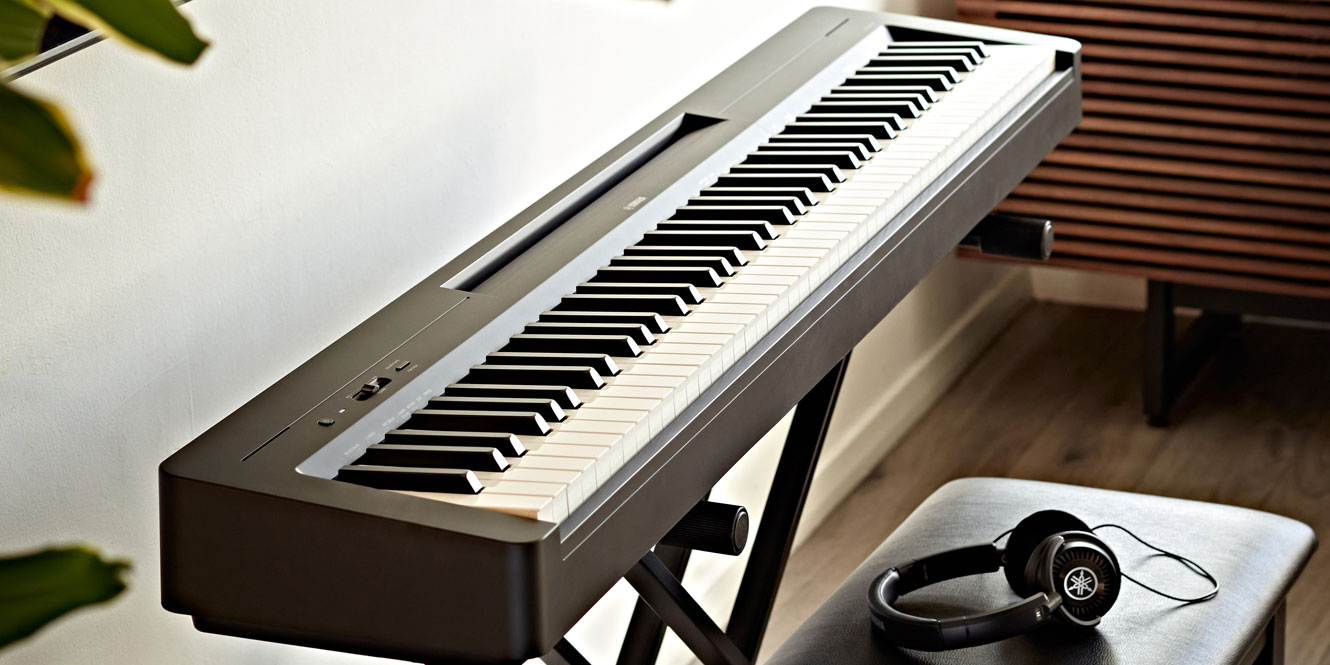
| Yamaha P145BT Digital Piano With Bluetooth | Graded Hammer Compact keyboard, Bluetooth audio, and 10 built-in voices. | Check the current price |
| Yamaha CLP 835 Digital Piano | GrandTouch S keyboard, Yamaha CFX & Bösendorfer piano voices, and Grand Expression Modelling technology. | Check the current price |
| Yamaha P225 Digital Piano | Graded Hammer Compact keyboard, Virtual Resonance Modelling Lite sound, and Bluetooth audio and USB MIDI connectivity. | Check the current price |
 Key features
2. Yamaha CLP 835 Digital Piano
 Key features
- GrandTouch S keyboard with textured keytops
- Yamaha CFX & Bösendorfer piano voices
- Grand Expression Modelling technology
Pros
- Realistic grand piano feel and touch
- Enhanced acoustic-style speaker placement
- Smart Pianist app integration
Cons
- Keys are synthetic rather than wooden
The CLP 835 digital piano gives you a refined grand piano feel in a smart, high-quality design. At its heart is the GrandTouch S keyboard, a weighted key action with textured keytops that supports expressive playing and delivers a realistic feel. It responds well to detailed dynamics, giving you nuanced control over tone and volume.
A major benefit of the CLP 835 is that it includes sounds sampled from Yamaha’s flagship CFX and Bösendorfer Imperial grand pianos, recreated with impressive detail. The speakers are carefully positioned to reflect sound as you’d hear it from an acoustic instrument. And if you’re playing quietly with headphones, binaural sampling helps preserve a natural sense of space.
Then there’s Grand Expression Modelling. This is Yamaha’s impressive technology that adds depth and acoustic realism to your performance by digitally recreating the way a grand piano responds to different playing techniques. It works alongside Virtual Resonance Modelling to reproduce the complex resonances heard throughout an acoustic piano.
Plus, with Bluetooth connectivity and the Smart Pianist app, you can play back songs and easily control the piano’s settings from your smart device. This can be especially useful when exploring new material.
The CLP 835 is ideal if you’re looking for an authentic piano experience without stepping up to concert-level price points.
3. Yamaha P225 Digital Piano
 Key features
- Graded Hammer Compact keyboard
- Virtual Resonance Modelling Lite sound
- Bluetooth audio and USB MIDI connectivity
Pros
- Compact and lightweight for easy transport
- Authentic grand piano-style sound and feel
- Smart Pianist app and Flowkey integration
Cons
- Pedal unit sold separately
The Yamaha P225 combines high-quality sound, portability, and playability in a slim, lightweight frame. Its GHC keyboard feels comfortable and natural to play, mirroring the key response, consistency, and dynamic range of its acoustic counterparts.
Yamaha’s flagship CFX concert grand is brought to life using Virtual Resonance Modelling Lite, which helps recreate the natural tonal changes you’d expect from an acoustic instrument. Paired with carefully positioned speakers and a Sound Boost function, the piano samples offer a clear, full-bodied sound across all registers.
It’s well-suited to a range of environments, from home to rehearsal spaces, with built-in Bluetooth audio streaming, USB MIDI/audio, and support for the Smart Pianist app. You can even record directly to your device using Yamaha’s Rec’n’Share app.
4. Yamaha CP88 Digital Stage Piano
 Key features
- Natural Wood Graded Hammer (NW-GH3) key action
- Yamaha CFX and S700 piano voices
- Direct physical control interface
Pros
- Realistic wooden-key feel
- Intuitive performance-friendly layout
- Durable and portable aluminium design
Cons
- No built-in speakers
If you’re a performing pianist and want a realistic piano feel alongside practical controls, the Yamaha CP88 is great. Its fully weighted Natural Wood Graded Hammer (NW-GH) keyboard uses wooden keys with synthetic ebony and ivory keytops, giving you a substantial, responsive action.
This is an easy-to-use stage piano with a direct, one-to-one control layout. Its Piano, Electric Piano, and Sub sections can be split or layered, with dedicated effects that are easy to adjust during a performance. There’s also a strong selection of sounds, including samples of Yamaha CFX and S700 grands, as well as the Bösendorfer Imperial.
And as it’s a stage piano, it’s built for reliable performances. Its robust aluminium body is designed to cope with regular use, while its relatively lightweight, streamlined design makes it easy to transport between rehearsals, recording sessions, and gigs.
5. Yamaha YDP 145 Digital Piano
 Key features
- Graded Hammer Standard (GHS) keyboard action
- Yamaha CFX concert grand piano sound engine
- Virtual Resonance Modelling Lite for authentic tone
Pros
- Realistic acoustic piano feel and response
- Stereophonic Optimiser improves headphone experience
- Built-in lesson songs and Flowkey Premium included
Cons
- No Bluetooth functionality
If you’re after a traditional feel in a modern instrument, the Yamaha YDP 145 is designed to deliver just that. With its 88-key graded hammer-action keyboard, the weight of each key mimics that of an acoustic grand – heavier in the bass and lighter in the treble. Matte keytops provide extra grip during longer practice sessions and add that extra touch of premium design.
The YDP 145 uses samples from Yamaha’s flagship CFX concert grand. These are rich and expressive, enhanced by Virtual Resonance Modelling Lite and a built-in tone escapement system, both designed to simulate how sound moves through a real piano cabinet.
It’s a great option for learners, with support for the Smart Pianist app and three months of Flowkey Premium included.
6. Yamaha CSP 295 Digital Piano
 Key features
- Authentic GrandTouch action
- Yamaha CFX and Bösendorfer Imperial sampling
- Smart Pianist app and Stream Lights learning system
Pros
- Exceptionally detailed grand piano sound and response
- Powerful three-way speaker system with a spruce cone
- Extensive selection of voices and accompaniment styles
Cons
- Smart device required for many features
The Yamaha CSP 295 combines an authentic piano experience with features that make playing accessible to the whole family. Its GrandTouch keyboard uses wooden keys, counterweights, and individually graded hammers to recreate the balanced response of a grand piano, allowing for detailed and expressive control.
Yamaha have carefully sampled every key of its flagship CFX and the Bösendorfer Imperial concert grands, capturing the individual character of both instruments. Virtual Resonance Modelling then recreates the way the strings and soundboard interact as you play. It even reproduces subtle mechanical details, including the sound of the dampers lifting, adding the small bumps and knocks heard throughout an acoustic.
The three-way speaker system uses pulp from the same spruce used for Yamaha’s CFX soundboards, giving notes a more natural attack. Carefully positioned speakers and bidirectional horns also help faithfully recreate the spacious sound of a grand piano.
With the Smart Pianist app, you can select sounds, adjust settings, and access songs and sheet music. Stream Lights show which keys to play next, while adjustable tempos and separate-hand practice modes make learning approachable for both beginners and more experienced players.
7. Yamaha YDP S56 Digital Piano
 Key features
- GrandTouch-E weighted keyboard with textured keytops
- Yamaha CFX sound engine with VRM Lite
- Bluetooth audio and Smart Pianist integration
Pros
- Responsive touch supports fast repetition
- Diffuser speaker system distributes sound evenly
- Slim cabinet suits smaller living spaces
Cons
- Limited selection of voices
The Yamaha YDP S56 is ideal if you want an authentic piano experience but don’t have room for a full-sized cabinet. Its GrandTouch-E keyboard is weighted, so the lower notes feel heavier than those higher up, just like on an acoustic piano. It also responds well to repeated notes and faster passages, giving you the control needed as your playing develops.
The sound comes from Yamaha’s flagship CFX concert grand. It’s warm and controlled when you play softly, but has plenty of depth when you add more power. VRM Lite recreates the natural resonance between the strings and body of an acoustic piano, while the diffuser speaker system spreads the sound evenly around the room. Intelligent Acoustic Control also keeps everything clear when you need to practise at a lower volume.
And if quiet practice is important, the Stereophonic Optimiser gives the sound a more spacious feel through headphones. You can also stream backing tracks using Bluetooth audio or connect to the Smart Pianist app to adjust settings and record your playing. With its reduced-depth cabinet and folding key cover, the YDP S56 is a great option for bedrooms, studies, and smaller living spaces.



0 Comments