



Looking to get your loved one an instrument they can truly get passionate about? A digital piano is a go-to for many reasons. Not only is it a beautiful instrument to play, but it also allows the player to practise techniques they can then transfer to an acoustic. And they offer the kind of creativity (sounds, effects, songs to play along to) that keeps things fun.
Speaking of correct technique, you may have seen the term “weighted keys” in your search.
Weighted keys are designed to replicate the natural resistance you feel in the keys of an acoustic piano. This is called action.
Action is important in an acoustic piano, as it’s what helps the player show their expressivity and articulation. So, if your loved one is serious about learning the piano, you’ll want to look for one with weighted keys.
In this article, we’ll discuss our favourite digital pianos with weighted keys and, afterwards, we’ll go into more detail about the benefits of weighted keys and the different types of weighting out there.
In a hurry?
Here are our top three picks.
| Keynote Compact Digital Stage Piano | A stylish, portable piano with authentic hammer action keys. | Check the current price |
| Yamaha P145BT Digital Piano | Great quality sounds and action in a beginner-friendly model. | Check the current price |
| DP-10X Digital Piano by Gear4music | Best digital upright piano for beginners. | Check the current price |

The best digital pianos with weighted keys
1. Keynote Compact Digital Stage Piano with Bluetooth
 A stylish, portable piano with authentic hammer action keys.
- Keyboard action: Fully Weighted Hammer Action
- Polyphony: 81
- In-built sounds: 30
- Effects: Reverb
The Keynote Compact Digital Stage Piano gives you the feel of an acoustic piano in a portable package. Its 88 fully weighted hammer action keys respond just like an acoustic, with a similar resistance, helping you develop proper finger strength and control.
But despite its weighted keyboard, the Keynote is actually very lightweight. And it’s adaptable to your space, with detachable legs that transform it from a stylish home piano into a portable stage instrument and make it easy to transport between rehearsals and performances.
Sound-wise, the Keynote Compact is built with the French-designed DREAM audio engine. This gives you 30 high-fidelity voices, including acoustic pianos, organs, and strings, to experiment with and an 81-note polyphony for tackling more complex passages without notes cutting out.
There’s also Bluetooth audio connectivity, so you can stream your favourite songs through the built-in speakers and play along.
2. Casio CDP S110 Digital Piano
One of the most compact graded hammer action pianos out there.
 Keyboard action: Scaled Hammer Action Keyboard II
- Polyphony: 64
- In-built sounds: 10 (grand piano x 3, electric piano x 3, harpsichord, strings, organ x 2)
- Effects: 4 reverbs, 4 choruses
The Casio CDP S110 Digital Piano has a tiny footprint and weighs only 10.5kg. Despite this, Casio have managed to put their Scaled Hammer Action Keyboard II into the CDP S110 by using their high-density mounting technology.
The Scaled Hammer Action Keyboard II is a full hammer action keybed with that’s weighted in zones. This means that the lower notes feel heavier and the higher notes feel lighter, just like they would on an acoustic piano.
Having graded hammer action keys on a piano that’s just over 10kg is perfect if you’re looking to gig or travel with your piano. Furthermore, you can buy the specially designed SC-800P case to safely carry your S110 around.
A single sustain pedal is also included so you can add expression to your playing.
3. Yamaha P145BT Digital Piano
Great quality sounds and action in a beginner-friendly model.
 Keyboard action: Graded Hammer Compact
- Polyphony: 64
- In-built sounds: 10 (grand piano x 2, electric piano x 2, organ x 2, strings, harpsichord x 2, vibraphone)
- Effects: Reverb x 4
Widely regarded as one of the very best pianos for beginners, the Yamaha P145BT is certainly a great choice if you’re after quality weighted keys.
The P145BT features Yamaha’s Graded Hammer Compact keybed. Like the CDP S110, this is a hammer action keyboard with heavier keys towards the bottom of the instrument’s range.
The P145BT’s speakers are meticulously angled to perfectly emulate the sound reflection found on a grand piano’s soundboard and lid, resulting in an impressively clear and robust tone that spans from the bass to the treble. Moreover, it features a Sound Boost function that adds an extra punch to your sound!
Boasting a minimal design, the front panel only has a handful of controls. The bulk of the piano’s settings can be altered by simply holding the button on the panel and pressing a certain key to change settings.
4. Roland FP 10 Digital Piano
Uses triple sensors make repetitive notes much easier.
- Keyboard action: PHA-4
- Polyphony: 96
- In-built sounds: 15 (grand piano x 4, electric piano x 2, harpsichord x 2, organ x 2, strings x 2, synth pad, jazz scat)
- Effects: Ambience, brilliance, strings resonance, damper resonance, and key-off resonance
The Roland FP 10 is Roland’s offering for a starter piano like the Yamaha P45. And it certainly doesn’t disappoint. Roland always do a great job with the quality of their sounds, so you can rest assured that the FP 10 has a fantastic array of sounds to get stuck in with, including four acoustic piano sounds and two electric piano sounds.
The PHA-4 keyboard action that Roland have installed is really great. Much like the P45, this is a graded weighting that replicates the heavier bass hammers and lighter treble hammers. It’s also a triple sensor action, so fast repeated notes will be much easier to pull off.

5. Casio AP-S450 Digital Piano
 Keyboard action: Smart Hybrid Hammer Action
Polyphony: 256 notes
In-built sounds: 26 tones
The Casio AP-S450 Digital Piano is a high-end piano with a premium keybed. If you’re after exceptionally authentic-feeling action, the Smart Hybrid Hammer Action keyboard is ideal.
It brings realism right to your fingertips, offering a tactile response akin to that of an acoustic piano, precisely responding with softer dynamics to lighter playing and heavier dynamics to more intense playing. This is then complemented by the resin construction of the keys.
Boasting a polyphony of 256 notes, the AP-S450 ensures that even the most intricate compositions are delivered with clarity and without the frustration of dropped notes. This, combined with its 26 built-in sounds, gives you extensive scope to compose, practise, and perform.
The piano features Bluetooth audio and MIDI connectivity, but, to be honest, we wouldn’t expect any less at this price point. This allows for seamless integration with various educational and recording applications, enhancing the learning and creative processes. The digital piano’s speaker system is engineered to produce a sound that is both rich and immersive, ensuring every note is heard in full-bodied clarity.
6. Yamaha P225 Digital Piano
Portable design with Yamaha’s innovative GHC keyboard.
 Keyboard action: Graded Hammer Compact (GHC)
- Polyphony: 192
- In-built sounds: 24
- Effects: Reverb x4, Wall EQ, Stereophonic Optimiser, Sound Boost x2
The Yamaha P225 is an elegantly compact and lightweight digital piano that’s designed for both beginners and seasoned pianists. It features a newly developed Graded Hammer Compact (GHC) keyboard, which provides a realistic piano-playing experience, mimicking the feel of an acoustic grand piano by offering an accurate response and a wide dynamic range.
One of the key highlights of this digital piano is its use of Virtual Resonance Modelling (VRM) Lite technology. This innovative technology allows the Yamaha P225 to emulate the rich, resonant tones of Yamaha’s flagship concert grand piano, the CFX, delivering an exceptional level of sonic realism.
Better still, the speakers are strategically placed to replicate the natural sound reflection you would expect from an acoustic grand, creating an immersive audio experience. And there’s Bluetooth audio compatibility, so you can wirelessly connect with your smartphone or tablet and play along with your favourite songs or just simply listen to music through the piano’s speakers!
You can also link to the Smart Pianist app, which provides access to a vast selection of preset songs and practice materials.
7. Casio PX S1100 Digital Piano
This piano’s action has smart features to simulate a triple sensor keybed.
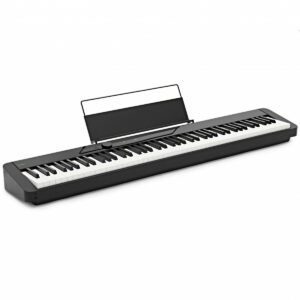 Keyboard action: Smart Scaled Hammer Action Keyboard
- Polyphony: 192
- In-built sounds: 18 (Grand piano x 3, piano x 3, electric piano x 3, harpsichord, vibraphone, strings x 2, organ x 4, bass)
- Effects: Acoustic simulator, hall simulator x4, surround x 2, chorus x 4, brilliance and DSP effects
The Casio PX S1100 Digital Piano is another extremely slimline piano that still offers hammer action. It boasts Casio’s Smart Scaled Hammer Action, which is based on the larger Scaled Hammer Action, changed to be compact enough to fit in the S1100’s chassis – this is where “smart” comes in.
As not all mechanisms are able to fit into the S1100, sensors and computer chips are used to fill in the gaps.
For example, a chip estimates the approximate position of the key between the two sensors when you press it. It then uses that guess to emulate a third sensor. This helps you play repetitive single notes as if you had a triple sensor key action.
The keys also feature synthetic ebony and ivory textures for a realistic feel.
8. Kawai ES120 Digital Stage Piano
Multiple high-quality Kawai pianos are sampled for use in this piano.
- Keyboard action: RH-Compact
- Polyphony: 192
- In-built sounds: 25 (piano x 9, electric piano x 4, organ x 3, vibraphone, harpsichord, bass x 3, pad, choir, strings x 2)
- Effects: Reverb
Kawai are famous for their acoustic upright and grand pianos. As you might expect from a company with such experience in acoustic pianos, their keyboard actions and piano sounds are among the best you can get today.
The ES120 is Kawai’s introductory stage piano. It features some fantastic feeling keys and great quality piano sounds.
Featuring Kawai’s Responsive Hammer Compact keyboard action, this piano feels amazingly realistic. It’s based on the larger and heavier Responsive Hammer Action III keybeds seen in Kawai’s more premium models.
Kawai also have a reputation for fitting some fantastic piano sounds in their instruments. The ES120 has several high-quality grand pianos inside it using their Harmonic Imaging sampling technique.
Usually, when sampling a piano, manufacturers record a certain key at various dynamics, they then record another key higher up the piano, and then the next one, and so on until there’s a database of samples to build a digital piano sound.
Kawai do this but they sample every single key on the piano, so each key’s unique effect on the overall piano sound is accurately replicated. This makes the piano much more detailed and higher in quality than many other pianos.

9. DP-10X Digital Piano by Gear4music
Looks great in your home thanks to the cabinet design.
 Keyboard action: Hammer action
- Polyphony: 64
- In-built sounds: 24 (Piano x 5, accordion, clavinet, harpsichord, organ x 2, vibraphone, strings x 2, choir, guitar x 2, bass guitar x 2, Brass x 2, flute, clarinet, pad x 2)
- Effects: Reverb x 9, chorus x 4, feedback, flanger x 3, delay x 2, celeste x 3
If you want a good beginner’s digital upright piano with hammer-action keys, you can’t go wrong with our DP-10X. This is perfect if you want an affordable way to get a digital piano in your own home.
All the keys are hammer weighted, meaning they feel very similar to the keys of an acoustic piano. You also can enjoy the use of the three integrated pedals in the cabinet. With these, you can unlock the full expressive potential of the piano through the soft, sostenuto, and sustain pedals.
There are built-in effects too, allowing you to customise your piano sound. Standard reverbs and choruses are included, but there are also some creative effects like feedback, flangers, and delays that you can use to completely change your sound.
The usual practice features are also present: you can use a metronome, save a two-track recording of your playing, and listen to demo songs. Plus, you can split the bass and treble parts in order to practise each hand separately alongside the songs.
10. G4M Sonori Low Top Digital Piano
 A premium home piano with an impressive range of sounds and features.
- Keyboard action: Fully Weighted Hammer Action
- Polyphony: 256
- In-built sounds: 42 (Grand piano x 8, upright piano x8, suitcase piano x 4, electric grand x4, wurli x 2, clav x 2, organ x 4, synths/pads x 10)
- Effects: 3 per instrument (instrument-specific)
Elegant and stylish, the G4M Sonori Low Top has a low-profile cabinet that makes for a sophisticated addition to any home. And it plays just as brilliantly, with 88 fully weighted hammer action keys that recreate the resistance of an acoustic piano for expressive, controlled playing.
The Sonori also offers 256-note polyphony. It’s powerful and allows you to play complex pieces of music with layers upon layers of sustained notes. There are 42 built-in voices to explore, ranging from grand and upright pianos to vintage electric keyboards and synths. A powerful four-speaker system, comprising two woofers and two tweeters, then ensures everything sounds full and detailed across the keyboard.
There’s plenty to help you practise, too, namely Tutor mode, which divides the keyboard into two matching ranges for playing alongside a teacher. Connectivity-wise, the piano has Bluetooth audio and MIDI, and there are three integrated pedals.
Benefits of weighted keys
Let’s briefly run over what weightings exist for digital pianos and what it means for your piano playing.
Semi-weighted – springs produce a little resistance when you press the keys down.
Weighted – similar to semi-weighted, just with more weight.
Hammer action – a series of levers and mechanisms designed to authentically replicate the action of an acoustic piano.
Graded hammer action – similar to hammer but the lower notes feel heavier and higher notes feel lighter, replicating the different hammer weights on an acoustic piano.
Principally, the main benefit of weighted keys is the level of realism you get from them – many of the other benefits arise from this extra realism and accuracy.
For example, the more realistic the key weighting is, the more strength you’ll build in your fingers and become accustomed to the resistance and weight that the keys have.
Many pianos also have advanced piano sounds that are designed to replicate the sounds of hammers or the subtleties in how you press the keys down. With an accurately weighted keyboard, you can play with the same expression you would have on an acoustic instrument and be able to hear and feel that expression through the instrument.
Weighting in the keys provides an easy transition from digital pianos to acoustic pianos. If you’re accustomed to a hammer-weighted digital piano, then moving over to an acoustic will be less difficult, and vice versa would also be true.
The other major benefit is that weighted keys feel more fun! They offer a more tactile response when you’re playing and can make it more enjoyable.

Different types of weighted keys
Semi-weighted and weighted
Semi-weighted is the form of weighting that you’ll find on many beginner pianos or ones designed for portability. Some high-end stage pianos also have premium-feeling semi-weighted keybeds. Old rock organs have often been described as having a similar action to semi-weighted and weighted pianos too.
Semi-weighted keys give some resistance when you press down on them. This replicates the resistance that acoustic pianos offer while not quite providing the realism of more advanced actions.
Weighted keys are very similar to semi-weighted, but as the name implies, weighted keys are a little heavier to press. They’re also likely to weigh more, so pianos with these keys are a little less portable.
Both of these types of weighting are often enjoyed by organ and electric piano players. The direct response from the springs can make fast and agile passages easier and more comfortable to play on weighted keys. Hammer action keys may not feel responsive enough for rhythmically tight styles of music like jazz or funk.
There are downsides and inaccuracies to this type of weighting. When you press the key down, the amount of resistance you will experience is consistent throughout the whole key press. With an acoustic action, you’ll initially feel some resistance but this lessens when the key is moving.
Hammer action
Hammer action uses more complex mechanisms to accurately replicate the series of weights and levers inside an acoustic piano.
This kind of action feels more like an actual piano, and it even includes the “notch” sensation that can be felt on an acoustic, which is why it’s favoured on digital pianos too.
Hammer action pianos are much heavier than non-hammer action pianos as the intricate mechanisms and counterweights in each key all add up.
That being said, you can still find stage pianos with hammer action that are designed for portability. Some of them are lightweight but some can still be heavy. However, they’re usually more compact and less bulky to make up for this.
Graded hammer action weighting
Graded hammer action weighting, sometimes known as “scaled hammer action weighting”, takes the same complex mechanisms involved with hammer-weighted keys and adds an extra layer of realism.
In an acoustic piano, the hammers for the lower notes are heavier as they need up to three heavier gauge strings. The higher strings are the opposite, being much thinner.
Graded weighting replicates this by making lower keys feel heavier than the higher keys. Usually, these are weighted in groups with “zones” of keys that progressively get heavier the lower you go.
This is extremely important for digitally replicating an acoustic piano in an authentic manner. The subtle differences in weight are noticeable if you play acoustic piano often – having to adjust your technique between acoustic pianos and digital pianos with no weighting can make practice very difficult.
Something to watch out for in these more advanced actions is the number of sensors in the keys. Usually, there are two: one that detects when you start moving the key and another that detects when the key is pressed.
The sound is usually made when the bottom sensor detects the key being pressed fully and then the sound stops when the upper sensor detects the key returning to its normal position.
This can cause issues with repetitive notes on a single key. On an acoustic piano, you can play these notes repeatedly without the key rising all the way back up, this would not be possible on a double-sensor keyboard action.
Triple-sensor keyboard actions place a third sensor in between the first and second. This means the piano can detect when the key is partially raised rather than only being able to tell If the key is fully released.
You can play repetitive passages far easier with the three sensors and the key will just feel more realistic too.

What else do I need?
As you can see from our selection, many digital pianos come as just the keyboard – with no stand included unless you purchase a package. Therefore, one major thing to consider when buying a digital piano is where you’ll store it and what kind of stand you’ll need.
Will you perch it on a desk or will you invest in a dedicated stand? If the latter, we recommend the modul Universal Wooden Keyboard Stand as it suits all 88-key keyboards and digital pianos, it’s robust enough to endure hours and hours of practice, and it offers a more stylish aesthetic than the standard X-frame stand.
You’ll also need a pair of headphones for silent practice. Check out our guide to the best piano headphones to help you narrow your search!
And finally, you’ll also need a stool. Choose one that’s sturdy, comfortable, and that matches the finish of your piano.
FAQs
Are non-weighted keys good?
Non-weighted keys are good if you’re playing synthesisers or any other instrument that only responds to velocity. Weighted keys capture the nuances of how a piano feels and well-designed piano sounds will reproduce things like the sound of the hammers moving or strings resonating.
Do weighted keys wear out?
As piano keys are essentially mechanical devices with several moving parts, there’s always a chance that a part will wear out over time. This shouldn’t be a concern though as this would have to be over an extremely long period of time with very intensive playing.
Do weighted keys affect sound?
Weighted keys don’t affect sound inherently. However, the sounds programmed into your piano are likely to be more premium with weighted keyboards and will sound better. Weighted keys can affect your technique and encourage more articulation and expression than an unweighted keyboard does. This will cause changes to the sound of your piano.
Final thoughts
So now you should know all about weighted keys and how they can affect your piano playing. Here’s a quick recap of what weighted keys are and how they can help your playing.
Acoustic pianos have levers behind each key to produce the motion needed for the hammer to strike the string. Digital pianos use different methods of weighting to try and emulate this.
Weighted and semi-weighted keys use springs and weights to supply resistance when you press keys down. They don’t have the “notch” feeling of resistance that acoustic pianos have.
Hammer action uses a mechanism that’s similar to the action in an acoustic piano. This creates a more accurate-feeling keyboard on which you can articulate and perform a wider range of techniques.
Graded (or scaled) hammer action is the same as hammer action, but the lower keys have more resistance when you press them and the higher keys have less. This is to emulate the heavier hammers in the bass notes on a piano.
Having good action in your piano helps you practise more accurately, especially if you play acoustic instruments outside of your personal practice. You’ll be much more accustomed to how a piano with real hammers feels and the strength in your hands will be properly built up.
Hammer action keyboards can often be very heavy, especially with very intricate weighting systems. Semi-weighted or fully weighted are better if you travel with your piano often.


0 Comments